
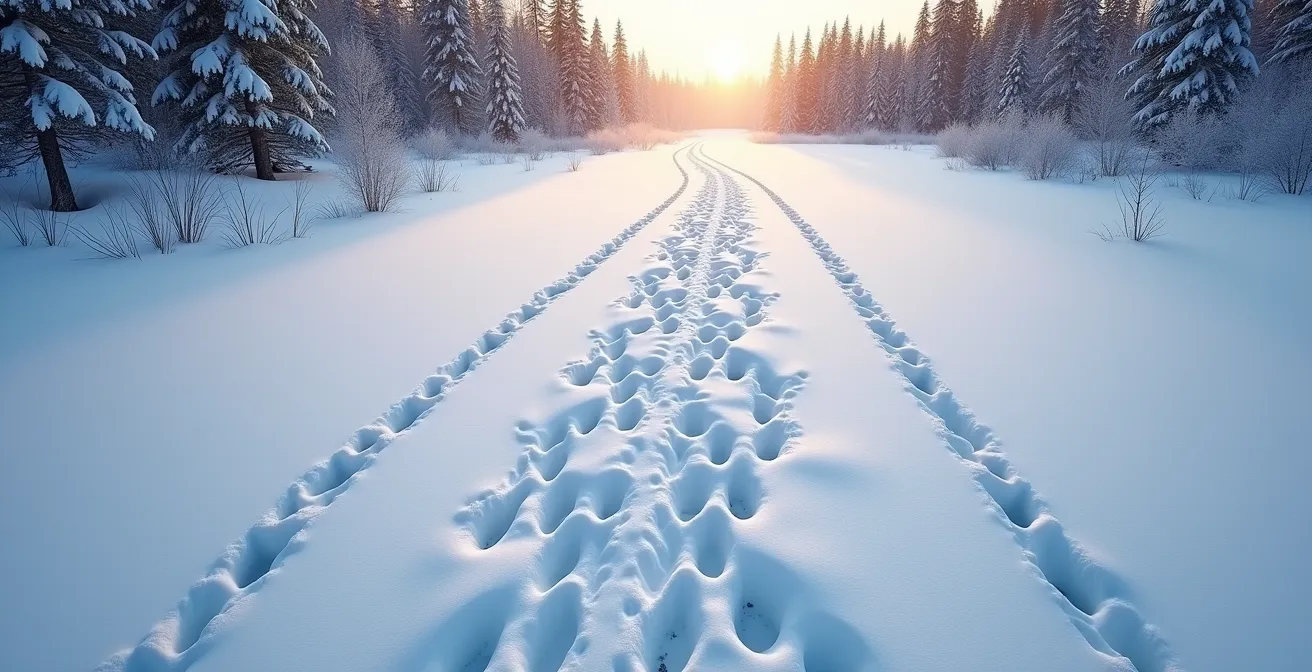
Contrary to popular belief, identifying an animal track isn’t just about comparing a photo in a book: it’s real detective work.
- The type of snow and the age of the track are just as important clues as its shape.
- The movement pattern (gait) often reveals the species even before a clear footprint is seen.
Recommendation: Learn to read the “scene” as a whole—the movement, meal remains, and sounds—to accurately reconstruct the story of an animal’s passage.
The fresh snow covering your land is not a blank page; it is a book of stories waiting to be read. For the curious homeowner or the attentive snowshoer, every mark, every trail is a sentence telling the story of a discreet neighbor’s nightly passage. Many think that tracking is limited to finding a perfect print and comparing it to an image in a guide. This is the first instinct, but it’s also the source of many identification errors. We focus on a single word while ignoring the rest of the sentence.
The reality of winter tracking is much more subtle and exciting. It is an art of deduction, closer to an investigation than a simple recognition game. What if the real key wasn’t the perfect shape of the footprint, but rather the collection of clues left behind? The condition of the snow, the animal’s gait, the remains of its last meal, the arrangement of tracks over several meters… these are the details that transform a simple observation into a near-certain identification. The footprint is only the starting point; the real story lies in its context.
This article will teach you how to become a nature detective. We will move away from the image catalog to adopt the investigator’s method. We will analyze how the snow itself modifies clues, how the rhythm of steps betrays the animal’s identity, and how every small sign, from the most obvious to the most discreet, allows you to reconstruct with surprising precision the secret life that comes alive on your property as soon as your back is turned.
Summary: The Secrets of Winter Tracking to Decode Quebec’s Wildlife
- Powder or crust: how does the state of the snow modify the appearance of a footprint?
- Bounder or walker: how does the animal’s gait help you identify it without seeing a precise track?
- Shape and content: what do droppings reveal about diet and species?
- Bevel or tearing: how to know if a hare or a deer ate your shrubs?
- Sharp or frosted edges: how to tell if the trail is an hour or two days old?
- The wolf vs. coyote track confusion error made by 90% of beginners
- Territory or rally: what does the howl you hear at night mean?
- Is the wolf truly a threat to hikers in Quebec?
Powder or crust: how does the state of the snow modify the appearance of a footprint?
Even before looking at the shape of a track, an experienced tracker analyzes the canvas on which it is printed: the snow. Its texture, depth, and consistency are the first clues because they radically dictate the appearance of any footprint. A coyote track in 10 centimeters of light powder will be wide, splayed, and poorly defined. The same track on a thin layer of wet snow over a hard base will, conversely, be sharp and rich in detail. Ignoring the nature of the snow is like reading a letter without considering the ink that has smeared.
Ideal tracking conditions are rare. As noted by researcher André Desrochers in a study by Laval University’s Forest Research Centre, “it needs to snow often, and the snowfalls must be spread out over time.” A sun crust, for example, can support a light animal like an ermine, leaving only tiny claw marks, while a deer will sink through, leaving a deep and confusing trail. Powder hides fine details like the number of toe pads but perfectly reveals the width of the path and the animal’s overall gait.
The state of the snow is also a clock. A track freshly left in cold snow will have perfectly sharp and chiseled edges. A few hours later, especially under the action of wind or sun, the snow crystals begin to transform through sublimation: sharp edges round off, fine frost crystals appear, and the track loses definition. An old track can even fill with drifting snow blown by the wind. Learning to read this degradation is essential to knowing if the animal passed an hour ago or two days ago.
Bounder or walker: how does the animal’s gait help you identify it without seeing a precise track?
When a trail is blurry or the snow is too deep to distinguish a sharp footprint, the true detective steps back and looks at the general pattern. The gait is the behavioral signature of the animal in motion. It is often more revealing than the shape of a single paw. By analyzing the arrangement of tracks over several meters, you can classify the animal into a major family even before identifying it precisely. We mainly distinguish three major types of movement among Quebec mammals.
Walkers, such as canids (wolf, coyote), felids (lynx), and cervids (deer, moose), are energy savers. They tend to walk in a nearly straight line, placing their hind paws exactly into the prints left by their front paws. The result is a simple, clean, and efficient trail that looks like it was made by a biped. Seeing a straight line of tracks is a major clue pointing to one of these families. Bounders, typically mustelids (weasel, marten, mink), move in successive jumps, with the back arching and extending. Their tracks often appear in pairs or groups of four close together, followed by a gap, then another group. Finally, gallopers, of which the snowshoe hare is the archetype, project their large hind paws in front of their front paws with each jump, creating a characteristic triangular or “Y” shaped trail.
The Canada lynx, for example, is a walker whose movement is perfectly adapted to its environment. As highlighted in a Quebec government fact sheet, its long legs equipped with wide, furry pads act like snowshoes, allowing it to move silently over deep snow without sinking. This adaptation is crucial for a predator whose diet consists of at least 60% snowshoe hare in winter.
To synthesize this information, the following table, based on field observations, provides a quick reference guide. It was developed from information compiled by organizations such as Nature-Action Québec.
| Movement Type | Animal Families | Track Characteristics |
|---|---|---|
| Walker | Canids (coyote, wolf), Felids (lynx), Cervids (deer, moose) | Straight-line pattern, hind paw lands on the front paw track of the same side, only two tracks visible |
| Bounder | Mustelids (weasel, marten, otter, ermine) | Body arches then extends repeatedly |
| Galloper | Snowshoe Hare | Hind paws land in front of front paws, triangular shape |
Shape and content: what do droppings reveal about diet and species?
A seasoned tracker never looks away from a clue as valuable as droppings. Often easier to identify than tracks altered by weather, scat is a true identity card left by the animal. Its shape, size, content, and location provide a wealth of information on the species, its health, and, above all, its recent diet. It is one of the most reliable clues you can find.
The simplest distinction is between herbivores and carnivores. Herbivores, like deer or snowshoe hares, produce hard, dry droppings in the form of small pellets or tablets. Deer pellets are often found in clusters, oblong in shape with a small point at one end. Carnivores and omnivores, like coyotes, foxes, or wolves, leave cylindrical and twisted scat, often filled with visible clues: hair, bone fragments, feathers. The presence of berry remains or seeds in a canid’s scat indicates an omnivorous diet, typical of the coyote or fox, while scat composed almost exclusively of hair and bones points to a more strictly carnivorous diet, like that of the wolf.
Observing these clues is a practice that even has scientific value. In Quebec, data collected in the field by citizens and trappers is essential. For example, it is notable that 100% of Quebec trappers must fill out a detailed harvest log, providing crucial data to biologists for population monitoring. Similarly, your observations can contribute to a better knowledge of local wildlife. However, it is imperative to observe droppings safely, as they can carry parasites.
Action Plan: Your Guide to Safe Scat Identification
- Maintain a distance: Always observe from a distance of at least one meter and never touch droppings with bare hands.
- Note shape and size: Identify the general shape (pellets, cylinder) and use a reference object (a coin, a glove) to photograph and document the scale.
- Analyze visible content: Look for dietary clues like hair, bones, fruit seeds, or scales without handling the sample.
- Document the location: Where the scat is left (middle of a trail, on a stump) is also a territorial marking.
- Apply strict hygiene: Even without direct contact, wash your hands thoroughly after your outing to prevent any risk of disease transmission, such as fox echinococcosis.
Bevel or tearing: how to know if a hare or a deer ate your shrubs?
In winter, when food is scarce, your young trees and shrubs can become a pantry for local wildlife. Browsing marks left on branches are another top-tier clue that often allows for very precise identification. The key to the riddle lies in the suspects’ dentition. A careful examination of the cut left on a twig can tell you without a shadow of a doubt if the visitor was a hare or a cervid.
The snowshoe hare, like all lagomorphs, has sharp incisors on both its upper and lower jaws. When it browses a young shoot, it clips it cleanly, like with a pair of scissors. The result is a clean, oblique cut at a 45-degree angle. If you find your shrub branches cleanly cut at this height (generally low), you have found the signature of a hare. This cut is so characteristic it cannot be confused.
Deer (White-tailed deer) and moose, on the other hand, do not have incisors on the upper jaw. They have a cartilaginous pad instead. To cut a branch, they pinch it between their lower incisors and this pad, then pull with a sharp head movement. This action produces a tearing rather than a cut. The mark left is therefore a shredded, frayed end with bark strips. The height of the browsing is also a clue: deer generally browse higher than hares. Observing these meal marks is vital information for biologists, who use all signs of presence to understand territory use by herbivores.

The image above perfectly illustrates this fundamental difference. On the left, the clean, sharp cut left by a hare; on the right, the torn and frayed end characteristic of a deer’s passage. The next time you inspect your property after a snowfall, take the time to interview your shrubs. They may have a story to tell you about their nocturnal visitors.
Sharp or frosted edges: how to tell if the trail is an hour or two days old?
Once you have identified a potential trail, the next question that comes to any good tracker’s mind is: “When did it pass?”. Dating a track is an art that relies on observing micro-changes induced by the environment. The main aging factor for a footprint in the snow is the action of sun, wind, and temperature fluctuations. It is by reading these subtle alterations that you can estimate the age of a trail.
A very fresh track, left within the hour, has unmistakable characteristics in cold, powdery snow. Its edges are incredibly sharp, as if cut with a knife. You can see the finest details, like the texture of the pads or the fine snow particles projected to the side. There is no trace of frost or ice inside. If the snow is very light, you can even sometimes see “angel dust,” a fine spray of snow that settled around the track at the moment of impact.
After a few hours, the degradation process begins. Solar radiation, even on overcast days, and the wind cause sublimation: ice crystals from the sharp edges of the footprint pass directly from a solid to a gaseous state. The edges round off, losing their sharpness. Frost crystals begin to form inside the track, giving it a slightly shimmering appearance. After a day, the edges are noticeably more rounded and the track has lost much of its depth. After two days or more, it becomes a simple depression in the snow, a “ghost trail” where details have almost entirely disappeared, often partially filled by drifting snow.
Fresh snow is ideal for seeing tracks, as rain or sun exposure will alter or erase the shape of prints over time.
– Nature-Action Québec, Animal Track Observation Guide
The wolf vs. coyote track confusion error made by 90% of beginners
One of the most common confusions for the amateur tracker in Quebec is differentiating between wild canid tracks, particularly those of the wolf, the coyote, and a domestic dog on a walk. Relying solely on size can be misleading, as there are large coyotes and juvenile wolves, not to mention the variety of dog sizes. The key lies, again, in a combination of clues: the shape of the footprint, but above all, the walking pattern.
The wolf is an efficient traveler. Its trail is characterized by a rectilinear gait, as if it were following an invisible line. It places its hind paws precisely into the prints of its front paws, thereby saving energy in the snow. Its prints are large (often more than 10 cm), oval, and compact. The two middle toes are significantly more forward, and the negative space between the pads forms a well-defined “X.” The coyote, while also following a fairly straight trajectory, has a smaller and rounder footprint. According to the Canadian Wildlife Federation, a coyote track generally measures between 5.3 and 7.6 cm long.
The domestic dog, however, is the wanderer of the group. Its trail is rarely in a straight line. It tends to zigzag, stopping to sniff, and turning in circles. Its paws are wider apart, leaving a broader path. Its prints are often rounder, with toes more splayed (“looser”) than those of wild canids. Additionally, a dog’s claws are generally blunter and leave stronger marks because it does not retract them and often walks on hard surfaces. The following table summarizes the major differences to observe.
| Characteristic | Wolf | Coyote | Domestic Dog |
|---|---|---|---|
| Print Size | 10-12 cm | 5.3-7.6 cm long | Variable (5-10 cm) |
| Shape | Oval, compact | Rounder and ‘looser’ | Variable, less uniform |
| Walking Pattern | Straight line, efficient | Relatively straight | Paws wider apart, rarely a straight line |
| Interdigital Space | X-shape | X between toes and pad | X but less distinct |
Territory or rally: what does the howl you hear at night mean?
The tracker’s investigation is not limited to visual clues. The soundscape of the Quebec winter, especially at night, is rich in information. The most iconic and often misunderstood sound is the wolf’s howl. Far from being a cry of aggression or hunting, the howl is a complex communication tool essential to the pack’s social structure. Hearing it is a rare chance that connects you directly to the wildlife of your region.
The primary function of the howl is long-distance communication. It serves two main purposes: rallying and territorial defense. A rally howl is used to locate other pack members when they are dispersed, for example, after a hunt. It’s a call that says “I am here, where are you?”. The territorial howl, on the other hand, is a message sent to neighboring packs signifying “This territory is occupied, stay away.” It is an effective mechanism for avoiding direct conflicts, which would be energy-costly and potentially fatal.
It is important not to confuse the wolf’s howl with coyote vocalizations. The wolf emits a long, deep, and sustained howl, often modulated, which can last several seconds. It is a pure and powerful sound. The coyote produces a more chaotic mixture of high-pitched yips, barks, and short howls, often in a group, which sounds like a noisy “party.” Other nocturnal sounds can enrich your listening, such as the shrill alarm call of the blue jay, the deep hooting of the great horned owl, or even the sound of a porcupine climbing a tree.
Key Takeaways
- Identification is not based on a single perfect footprint, but on a collection of clues: gait, browsing, droppings, and sounds.
- The state of the snow (powder, crust, wet) and the age of a track (sharp or frosted edges) are just as crucial as its shape.
- Distinguishing between animals (hare vs. deer, wolf vs. coyote) is often done by observing behavioral details (bevel cut vs. tearing, straight vs. sinuous gait).
Is the wolf truly a threat to hikers in Quebec?
The figure of the wolf, amplified by tales and folklore, arouses ancestral fear. Hearing a howl in the distance or crossing a fresh trail can trigger legitimate concern in a hiker or homeowner. However, it is essential to confront this fear with biological and statistical reality. In Quebec, as in the rest of North America, the wolf is an extremely discreet animal that actively seeks to avoid humans.
The data is clear: wolf attacks on humans are absolutely rare. According to records, dangerous encounters are extraordinarily infrequent. A Parks Canada publication, for example, emphasizes that wild animals, including wolves, are shy and keep their distance. Observing their tracks is actually an excellent way to avoid encounters. The fear of the “big bad wolf” is a cultural myth, not a field reality. In fact, you are infinitely more likely to have a bad encounter with an unsupervised domestic dog than with a wild wolf.
This discretion does not mean that safety rules should be ignored. Coexisting intelligently with wildlife relies on respect and prevention. The goal is not to eliminate risk but to manage it responsibly. The best approach is to signal your presence and never, ever feed a wild animal, which would alter its natural behavior and encourage it to approach humans. Here are some common-sense protocols to apply in large predator territory:
- Make noise: Talk, sing, or attach a bell to your pack to signal your presence and avoid surprising an animal.
- Stay in control: Always keep your pet on a leash. A free-roaming dog can provoke a defensive reaction from a wild animal.
- Manage food: Never leave food unattended. In parks, use the bear-resistant containers provided and camp away from water points frequented by wildlife.
- In case of an encounter: Never run; this could trigger a chase reflex. Stand tall, make yourself large, and speak in a firm voice. Back away slowly without ever turning your back.
Now that you hold the keys to deciphering the clues left in the snow, every winter outing will transform into an adventure. Tracking is a skill that sharpens with practice. Assess your land now not as an empty surface, but as a living chronicle of local wildlife activity.
Frequently Asked Questions on Quebec Wildlife Sound Clues
How to differentiate a wolf howl from a coyote cry?
The wolf emits a long, deep, and modulated howl lasting 3 to 11 seconds. The coyote produces yips, barks, and high-pitched cries in a group, creating a chaotic ‘song’.
Why do animals respond to sirens?
This is an instinctive territorial communication. Siren frequencies resemble certain howls, triggering a defensive territory response, not a sign of aggression.
What other nocturnal sounds can be heard in winter?
Blue jays sound their alarm call, the great horned owl hoots, and one can hear the knocking sounds of a porcupine climbing a tree.