

In summary:
- Participating in structured surveys like the Christmas Bird Count provides crucial data on long-term population trends.
- Using apps like Merlin and eBird with rigour allows for the generation of massive amounts of validated data for science.
- Following strict ethical protocols when reporting rare birds protects vulnerable species from disturbance.
- Learning to identify nesting evidence transforms a simple summer observation into a confirmed breeding record, a high-value piece of data.
The thrill of spotting a rare bird or simply watching the dance of chickadees at a feeder is a joy shared by thousands of Canadians. Every observation is a privileged moment, a connection with nature. But beyond personal wonder, a question often arises: can this simple observation have a real impact? Can it transcend a personal notebook to become data useful for the protection of the species we so admire?
We often hear that we should use apps like eBird or that our data is “important for science,” but these claims often remain vague. Confusion persists about what differentiates an anecdotal observation from a tangible scientific contribution. The value of a data point lies not only in the identification of the species but in the context and method of its collection. This is where the amateur birder can play a decisive role, moving from observer to citizen scientist.
But what if the real key wasn’t just seeing, but knowing *how* to look and *why* to report? This article proposes a different perspective: transforming your passion into a credible contribution requires mastering rigorous protocols and understanding the unique value of each type of data. It’s not about becoming a biologist overnight, but about adopting a structured approach that gives scientific weight to every field outing.
Together, we will explore concrete methods so that your observations, from winter counts to identifying a nest, become essential pieces of the great puzzle of bird conservation in Canada. You will discover how technological tools, century-old traditions, and a rigorous ethics can transform your hobby into a powerful lever for science.
For those who prefer a visual introduction, the following video presents the testimony of an enthusiast who perfectly illustrates how birdwatching can become a quest for knowledge and sharing, thus complementing the practical advice in this guide.
This guide is structured to accompany you step-by-step, from the most established citizen science programs to ethical dilemmas and choosing equipment. The table of contents below will allow you to navigate easily between the different facets of this fascinating discipline.
Table of Contents: Participating in Ornithological Science in Quebec and Canada
- Christmas Bird Count: Why is counting birds at -20°C a crucial scientific tradition?
- Bird Banding: How do you become a certified bander and what is it for?
- Merlin Bird ID: How is AI revolutionizing acoustic inventory for amateurs?
- Rare Bird Alert: What is the ethical protocol before publishing a precise location?
- Nesting Evidence: How to confirm that a species is actually nesting in your square?
- How to use eBird to find rare birds near you?
- Snow Goose or Ross’s Goose: What detail allows you to tell them apart for sure?
- What equipment to choose to start birding in Quebec with a $300 budget?
Christmas Bird Count: Why is counting birds at -20°C a crucial scientific tradition?
Venturing into the biting cold of a December day, when the thermometer hovers around -20°C, might seem like a strange idea for birdwatching. Yet, the Christmas Bird Count (CBC) is much more than just a tradition for hardened enthusiasts. It is one of the oldest and most important citizen science programs in the world, providing an annual snapshot of the distribution and abundance of bird populations in winter. This data, collected in a standardized manner year after year, is of invaluable value.
Their power lies in repetition. It is thanks to this consistency that scientists can detect long-term trends that are otherwise invisible. For example, CBC data was fundamental in confirming alarming information: a 67% decline in the Evening Grosbeak population since 1970. Without the thousands of hours spent by volunteers in the cold, this dramatic trend would have been much harder to quantify with such certainty. The effort is far from marginal: the 2024-2025 season marked the 125th anniversary of the event, with record participation of 481 participating count circles in Canada.
Participating is simpler than it seems. You just need to find the nearest count circle and contact the responsible compiler. For beginners, it is often possible to be paired with an experienced birder to learn in the field. It is not even always necessary to brave the polar cold; if you have feeders, you can contribute by inventorying visitors from the comfort of your home for part of the day. Every bird counted, from the most common to the most unexpected, adds to a database that feeds essential reports like The State of Canada’s Birds.
This collective effort, repeated every winter, transforms a simple day of observation into a major scientific act, essential for guiding conservation strategies.
Bird Banding: How do you become a certified bander and what is it for?
Bird banding is a fascinating discipline: capturing and handling a bird to attach a unique band seems to be the pinnacle of scientific involvement. However, it is crucial to understand that this practice is highly regulated and requires considerable expertise. Becoming a certified bander in Canada is a long process that requires hundreds of hours of learning under the supervision of a mentor, rigorous training in identification, aging, sexing birds, and, above all, safe handling. This is not a path accessible to the average amateur birder, but it is essential to understand its purpose to appreciate the science that results from it.
So, what is the purpose of this demanding process? Banding is the only reliable method for tracking individuals. A band is like an identity card that allows for the collection of information impossible to obtain through simple observation: longevity, site fidelity, and above all, migratory routes. Every recapture, whether at the same location a year later or thousands of kilometers away, is a precious data point.
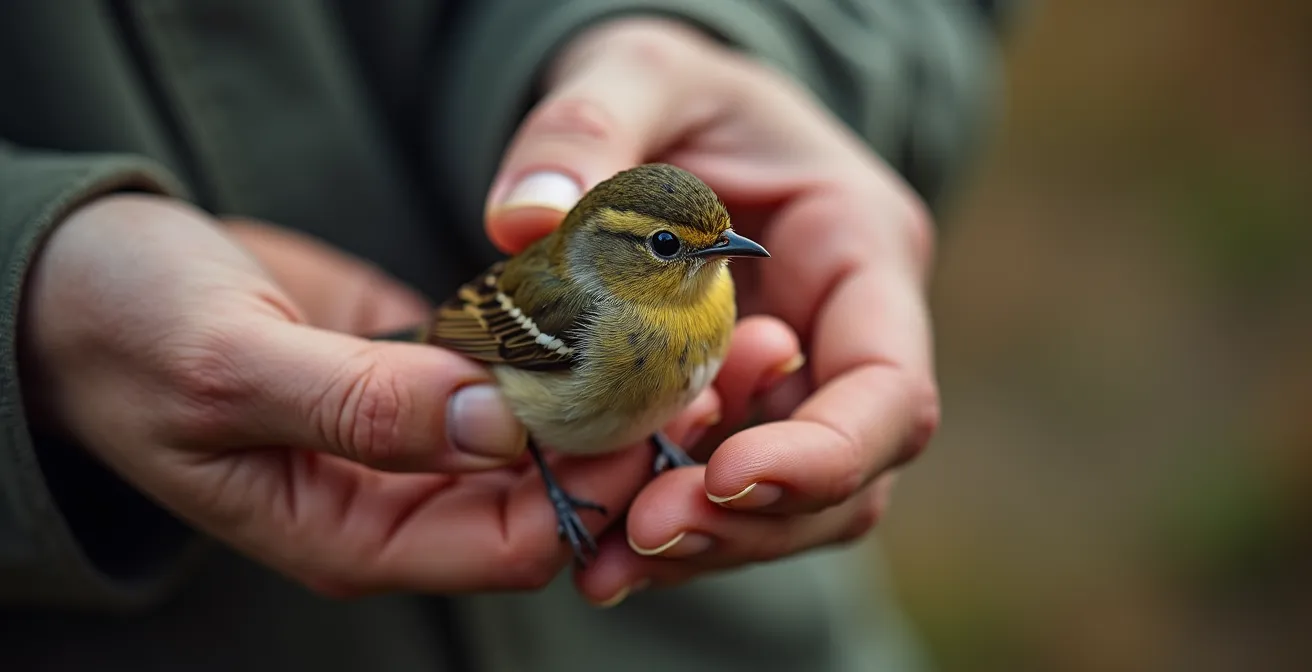
A striking example comes from the Tadoussac Bird Observatory (TBO), a major site for monitoring migration in Quebec. By analyzing ten years of banding data, TBO scientists were able to map the migration routes of several boreal and Arctic species with unprecedented precision. They discovered previously unknown migratory corridors for the Horned Lark and Swainson’s Thrush, and confirmed specific behaviors, such as the fact that the Purple Finch migrates mainly at night. These discoveries, published in scientific journals, are vital for identifying and protecting critical stopover sites.
As an observer, if you find a banded bird (dead or alive), reporting the band number to the Bird Banding Office of Canada is a direct and extremely valuable contribution to this vast research program.
Merlin Bird ID: How is AI revolutionizing acoustic inventory for amateurs?
For decades, identifying birds by their song was the domain of experts—those capable of distinguishing dozens of subtle vocalizations after years of practice. Today, artificial intelligence, embodied by apps like Merlin Bird ID from the Cornell Lab of Ornithology, has radically democratized this skill. By simply activating the “Sound ID” function on a phone, any amateur can get a real-time list of the species singing around them. This technological advancement is much more than a simple gadget: it is revolutionizing the collection of acoustic data on a large scale.
This revolution is based on a simple principle, brilliantly summarized by Jean-Sébastien Guénette, Director General of QuébecOiseaux:
The quantity of data drowns out the uncertainty.
– Jean-Sébastien Guénette, Radio-Canada
By allowing thousands of users to generate observation lists based on sound, Merlin multiplies the amount of available data. This information, once uploaded to the eBird platform, is then subjected to a data validation process by volunteer but certified regional reviewers. This human filter guarantees the scientific reliability of the reports, transforming a simple AI identification into data usable for research. The impact of this synergy between technology and community validation is colossal.
The following table illustrates the transformation of bird data collection practices thanks to these new tools, making citizen science more accessible, precise, and engaging, especially for younger generations.
| Method | Before 2010 | With Merlin/eBird | Advantages |
|---|---|---|---|
| Identification | Paper guides only | AI + community validation | Increased precision, easier learning |
| Recording | Personal notebooks | Global database | Data usable for science |
| Validation | Limited local expertise | Certified regional reviewers | Scientific reliability |
| Youth Participation | Local clubs only | Digital Christmas Bird Count Rally | Over 1,000 young participants in 2024-2025 |
Thus, AI does not replace the birder, but it provides them with a superpowered tool. It lowers the barrier to entry and allows an unprecedented number of people to participate in biodiversity inventorying, creating a volume of data unimaginable only a decade ago.
Rare Bird Alert: What is the ethical protocol before publishing a precise location?
Finding a rare bird is one of the most exciting moments in a birder’s life. The first instinct is often to share this discovery with the community. However, this enthusiasm must be tempered by a crucial responsibility: the protection of the bird. Instant dissemination of a precise location can attract crowds of observers, causing significant stress to the bird and habitat degradation. This is why an ethical reporting protocol is not only recommended but essential.
The Quebec birding community has adopted modern tools to manage this dilemma, such as the “Birding Québec” Discord server. This platform allows for near-instant exchanges, which is crucial for as many people as possible to see a rarity, but it operates within a community that shares and promotes rules of good conduct. The goal is to find a balance between sharing information and the bird’s well-being. The golden rule is simple: the bird’s well-being always takes precedence over the desire to observe or photograph it.
Before any publication, whether on eBird, Discord, or social media, a process of reflection is necessary. Some species, particularly those at risk like the Piping Plover or several owl species, are considered “sensitive.” For these, disseminating precise locations is prohibited. eBird automatically hides this data from the general public. Ethics go further, including a ban on using “playback” (playing recorded songs) to attract sensitive species, especially during the nesting season, as this can seriously disrupt their reproductive cycle.
Your Action Plan: Ethical Reporting Protocol for a Rare Species
- Check the status: Consult the eBird sensitive species list or the Species at Risk Act (SARA) statuses to see if the bird is vulnerable.
- Hide the location: For species at risk, never publish a precise location. Use general locations (e.g., “La Jacques-Cartier MRC” instead of the name of a specific trail).
- Inform with caution: If sharing information in a restricted circle, remind others of the rules of good conduct (distance, discretion).
- Consult experts: When in doubt, contact a local club or an eBird reviewer for advice before publishing.
- Avoid all disturbance: Refrain from using playback or any other means to attract the bird, and always maintain a respectful distance.
By adopting these reflexes, you ensure that your discovery remains a source of joy for the community without ever turning into a threat to the object of your admiration.
Nesting Evidence: How to confirm that a species is actually nesting in your square?
Observing an American Goldfinch in a field in the middle of June is pleasant, but it does not constitute proof of nesting. The bird could simply be passing through or feeding far from its nest. For breeding data to be scientifically valid, particularly within the framework of major Breeding Bird Atlas projects, tangible proof must be provided. Structured citizen science takes on its full meaning here: it’s not about finding a nest, but about recognizing and recording specific behaviors using standardized codes.
These projects, conducted at the provincial level approximately every 20 years, aim to map the distribution of all breeding bird species. The territory is divided into 10×10 km “squares,” and volunteers must spend a certain number of hours there to record nesting evidence. The simple presence of a bird in suitable habitat (code H) is the weakest evidence. The real added value comes from the attentive observation of more conclusive behaviors.

Canadian atlases use a system of codes to classify the level of nesting certainty: Possible, Probable, and Confirmed. For example, hearing a singing male in the same spot one week apart (code T for Territory) is “Possible” evidence. Observing a pair in full courtship display (code C for Courtship) elevates the certainty to “Probable.” The ultimate proof, “Confirmed,” is obtained by observing an adult carrying food for young (code CF), finding a nest with eggs (code NE), or, most easily observed, seeing fledglings recently out of the nest that are still clumsy (code FY).
This table summarizes the most common codes and their value to scientists, who rely on this standardized data for their analyses.
| Code | Meaning | Certainty Level | Scientific Value |
|---|---|---|---|
| T | Territory (repeated song) | Possible | Preliminary indication |
| C | Courtship behavior | Probable | Strong presumption |
| NU | Used Nest | Confirmed | Direct evidence |
| FY | Fledged Young | Confirmed | Successful reproduction |
Learning to recognize these behaviors and recording them rigorously is one of the most valuable contributions an amateur birder can make, as it directly informs on the reproductive success of populations, a key indicator of their health.
How to use eBird to find rare birds near you?
The eBird platform is much more than a simple digital notebook. It is also an incredibly powerful tool for knowing what is happening ornithologically around you in real time. For the amateur eager to see new species or find a rarity reported in their region, eBird offers alert and exploration features that can transform an ordinary day of birding into a true treasure hunt. The secret is to correctly configure alerts to receive information that is relevant to you.
The first step is to create a free account on eBird.org. Then, in your profile settings, you can set up personalized alerts. You can choose to receive a daily or hourly email for a specific region, such as your municipality (MRC) or the entire province of Quebec. Two types of alerts are particularly useful: the “Rare Bird” alert, which notifies you of any species unusual for the time and place, and the “Needs” alert, which informs you when a species you have never checked on your personal life list is observed nearby.
These automated tools are an excellent starting point and demonstrate the growing engagement of the community. In Quebec alone, according to data from the QuébecOiseaux “Birds at Home” program, more than 4,000 people have registered, forming a dense network of observers. For maximum responsiveness, it is recommended to supplement eBird alerts by joining instant discussion platforms like the “Birding Québec” Discord server. Furthermore, the QuébecOiseaux rare bird page, updated daily, remains an essential reference for a global overview of notable observations across the province.
In summary, here are the steps to never miss a rarity again:
- Create an account on eBird.org and explore the “Explore” tab.
- Configure email alerts for your region (MRC and province) targeting “Rare Birds” and your “Needs.”
- Join the “Birding Québec” Discord server for real-time reporting.
- Regularly consult the rare bird page on the QuébecOiseaux website.
By combining these resources, you move from passive observation to active research, considerably increasing your chances of making exciting observations while contributing to the tracking of species movements.
Snow Goose or Ross’s Goose: What detail allows you to tell them apart for sure?
In spring and autumn, the Quebec sky is crossed by tens of thousands of white geese. For the beginner, it all looks like a massive cloud of Snow Geese. Yet, among these flocks hides another species, smaller and more discreet: the Ross’s Goose. Knowing how to differentiate them is not just a simple identification challenge for purists. This distinction is ecologically crucial. Indeed, the Snow Goose population is overabundant, to the point of causing significant damage to the fragile Arctic tundra where it nests. Conversely, the Ross’s Goose population is much more stable. Accurate identification in the field, particularly at major migratory stopovers like Baie-du-Febvre, is therefore essential so that scientists can track the respective population dynamics of these two species and adjust management plans.
So, how do you distinguish them? Size is the first clue: the Ross’s Goose is visibly smaller and stockier, with a shorter neck. But this criterion is difficult to apply to an isolated bird. The most reliable detail is found on the head, specifically the bill. The Snow Goose has a fairly long and robust bill, characterized by a black line on the side of the mandibles, often called the “black grin patch.” The Ross’s Goose, on the other hand, has a much shorter, triangular bill, which is pinkish and lacks this distinctive “grin.” Furthermore, mature adults often develop bluish warty caruncles at the base of the bill, a trait absent in the Snow Goose.
The following table details the advanced criteria for no longer confusing them. The presence of hybrids, although rare, can complicate identification, but focusing on the shape of the bill and head is generally the surest method.
| Criterion | Snow Goose | Ross’s Goose | Difficulty |
|---|---|---|---|
| Size | 70-75 cm | 55-65 cm | Easy in mixed groups |
| Bill Shape | Long with ‘grin patch’ | Short, triangular | Medium |
| Base of Bill | Smooth | Warty caruncles (adult) | Difficult at distance |
| Head Shape | Elongated | Round, domed forehead | Medium |
| Hybrids | Intermediate characteristics | Very difficult | |
The next time you face a sea of white geese, take the time to scan the heads. Every Ross’s Goose you correctly identify and report on eBird is a small victory for conservation science.
Key Takeaways
- The value of an observation lies not in the rarity of the bird, but in the rigour with which the data is collected and shared.
- Structured programs (Christmas Count, Atlas) transform individual observations into powerful data series for analyzing long-term trends.
- Ethics are non-negotiable: the bird’s well-being must always come before the desire to observe it, especially for rare species or during nesting.
What equipment to choose to start birding in Quebec with a $300 budget?
Getting started in birdwatching doesn’t require emptying your bank account. While it’s easy to be impressed by high-end spotting scopes and binoculars, it is entirely possible to equip yourself very decently for starting out in Quebec with a modest budget of around $300. The key is to make wise choices and prioritize the essential: a good pair of binoculars.
The centerpiece of your equipment will be a pair of 8×42 binoculars. The “8x” represents the magnification (sufficient for most situations) and the “42” the objective lens diameter (providing good light without being too heavy). For a budget of $200 to $300, several entry-level models offer excellent value for money. It is useless to look for the cheapest possible model; investing a minimum ensures clear optics, waterproof construction (essential in Quebec!), and ease of use that will make all the difference in the field.
Once the binoculars are chosen, the rest of the budget can be allocated intelligently. Rather than immediately buying an expensive paper guide, download the free Merlin Bird ID app. It includes a complete field guide for the region, photos, songs, and an identification tool. The savings realized (about $40) can be invested in a membership to QuébecOiseaux (about $30), which gives access to a wealth of resources and supports conservation. A simple waterproof field notebook completes the kit for recording your observations. The best advice for a beginner is summarized by Quebec bird clubs:
Contact a local Bird Club like the COQ or COO to participate in an excursion where it is often possible to borrow or test different binocular models before buying.
– Club d’ornithologie du Québec, Recommendation for beginners
This table compares some popular 8×42 binocular options available in Quebec that respect this budget.
| Model | Approx. Price | Key Strengths | Quebec Availability |
|---|---|---|---|
| Celestron Nature DX 8×42 | $200-$250 | Waterproof, fast focus | Specialty shops in Montreal/Quebec City |
| Nikon Prostaff 3S 8×42 | $250-$300 | Clear optics, lightweight | Photo/nature retailers |
| Vortex Crossfire HD 8×42 | $280-$300 | Lifetime warranty, robust | Online and specialty stores |
The next step isn’t to buy more gear, but to use it. Join a local club outing, explore the nature parks near you, and start filling your first observation lists. It’s the beginning of a fascinating journey into the heart of citizen science.