
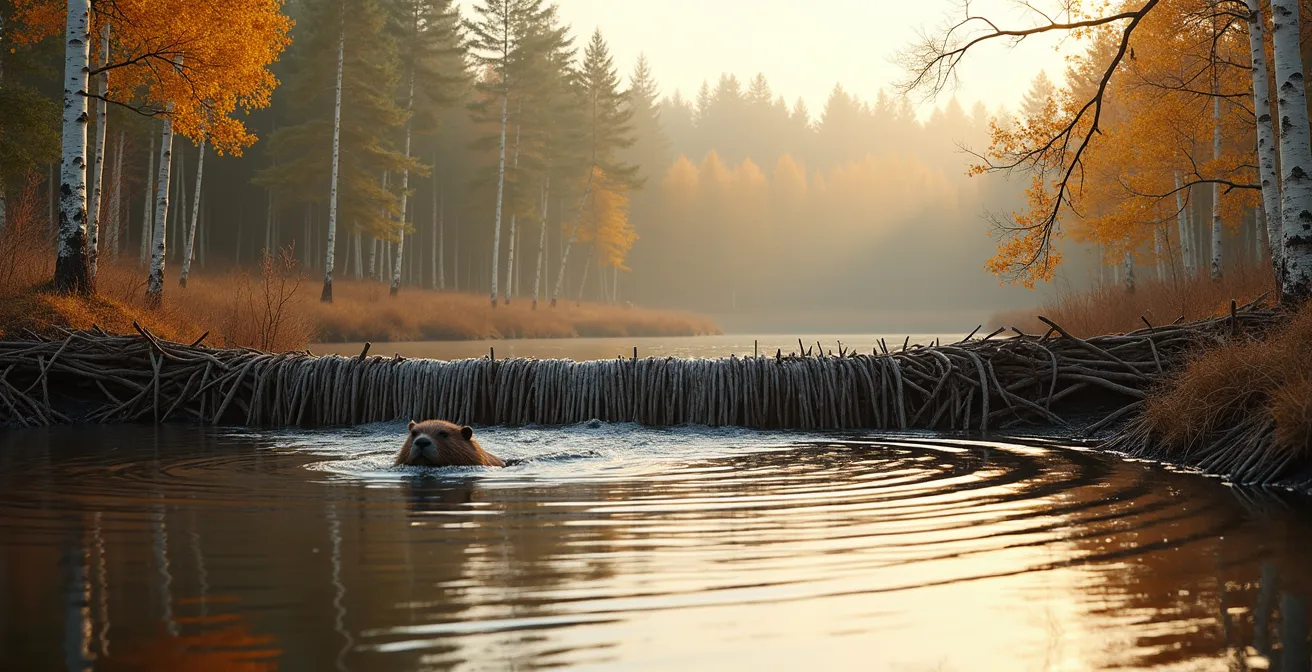
Contrary to popular belief, beaver activity is not an act of destruction, but a survival strategy that makes it one of the greatest ecosystem engineers.
- Dams are not intended to stop the sound of water, but to create a deep body of water for protection against predators and frost during the Canadian winter.
- Flooded areas, often perceived as a nuisance, transform into wetlands rich in biodiversity, essential to many other species.
Recommendation: Before considering radical measures, understanding the beaver’s logic allows for the implementation of intelligent and sustainable cohabitation solutions.
Watching a pond form where a meadow once stood or discovering freshly cut poplars along your trail can be a source of frustration. For many landowners and park managers in Canada, the beaver is primarily synonymous with problems: flooding, infrastructure damage, and tree loss. The initial reaction is often to seek a way to get rid of this “pest.” Thoughts turn to trapping it or destroying its dam, hoping for a return to normalcy.
However, this conflictual approach ignores a fundamental truth. Beaver activity is neither random nor malicious; it responds to a perfectly honed survival logic inherited from millions of years of evolution. What if the key was not to fight this animal, but to understand its role as a hydraulic engineer? By deciphering its motivations, we discover that its actions, far from being solely destructive, are at the root of creating the richest and most resilient ecosystems in our territory: wetlands.
This article proposes a change of perspective. We will not only list the problems but explain the “why” behind every dam built and every tree cut. By diving into the biology and ecology of the North American beaver, you will gain the keys to moving from an exhausting struggle to enlightened cohabitation, transforming an apparent problem into an asset for the biodiversity of your property.
To navigate through the complexity of this nature’s engineer, this article is structured to answer the most practical questions you may have. The table of contents below will guide you through the different facets of beaver activity and its impact on your environment.
Table of Contents: Understanding the Beaver’s Impact on Your Environment
- Why do beavers build dams even if there is no strong current?
- How to install a water level controller to cohabit with a beaver colony?
- Flat tail or thin tail: which rodent is swimming in front of your dock?
- The mistake of underestimating the beaver’s cutting distance on your waterfront property
- Tail slapping: what does this loud beaver warning signal mean?
- The mistake of filling a “mud hole” on your land without a municipal permit
- Cladonia or sphagnum: what is the role of this vegetation mat for caribou?
- Bevel or tearing: how to tell if a hare or a deer ate your shrubs?
Why do beavers build dams even if there is no strong current?
The beaver is often imagined as a relentless worker, obsessed with the sound of running water, which it would seek to silence at all costs. While this auditory stimulus plays a role, the true reason for dam construction is much more strategic and vital: it is a matter of safety and winter survival. The dam is not the goal, but an engineering tool to modify the habitat to its advantage.
The beaver’s primary objective is to create a body of water that is deep and stable enough. This mass of water fulfills two crucial functions. First, it submerges the entrance to its lodge, making it inaccessible to most of its terrestrial predators like wolves, coyotes, or bears. Second, and this is essential in our Canadian latitudes, it ensures that the water will not freeze to the bottom in winter. The lodge entrance must remain below the ice, in liquid water.
This need for depth is significant. Scientific data confirms that the lodge entrance must be at a sufficient depth to remain ice-free, generally more than 60 cm below the frozen surface, allowing the beaver to access its food cache. This cache, consisting of branches cut and stored at the bottom of the pond, is its pantry for the entire winter. Without a dam maintaining an adequate water level, this survival strategy would be impossible. The beaver therefore builds to create its fortress and its refrigerator.
How to install a water level controller to cohabit with a beaver colony?
When a beaver dam causes flooding that threatens a road, field, or trail, the last resort solution is often trapping. However, a more sustainable and ecological approach is gaining popularity: integrated management through water level control. This technique allows for the preservation of the ecological benefits of the beaver pond while protecting human infrastructure.
The principle is simple yet ingenious. It involves installing a pipe system (often called a “beaver deceiver”) that passes through the dam. The pipe intake is placed far upstream of the dam, submerged and protected by a cage so that the beaver cannot block it. The pipe passes through or over the dam and discharges the water downstream. The beaver hears the water flowing at the outlet, but being unable to locate the intake upstream, it abandons its attempts to seal it.
The height of the pipe in the dam determines the maximum level of the pond. In this way, an acceptable water level can be set that preserves the beaver’s lodge while avoiding problematic overflows. This intelligent cohabitation is increasingly being implemented. In Quebec, the pilot project at Lake Durand in Stoneham-et-Tewkesbury, led by the municipality in partnership with the organization Agiro, is an excellent example. Faced with recurring conflicts, they opted for integrated management aimed at harmonizing the presence of beavers and the protection of infrastructure, illustrating a desire to value this species rather than systematically eradicate it.
Flat tail or thin tail: which rodent is swimming in front of your dock?
The surface of the water ripples, a head emerges, and a wake appears. Is it really a beaver? Before attributing the cutting of a shrub or the construction of a dam, it is crucial to properly identify the animal. Several semi-aquatic mammals share our waterways in Canada, and confusion is common, particularly with the muskrat.
The most reliable clue is the tail. The beaver’s tail is unique: wide, flat like a paddle, and hairless. When it dives, it often uses it to slap the water loudly. The muskrat, much smaller, has a thin, long, and scaly tail that it uses as a rudder. The river otter, more slender, has a tail that is thick at the base and tapers gradually, while the American mink’s tail is bushier.
The swimming style is also a good indicator. The beaver swims calmly, with its head well out of the water, and often carries a branch in its mouth. The muskrat creates a more discreet V-shaped wake. The otter has a characteristic sinusoidal swim, undulating its body up and down. Observing the animal often clears up any doubt.
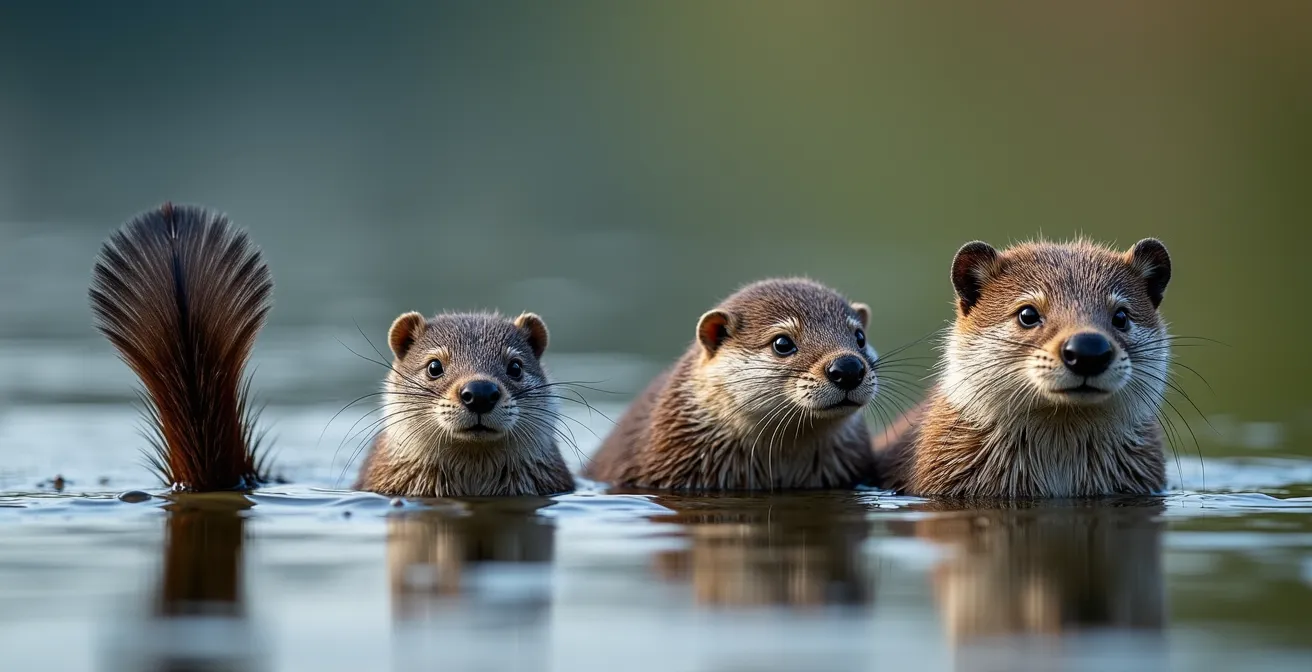
To help you distinguish them, here is a summary table of the main characteristics of these aquatic neighbors. Correct identification is the first step in understanding what is actually happening on your property.
| Feature | Beaver | Muskrat | River Otter | American Mink |
|---|---|---|---|---|
| Tail | Flat and wide (30 cm) | Thin and scaly | Thick at the base | Bushy |
| Size | 1-1.3 m | 40-60 cm | 90-120 cm | 40-70 cm |
| Swimming | Loud dive, head emerged | Discreet V-shaped wake | Sinusoidal swim | Fast, leaping |
| Load Carried | Branches in mouth | Aquatic grasses | Fish | Small prey |
The mistake of underestimating the beaver’s cutting distance on your waterfront property
Seeing a valuable tree cut on one’s property is often the main point of friction with the beaver. To effectively protect your plantings, you must understand the logic that guides its movements: the beaver practices a central-place foraging strategy, tied to its lodge. It does not wander blindly at infinite distances.
Its primary feeding area is the riparian buffer strip. It much prefers to cut trees near the water to minimize the time spent on land, where it is vulnerable. However, this “proximity” is relative. Research in the Canadian boreal forest shows that while beavers generally stay within 60 m of their lodge to feed, they can exceptionally travel up to 100 meters when nearby resources are exhausted. Underestimating this range of action is a common mistake that leads to insufficient tree protection.
As researchers specializing in beaver dynamics in Canada point out:
Beavers use a central-place foraging strategy linked to the lodge. As a result, they generally stay within 60 m of it to feed and very rarely more than 100 m.
– Arsenault et al., Dynamics of territory occupation by the North American beaver in the boreal forest
The beaver also has clear food preferences. It particularly likes softwoods such as trembling aspen, willow, birch, and maple. It generally ignores conifers (pine, fir, spruce) and alders, except in times of scarcity. Prioritizing the protection of the most at-risk trees within its range of action is therefore the most effective strategy.
Action Plan: Strategically Protecting Your Trees
- Tree Inventory: Identify the beaver’s preferred species (poplars, willows, birches) within a 100 m radius of the shore.
- Physical Protection: Protect the trunks of valuable trees with robust wire mesh (1-2 cm mesh size), to a minimum height of 1.2 m to anticipate snow cover.
- Correct Installation: Ensure you leave a space of at least 2 to 5 cm between the mesh and the trunk to avoid harming the tree’s growth.
- Creation of a Buffer Zone: If possible, encourage the growth of species favored by the beaver (such as willow) directly at the water’s edge to entice it to stay near the shore.
- Monitoring and Maintenance: Annually check the condition of the protections and adjust them if necessary, especially on young, growing trees.
Tail slapping: what does this loud beaver warning signal mean?
The sound is spectacular and impossible to ignore: a powerful “SLAP!” that echoes across the pond, followed by silence. This tail slap is one of the beaver’s best-known behaviors, but its meaning is often misinterpreted. It is not a sign of aggression towards you, but a sophisticated alarm signal intended for its colony.
When a beaver perceives a potential threat—whether it’s a human on the shore, a dog, or a natural predator like a coyote or lynx—it violently strikes the surface of the water with its wide, flat tail before diving. This sound travels far, both in the air and underwater. It serves a dual function. First, it instantly alerts all other family members who are outside the lodge. Upon the signal, they immediately dive to take refuge in the underwater shelter. It is an extraordinarily effective communication system for a species that spends a lot of time dispersed around its pond.
Second, the sudden noise and massive splash can have the effect of surprising or even frightening the predator itself, giving the beaver a precious second to disappear underwater. It is a deterrent display of strength. Hearing this signal is therefore a sign that you have been spotted. It is a clear message: “Danger detected, everyone to the shelter!”. It testifies to the social cohesion and collective defense strategies of the colony.

Observing this behavior is a privilege. It is proof that you are in the presence of an active and vigilant colony, perfectly adapted to its environment. Far from being a provocation, it is a fascinating demonstration of the social intelligence of this animal.
The mistake of filling a “mud hole” on your land without a municipal permit
An area of your property that was once dry has become swampy, an impassable “mud hole” following beaver activity. The temptation may be great to solve the problem by dumping soil or gravel to fill the area. This is a mistake that can prove costly and illegal. In Canada, and particularly in Quebec, these “mud holes” are very often newly created wetlands and, as such, are protected by law.
The Act respecting the conservation of wetlands and water bodies aims to prevent the net loss of these vital ecosystems. Before undertaking any backfilling, drainage, or excavation work in a flooded area, it is imperative to contact your municipality. An inspector can determine if the sector is considered a wetland and inform you of the required authorizations, such as a municipal or governmental certificate of authorization.
Rather than seeing this area as a problem, it is possible to consider it an opportunity. As the Government of Quebec points out, cohabitation with the beaver is preferred because of its ecological importance. Transforming this constraint into an asset is a constructive approach. Instead of destroying this new habitat, you can enhance it:
- Plant native species that love moisture (dogwoods, willows, blue flag iris) to stabilize the banks and attract pollinators.
- Install nesting boxes to attract birdlife that will benefit from this new source of food (insects, amphibians).
- Build a raised observation trail (wooden boardwalk) to enjoy the spectacle of nature without getting your feet wet.
- Document the biodiversity that settles there: frogs, dragonflies, ducks, etc.
This approach transforms a “mud hole” into a living biodiversity laboratory, increasing the ecological and aesthetic value of your property. This is the very essence of integrated management: working with nature, not against it.
Cladonia or sphagnum: what is the role of this vegetation mat for caribou?
At first glance, the link between a beaver building a dam and a caribou searching for food in the boreal forest seems tenuous. However, beaver activity is such a powerful ecological engine that it influences entire ecosystems, creating a mosaic of habitats on which many other species depend, including iconic animals like the woodland caribou.
When the beaver floods an area, it doesn’t just create a pond. It permanently modifies the hydrology, soil composition, and vegetation. By feeding on deciduous trees like poplar, it opens the canopy, allowing light to reach the ground. The stagnant water of the pond becomes acidic and oxygen-depleted. These conditions are ideal for the growth of a very specific plant: sphagnum moss, which forms thick mats. Over decades and centuries, the accumulation of sphagnum can lead to the formation of a peatland.
This is where the caribou comes in. Peatlands and other wetlands created or maintained by beavers are crucial habitats. They provide refuge zones from predators and, above all, house another essential food source in winter: lichen, specifically cladonia (often called “caribou lichen”). The impact of the beaver is immense; it is estimated that nearly 85% of North American waterways could be shaped by its dams. By creating this diversity of landscapes—ponds, wet meadows, peatlands—the beaver acts as a true ecosystem engineer, whose work benefits a cascade of other species.
Key Takeaways
- Beaver activity is not a blind nuisance, but ecological engineering aimed at its survival, which simultaneously creates vital wetlands.
- Before acting, it is crucial to correctly identify the animal and understand the extent of its range to effectively protect valuable trees.
- Cohabitation is possible and often preferable. Solutions like water level controllers mitigate damage while retaining the ecological benefits of beaver ponds.
Bevell or tearing: how to tell if a hare or a deer ate your shrubs?
Not all damage to vegetation is the work of the beaver. In winter, when food is scarce, several other herbivores leave traces on young trees and shrubs. Knowing how to distinguish them is essential for implementing the right protection measures. The “signature” left on the cut stem is often the best clue.
The beaver’s cut is clean and unambiguous. Thanks to its powerful incisives, it leaves a “pencil point” or beveled mark on the stumps. It can tackle trees of considerable diameter, and the wood chips left on the ground are another clue. Annually, a single beaver can cut on average more than 200 trees according to Quebec government data.
The snowshoe hare, on the other hand, attacks smaller stems and twigs. Its sharp incisors leave a perfectly clean, oblique cut at a 45° angle. The white-tailed deer, in contrast, has no incisors on its upper jaw. It therefore cannot cleanly cut a stem; it pinches it between its lower incisors and its hard palate, then pulls. The result is browsing by tearing, with a shredded and frayed end.
The height of the damage is also a clue. The hare browses at ground level or at the height of the snowpack. The taller deer generally browses between 0.5 and 1.5 meters in height.
| Animal | Type of Cut | Target Diameter | Peak Season | Cut Height |
|---|---|---|---|---|
| Beaver | Clean ‘pencil point’ cut | 1 to 20 cm | Autumn (winter cache) | Variable, up to 1 m |
| Deer | Browsing by tearing (no upper incisors) | Young shoots | Winter (snow covers food) | 0.5 to 1.5 m |
| Snowshoe Hare | Clean 45° oblique cut | Very young stems/twigs | Winter | Up to 50 cm (depending on snow) |
Ultimately, understanding the beaver’s logic radically transforms our perception of its presence. Far from being a simple destroyer, it reveals itself to be an essential architect of our landscapes, an engineer whose millenary work has shaped Canada’s rich wetlands. By learning to read its actions not as nuisances but as survival strategies, you hold the key to transforming a potential conflict into a unique opportunity to observe and promote biodiversity on your own land.