
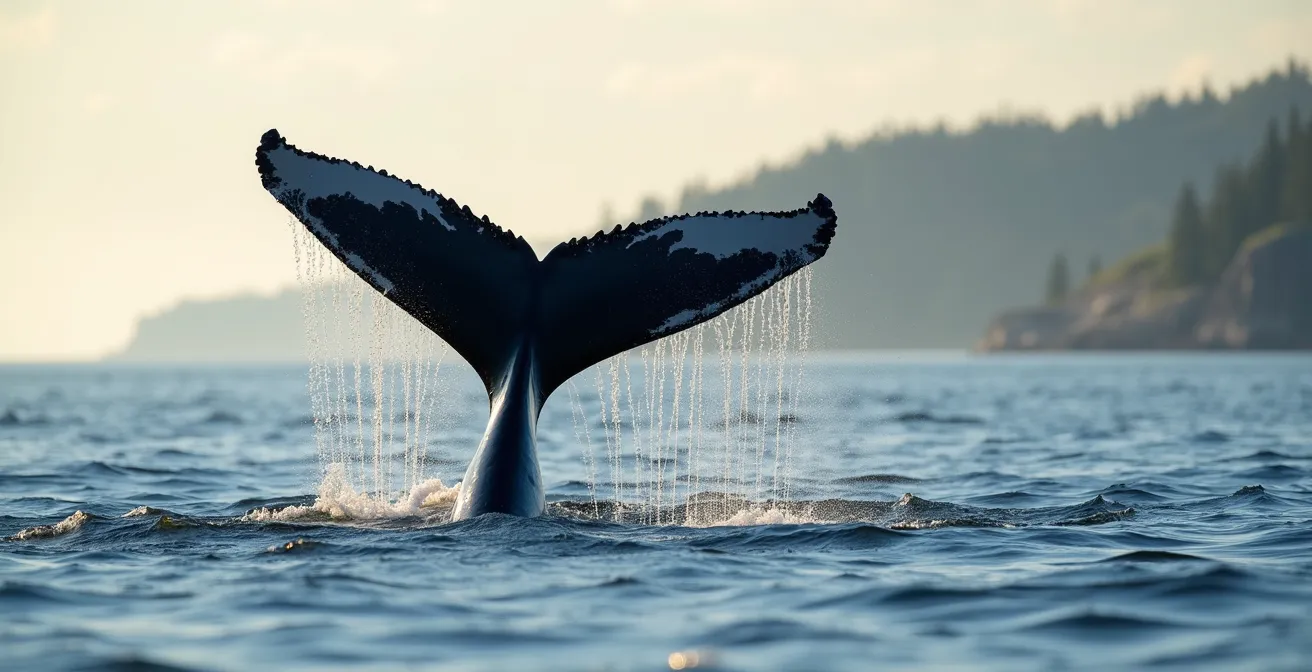
Observing a humpback whale’s tail is more than just a spectacle: it is the starting point of a concrete scientific contribution.
- The coloration under the fluke, or “biological ID card,” is unique to each individual and allows for long-term tracking.
- Surface behaviors such as breaching or bubble-net feeding are not random; they reveal a true social and hunting “behavioral grammar.”
Recommendation: Learn to anticipate the moment of the dive and frame your photo not just as a souvenir, but as precious data for research on St. Lawrence cetaceans.
The moment is suspended. A powerful blow pierces the silence of the St. Lawrence Estuary, followed by a dark mass gliding beneath the surface. Then, majestic, an immense bicolor tail unfolds before disappearing into the depths. For many observers, the goal is to capture this moment, to bring back a memory of this encounter with a giant. But what if this photo, beyond the emotion, could become an essential piece of a large scientific puzzle? As a researcher with the Group for Research and Education on Marine Mammals (GREMM), I invite you to change your perspective. Whale watching, and particularly humpback whale watching, is not a passive activity.
Usual advice often focuses on the spectacular: spotting breaches, admiring the blows. These manifestations are certainly impressive, but they are primarily fragments of a complex language. The angle of this article is resolutely participatory. We will go beyond simple identification to give you the keys to “behavioral reading.” The idea is not just to know that the tail is a fingerprint, but to understand why and how your snapshot of this “biological ID card” fits into decades of research in Quebec. We will see that the true key is not the luck of being in the right place at the right time, but the ability to anticipate, decode, and document what you see with the rigor of a field scientist.
This article is structured to transform you, step by step, from a marveling spectator into an informed observer and potential contributor. Together, we will decode the behavioral grammar of these cetaceans, learn to differentiate them from their cousins, and guide you so that your next fluke photo is perfectly usable by our teams.
Summary: The Humpback Whale Behavioral Identification Guide
- Why do humpback whales perform spectacular breaches out of the water?
- How to recognize the bubble-net feeding technique at the surface?
- Tic Tac Toe or Siam: who are the humpback stars of the St. Lawrence this year?
- The mistake of confusing a fast fin whale with an acrobatic humpback whale
- Blurry photo: how to take a fluke snapshot usable by researchers?
- 6-meter column: how to spot the powerful blow of the blue whale on the horizon?
- Why does the depth of the Saguenay Fjord attract large cetaceans?
- Why is the St. Lawrence beluga population in critical decline?
Why do humpback whales perform spectacular breaches out of the water?
A humpback whale’s jump, or “breach,” is one of the most powerful manifestations in the animal kingdom. Far from being simple play, this behavior follows a complex behavioral grammar. The first hypothesis is acoustic communication: the colossal impact of several dozen tons on the water generates a low-frequency sound that travels for miles under the surface, serving to signal its presence to other individuals. Another function is parasite removal; the shock helps get rid of certain skin parasites like sea lice. These breaches are particularly frequent in the Saguenay–St. Lawrence Marine Park, where the population has significantly increased, rising from an average of 5 individuals between 2008 and 2017 to more than 100 humpback whales observed in 2021, increasing interactions accordingly.
This behavior is also a powerful social indicator. It is not just about communicating, but about transmitting a specific message depending on the context.
Case Study: Breaches as Social Indicators in Young Males
The behavioral strategies of humpback whales appear as complex as the use of tools by great apes in the forest, with explosive breaches distinct depending on age and social context. Young males perform more frequent and energetic breaches during periods of competition for females, using these demonstrations of strength to intimidate rivals. Conversely, calves are often observed mimicking their mothers in shorter, less ample learning jumps, thus integrating the communication codes of their species.
Observing a breach is therefore not just a show, but a window into a group’s social dynamics. The frequency and energy of the jumps can inform researchers about the group’s composition (presence of competing males, mothers with calves) and the period of the life cycle.
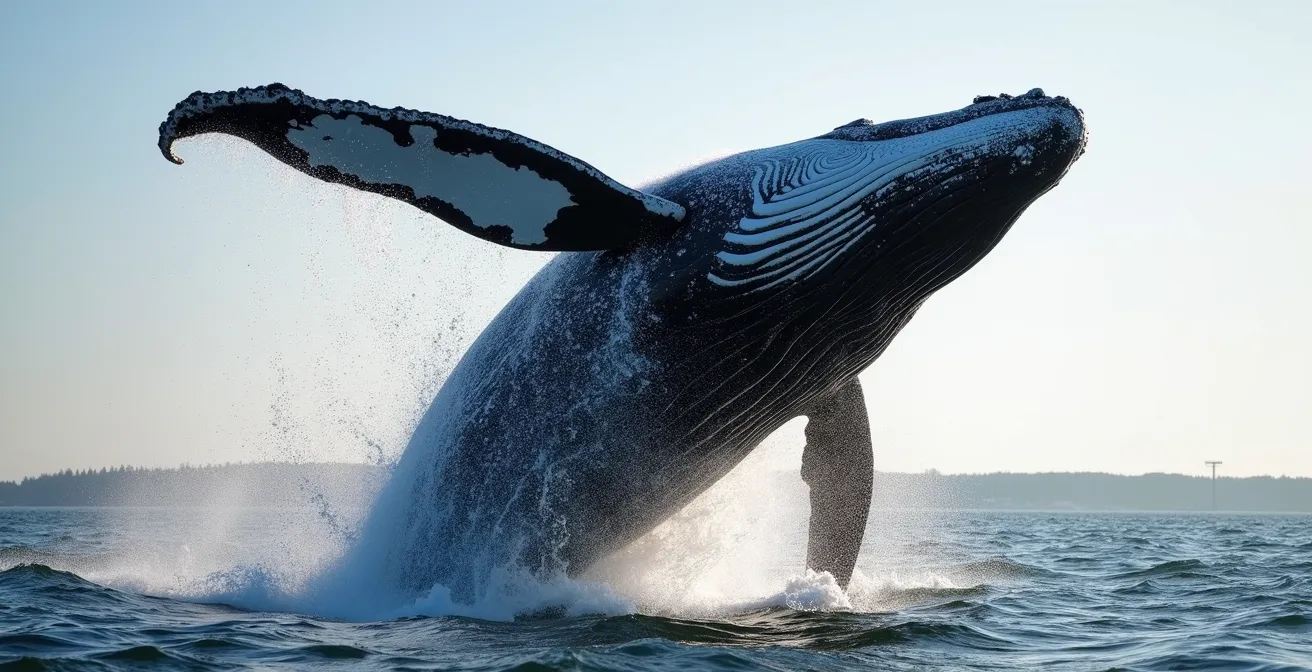
Attentive observation of these behaviors is therefore crucial. An isolated breach does not have the same meaning as a series of five consecutive breaches. Similarly, pectoral slapping or lobtailing (slapping the tail on the water) are other “words” in this body vocabulary, often used for shorter-distance communication.
How to recognize the bubble-net feeding technique at the surface?
The humpback whale is not just an acrobat; it is also an engineer. Its most fascinating hunting technique, “bubble-net feeding,” is a remarkable example of cooperation and strategy. This method involves circling a school of prey (often krill or small fish like capelin) while exhaling air to create a “wall” or “cylinder” of bubbles. This visual curtain frightens and concentrates the fish toward the surface, where one or more whales then surge up mouth agape in the center of the trap to engulf thousands of prey at once. Recognizing the warning signs of this hunt from an observation boat is an exciting challenge for an informed observer.
The first clue is often both auditory and visual: repeated lobtailing can serve to herd the fish. Next, one must scan the water’s surface. Do not look for the whale itself, but rather for the traces of its action. The appearance of a nearly perfect circle of bubbles or abnormal “foam” at the surface is the most convincing sign that the trap is being set. Seabirds, such as Northern gannets or gulls, are also excellent indicators. A sudden gathering of birds frantically diving in the same spot means a feast is about to be served at the surface.
Observing this technique is a privilege, as it demonstrates advanced intelligence and social coordination. In some parts of the world, whales even emit specific vocalizations to coordinate the attack. In the St. Lawrence, it is often a solitary action or performed in a small group. Signs to look for include:
- The appearance of circles or spirals of bubbles rising to the surface.
- Massive grouping and diving of seabirds in a highly concentrated area.
- Observation of the “wall” of the flanks of several whales converging underwater toward a central point.
- Tail slapping (lobtailing) that often precedes the active hunting phase.
- The presence of several individuals whose movements seem synchronized and coordinated.
Being able to spot these clues allows you not only to anticipate the spectacular moment the whale will surge to the surface but also to understand the complexity of the ecological engineering deployed by these giants to feed.
Tic Tac Toe or Siam: who are the humpback stars of the St. Lawrence this year?
Thanks to photo-identification, we no longer see anonymous humpback whales, but individuals with a history, a genealogy, and habits. This is where your role as a citizen observer takes on its full meaning. Every clear photo of the underside of a fluke is compared to a catalog of several hundred known individuals that frequent the St. Lawrence. Some are true celebrities, followed by our teams for decades. One of the best known is undoubtedly Tic Tac Toe, a female whose family history perfectly illustrates the power of this long-term tracking.
Case Study: Tic Tac Toe, Three Generations of Humpback Whales
Tic Tac Toe, a female now 27 years old, has been known to GREMM researchers since 1999. She is easily recognizable thanks to the “X” shaped pattern visible under her fluke. In 2007, she made history by bringing the very first known calf born to a St. Lawrence mother into the estuary, a young female named Aramis. Thirteen years later, in 2020, the power of international tracking allowed Aramis to be observed in the warm waters of the Turks and Caicos Islands with her own calf. Tic Tac Toe thus became a grandmother at 23, and we were able to document a lineage over three generations.
Other individuals like Siam, Irisept, or Bolt (named for a lightning bolt-shaped mark on her tail) are also regulars in the estuary. Monitoring these “stars” and their movements provides us with vital information on their migratory routes, reproduction rates, and life expectancy. Seeing them return year after year to the St. Lawrence confirms the importance of this habitat as a crucial summer feeding ground. It is during this period that they must accumulate enough fat reserves to survive the long journey and the winter breeding season.
As highlighted by an analysis from the Group for Research and Education on Marine Mammals (GREMM) reported by Whales Online:
Which may be normal given that humpback whales migrate to the West Indies in winter and spend the cold season without feeding, living off their fat reserves.
– Group for Research and Education on Marine Mammals (GREMM), Whales Online
Every new observation of a known individual or the discovery of a newcomer is a victory for research. It proves that the St. Lawrence Estuary remains an ecosystem rich enough to attract and support these giants, generation after generation.
The mistake of confusing a fast fin whale with an acrobatic humpback whale
In the excitement of an observation, identification can be tricky. A frequent error for the uninitiated is confusing a humpback whale with a fin whale. Yet, their “personalities” and physical characteristics are very different. The fin whale is the “greyhound of the seas”: long, sleek, and incredibly fast, capable of speeds up to 40 km/h. It moves in a straight line, performs a series of 3 to 5 powerful, rapid breaths, then dives for a long period without ever showing its tail. Its blow is a tall, narrow column.
The humpback whale, on the other hand, is the “ballerina” of the oceans. Stockier, it is much slower and more sinuous in its surface movements. Its behavior is far more acrobatic: it jumps, slaps the water with its immense pectoral fins, and, above all, almost systematically shows its wide fluke before a deep dive. Its blow is lower and bushier, shaped like a balloon. The dorsal fin is also a key criterion: small and located very far back on the body in the fin whale, it is stockier and placed on a characteristic hump in the humpback whale.
The following table summarizes the fundamental differences to observe to avoid confusion, also including the minke whale, another frequent visitor to the St. Lawrence.
| Characteristic | Fin Whale | Humpback Whale | Minke Whale |
|---|---|---|---|
| Breathing Sequence | 3-5 rapid breaths | Bushy blow, slow | Blow nearly invisible |
| Fluke (Tail) | Never shows tail | Always shows tail when diving | Tail rarely visible |
| Swimming Speed | Linear sprinter (40 km/h) | Slow and sinuous | Tendency to porpoise |
| Average Size | 18-20 meters | 13-15 meters | 6-10 meters |
| Dorsal Fin | Small, very far back | Hump + short dorsal | Pronounced dorsal |
These differences are subtle from afar but become obvious with a little practice. The next time you see a large cetacean, ask yourself the right questions: Can I see the tail? Is the movement fast and direct or slow and erratic? Is the blow a column or a bush?
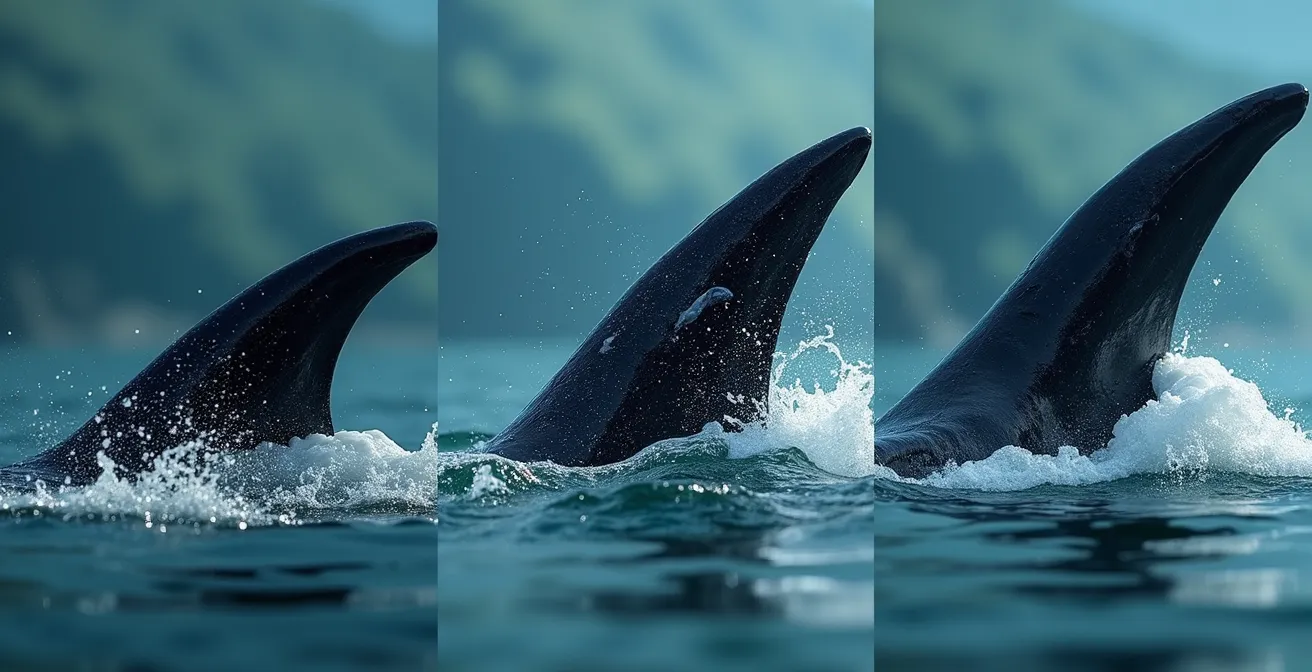
This distinction is important because it informs us about the diversity of megafauna present in a given area at a given time, valuable information for assessing the health of the marine ecosystem.
Blurry photo: how to take a fluke snapshot usable by researchers?
You have successfully identified a humpback whale, you are anticipating its dive… This is the crucial moment. The goal is not to take a pretty photo, but a useful photo. This is where participatory science takes on its full meaning. A usable photo is one that allows for unambiguous identification of the coloration patterns, scars, and the trailing edge of the underside of the fluke. As specified by the Mingan Island Cetacean Study (MICS), an authority in the field, this snapshot is the cornerstone of their work.
According to the Mingan Island Cetacean Study (MICS) in its photo-identification guide:
Humpback whales can be identified using the pigmentation on the ventral surface of their fluke. Colors can range from solid black to solid white, including a myriad of black and white patterns. This is the most easily recognizable whale species.
– Mingan Island Cetacean Study (MICS), Photo-identification Guide
A blurry, poorly framed photo or one taken from a bad angle is unfortunately unusable. The secret lies in anticipation and technique. The whale generally performs a series of breaths at the surface before arching its back (a movement called “humping”) just before the dive. That’s the signal! Your camera must be ready. Aim for the whale’s back and follow its downward movement. The tail will appear at that precise spot. Your camera’s “burst” mode is your best ally to increase your chances of getting a sharp image at the peak of the tail’s arc.
To turn your attempt into a success, follow a rigorous method. Every detail counts so that your snapshot can be included in identification catalogs and truly contribute to population monitoring.
Your Action Plan for Successful Photo-Identification
- Anticipation: Spot the breathing sequence and the “humping” that precedes the dive. Position your camera even before the tail emerges from the water.
- Framing and Focus: Aim for the entire fluke. Ensure the image is as sharp as possible, particularly on the pigmentation patterns and the trailing edge (the back edge of the tail).
- Light and Angle: Try to have the sun at your back to well-illuminate the underside of the tail. A photo taken perpendicular to the tail is ideal.
- Documentation: Note the date, time, and the most precise GPS location possible of your observation. This metadata is as important as the photo itself.
- Transmission: Submit your best photos (even if they seem imperfect to you) to citizen science platforms or directly to the GREMM or MICS catalogs.
By following these steps, you are no longer just taking a souvenir photo. You are collecting scientific data—a dated and localized “biological ID card” that will enrich our knowledge of the lives of these fascinating sea nomads.
6-meter column: how to spot the powerful blow of the blue whale on the horizon?
If the humpback whale is an acrobat, the blue whale is a force of nature. The largest animal ever to live on Earth signals itself in its own unique way: its blow. Spotting a blow on the horizon is the first step of any observation, but not all blows are equal. The blue whale’s blow is incomparable and immediately recognizable to a trained eye. It is a vertical, straight, and explosive column that can reach over 6 meters in height—the size of a giraffe! In calm weather, its powerful sound can be heard even before the blow is visible.
Observing this blow is a particularly moving moment, as the North Atlantic blue whale is an endangered species. Its population is estimated at only a few hundred individuals. Every confirmed observation in the St. Lawrence is therefore data of paramount importance, a sign that this fragile giant continues to frequent the estuary to feed. Unlike the bushy, balloon-shaped blow of the humpback whale, the blue whale’s is a signature that does not deceive.
The following comparative table will help you become an expert in the art of “reading blows,” an essential skill for long-distance identification.
| Species | Blow Height | Characteristic Shape | Sound |
|---|---|---|---|
| Blue Whale | 6 meters | Straight vertical column | Explosive, very loud |
| Humpback Whale | 2.5-3 meters | Bushy balloon | Noisy, dispersed |
| Fin Whale | 4-5 meters | V-shaped (seen from behind) | Powerful, brief |
| Right Whale | 5 meters | Double V-shaped jet | Characteristic |
Training consists of scanning the horizon not for a whale, but for an anomaly: a sudden “smoke” above the water. Once spotted, analyze its shape, height, and, if possible, listen to the sound. A tall vertical column rising with a dull thud? You may be in the presence of the giant of giants. Never forget that this observation is a privilege and valuable information for the conservation of the species.
Why does the depth of the Saguenay Fjord attract large cetaceans?
The mouth of the Saguenay Fjord, near Tadoussac, is world-renowned as one of the best whale-watching sites. This is no accident, but the result of a unique oceanographic phenomenon: upwelling. This location is a true pantry for cetaceans, and its exceptional productivity is explained by very specific underwater topography. The St. Lawrence River hides a deep underwater valley within it, the Laurentian Channel, which reaches nearly 450 meters in depth here.
This phenomenon acts like a natural pump, creating an oasis of life in the middle of the estuary. It is this concentration of food that attracts large migratory rorquals between May and October, the best period to observe them.
Case Study: The Upwelling Phenomenon at the Mouth of the Saguenay
The Laurentian Channel, with its 450 meters of depth, abruptly hits a shoal only 20 meters deep at the head of the channel, near Tadoussac. When rising tides force deep, cold, and nutrient-rich waters from the channel up this steep slope, they are projected toward the surface. This massive influx of nutrients (nitrates, phosphates) and oxygen into the sunlit surface layers triggers an explosion of life. Phytoplankton proliferates, in turn feeding immense swarms of zooplankton (like krill), which are the dietary staple for many fish and, of course, large marine mammals.
However, it is crucial to distinguish permanent residents from seasonal visitors. Only belugas and harbor seals reside year-round in the area. Large cetaceans like humpback whales, fin whales, and majestic blue whales are only summer visitors. They concentrate at the mouth, taking advantage of the abundance of food, but very rarely venture into the fjord itself, unlike belugas which have made it their sanctuary.
Understanding this ecological dynamic allows one to realize that the presence of whales is not guaranteed. It depends entirely on the health and productivity of a fragile ecosystem, of which the head of the Laurentian Channel is the engine. Every observation is therefore a testament to the vitality of this exceptional feeding ground.
Key Points
- Identifying a humpback whale goes beyond the visual; it is about decoding behavior (breaching, hunting).
- Your fluke photo is a crucial “biological ID card” for research if it is sharp, well-framed, and documented.
- The presence of whales in the St. Lawrence is directly linked to specific oceanographic phenomena like the Tadoussac upwelling.
Why is the St. Lawrence beluga population in critical decline?
Amidst the ballet of migratory giants, a resident and emblematic population of the St. Lawrence is fighting for survival: the beluga. Unlike rorquals that only spend the summer here, belugas live here year-round. Their situation is dramatic. Once 10,000 strong, the population has plummeted to about 1,100 individuals today. Designated as an endangered species in Quebec, this white whale is a true sentinel of the river’s health. Its decline is a symptom of an ecosystem under pressure.
The threats facing the beluga are multiple and complex, often summarized by the “3 Cs” rule: Contamination, Collisions, and acoustic Chaos. As an apex predator, the beluga accumulates pollutants in its fat that seep into the river. Carcass analyses reveal high levels of PCBs, DDT, and flame retardants, weakening their immune systems and reproductive capacity.
The message carried by the fate of the beluga is a powerful warning, as phrased by Fisheries and Oceans Canada:
The beluga, at the top of the food chain, is a sentinel of the river’s contamination. The pollutants found in their fat are a mirror of the pollution in the ecosystem we share.
– Fisheries and Oceans Canada, Action plan to reduce the impact of noise on the beluga
Furthermore, the increase in maritime traffic in the St. Lawrence exposes belugas to an increased risk of fatal collisions and, above all, to acoustic “chaos.” The constant underwater noise generated by ship engines interferes with their ability to communicate, navigate, and find food, creating chronic stress that affects their survival. Measures, such as speed limit zones, are in place to try to mitigate this impact, but the situation remains critical. Observing a beluga is therefore a poignant reminder of the fragility of this ecosystem and of our collective responsibility.
Every observation, whether of a humpback whale or a beluga, is a piece of a larger puzzle: that of the health of the St. Lawrence. By becoming an informed observer and participating in data collection, you contribute directly to conservation efforts. The next step is to transmit your observations to the right organizations so they can have a real impact.