
Contrary to ancestral fears, the Quebec wolf is not a threat to hikers, but an indicator of our forests’ health whose language we must learn to decode.
- Identification is complex: the gray wolf coexists with the coyote and hybrids (“coywolves”), making visual and track differentiation essential.
- Its behavior is social and territorial: howls are a form of communication, not a threat, and the pack structure dictates its movements.
Recommendation: For a serene hiking experience, replace fear with knowledge by learning to read the signs of its presence and respecting its territory, notably by keeping your dog on a leash.
The shiver that runs down a hiker’s spine at the sound of a distant howl in the Quebec forest is an almost visceral reaction. It draws its source from centuries of tales and legends where the wolf embodies the ultimate predator. This fear, while understandable, is often disconnected from the biological and behavioral reality of Canis lupus. Usual advice is often limited to reactive instructions: “do not run,” “make yourself big,” “make noise.” These recommendations are useful, but they keep the hiker in a defensive posture against a perceived threat.
However, true safety and the richness of the wilderness experience lie not in simple reaction to an unlikely encounter, but in a proactive understanding of the animal. What if the key was not preparing for a confrontation, but becoming an enlightened observer, capable of decoding the language of the forest? Understanding why the wolf acts as it does, what its vocalizations mean, and how to read its signature on the landscape transforms an irrational fear into deep respect. It is a shift from being a simple walker to an amateur naturalist who grasps the fundamental place of this apex predator in the dynamics of our ecosystems.
This article proposes to deconstruct the myth of the “big bad wolf” by giving you the tools to understand its world. We will explore the complex social structure of the pack, the criteria for differentiating it from the coyote, the meaning of its howls, and the ecological impact of its presence. The goal is simple: to allow you to hike with more serenity, not through ignorance of the risk, but through a sharp knowledge of the animal and its environment.
This guide will accompany you through the different facets of the wolf in Quebec, offering you the keys to an enlightened coexistence. The summary below details the points we will cover to transform your perception of this fascinating predator.
Summary: Demystifying the Wolf, Predator of Quebec Forests
- Why does only the Alpha pair breed in a wolf pack?
- Pointed ears or wide snout: how to tell a wolf from a coyote at 50 meters?
- Territory or rallying: what does the howl you hear at night mean?
- The mistake of leaving your dog off-leash in wolf territory that causes territorial conflicts
- Trophic cascade: how the return of the wolf promotes forest health?
- The mistake of confusing wolf and coyote tracks that 90% of beginners make
- Increased predation: how forest roads favor wolves and bears?
- How to identify animals that have passed through your land using their tracks?
Why does only the Alpha pair breed in a wolf pack?
To understand wolf behavior, it is essential to grasp the fundamental structure of its social unit: the pack. Far from being an anarchic gathering of predators, the pack is a complex and highly hierarchical family organization. At the top of this structure is the breeding pair, often mistakenly called the “Alpha pair.” In reality, these are the parents, the founders of the family. Other members are generally their offspring from different generations who have not yet left the group to form their own family. This cohesion ensures effective cooperation for hunting, territory defense, and raising the young.
Reproduction is almost exclusively reserved for this dominant pair. This social regulation mechanism has a precise ecological function: it allows the number of births to be adjusted to the food resources available in the territory. If food is abundant, the survival of the pups will be better. If it is scarce, the pack limits its own growth to avoid exhausting its prey. It is a long-term survival strategy. As the Government of Quebec states in its species fact sheet:
The pack generally lives in a hierarchical family group of five to eight individuals or more, led by a dominant couple
– Government of Quebec, Gray wolf species fact sheet
For the hiker, this knowledge has a direct implication. The reproductive cycle strongly influences the pack’s behavior and movements. From April to July, during the birthing and pup-rearing period at the den, wolves are particularly sensitive to disturbance. Rendezvous sites, often clearings near water points, become nerve centers of pack life from summer until early autumn. Knowing these periods and types of locations allows hikers to adapt their routes to respect the pack’s privacy and minimize the risk of unwanted encounters.
Pointed ears or wide snout: how to tell a wolf from a coyote at 50 meters?
One of the greatest points of confusion for the untrained observer in Quebec’s forests is the distinction between the wolf and the coyote. These two canids share similarities, but several key clues allow for differentiation, even at a distance. The first criterion is body mass and silhouette. The gray wolf is significantly more massive, with a weight that can reach 70 kg, while the coyote rarely exceeds 23 kg. This difference results in a more powerful appearance and longer legs for the wolf, giving it a wide and confident gait.
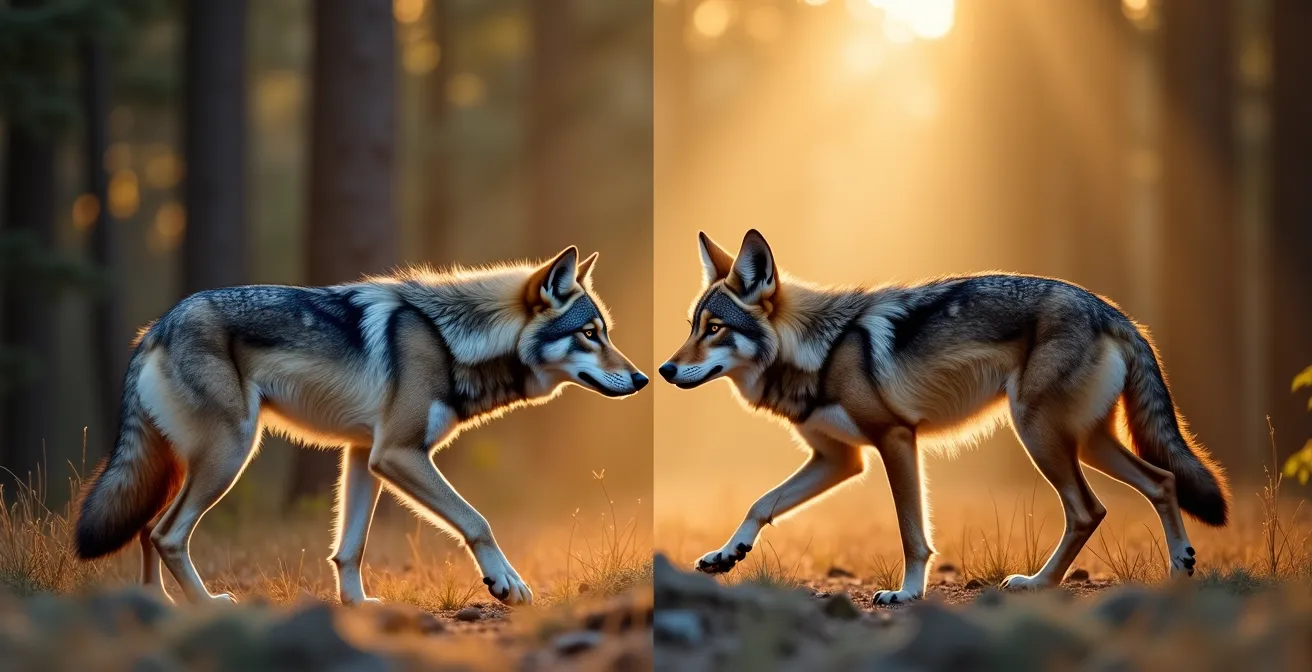
When observing the head, the wolf’s snout is wide and short, whereas the coyote’s is visibly more tapered and narrow. The ears are another excellent clue: they are somewhat rounded and short on the wolf, and distinctly longer and more pointed on the coyote. Finally, the tail position while moving is very revealing: the wolf generally holds it high, in line with its back, while the coyote tends to keep it low, between its back legs.
However, the situation in Quebec is complicated by a well-documented phenomenon: hybridization. A study by the Ministry of the Environment revealed the existence of several genetic groupings, notably the “Eastern wolf” and the “Eastern coyote,” which are actually hybrids. Commonly called the “coywolf,” this animal exhibits intermediate characteristics that can blur the lines of visual identification. It is often larger than a pure coyote but smaller than a gray wolf, with mixed physical traits. This genetic reality necessitates greater caution in formal identification.
The following table, based on provincial government information, summarizes the most reliable differentiation criteria between “pure” species.
| Characteristic | Gray Wolf | Coyote |
|---|---|---|
| Weight | 18-70 kg | 9-23 kg |
| Shoulder Height | 66-97 cm | 58-66 cm |
| Ears | Rounded | Pointed |
| Snout | Wide and short | Tapered and narrow |
| Tail during running | High | Low |
| Presence zone in Quebec | Abitibi, Côte-Nord | Montérégie, Estrie |
Territory or rallying: what does the howl you hear at night mean?
The wolf’s howl is undoubtedly the most iconic and most misinterpreted sound of Quebec’s wildlife. Far from being a battle cry announcing an imminent hunt, it is a sophisticated social communication tool. For the hiker or camper hearing it echo in the silence of the night, understanding its function is the best antidote to anxiety. Howling primarily serves two functions: rallying and territorial defense.
Firstly, it serves as an acoustic beacon for pack cohesion. A wolf separated from its group can howl to signal its position and allow others to locate it. Conversely, a chorus of several individuals howling together reinforces social bonds and the hierarchical structure within the family. It is the equivalent of a “roll call” to ensure everyone is present and to reaffirm group unity. Under ideal conditions, these vocalizations can carry for more than 10 kilometers, making howling an extremely effective long-distance communication tool.
Secondly, howling is a declaration of ownership. By howling, the pack signals to neighboring packs: “This territory is occupied.” This is a way to avoid direct and potentially dangerous confrontations over control of hunting resources. It is a form of auditory boundary, an audible territorial map that regulates interactions between different wolf families. Hearing a howl is therefore not a sign that you are a target, but rather that you have entered the “living room” of a wolf family communicating with its members or neighbors.
It is crucial never to attempt to howl back. Imitating the sound can be interpreted in various ways by the pack: as a territorial challenge from an intruder wolf or as a call from a distressed member. In both cases, this can generate unnecessary stress for the animals and potentially attract their curiosity, which is precisely what one seeks to avoid for peaceful coexistence.
The mistake of leaving your dog off-leash in wolf territory that causes territorial conflicts
For many outdoor enthusiasts, a hike is only complete in the company of their dog. However, in wolf territory, allowing your canine companion to roam off-leash is one of the most common and riskiest mistakes. The problem does not stem from predatory aggressiveness of the wolf toward the dog, but from a dynamic of territorial competition. To a wolf pack, a domestic dog is not perceived as a pet, but as an intruder canid—a rival encroaching on their home range and resources.
The wolf defends its territory fiercely against other wolves or canids it considers competitors. An off-leash dog, marking its path with urine and exploring the surroundings, sends exactly the same signals as a stranger wolf attempting to claim the area. This intrusion can provoke a defensive reaction from the pack, which will seek to drive away or neutralize the intruder. The vast majority of rare negative interactions reported between wolves and humans in Quebec involve the presence of a dog not kept on a leash.
Beyond behavioral conflict, there is a significant health risk. Wild canids can carry various diseases and parasites transmissible to domestic dogs, and vice versa. Keeping your dog on a leash and in immediate proximity limits potential contact with carcasses, excrement, or directly with wild animals. Indeed, the provincial government information sheet mentions that the wolf can carry several parasites, including rabies, sarcoptic mange, and echinococcosis, which is confirmed according to the Government of Quebec sheet on parasitic risks.
Keeping your dog on a leash is therefore a triple protection measure: it protects your dog from a territorial confrontation, it protects the wolf pack from unnecessary stress and disturbance, and it prevents the potential transmission of diseases between wild and domestic populations. It is an act of responsibility and respect toward the ecosystem you are visiting.
Trophic cascade: how the return of the wolf promotes forest health?
The presence of the wolf in an ecosystem goes far beyond its own existence. As an apex predator, or “keystone species,” it triggers a series of chain reactions called a trophic cascade, which benefits the entire forest. Understanding this mechanism allows one to shift from viewing the wolf as a mere creature to seeing it as an indispensable engineer of the boreal ecosystem.
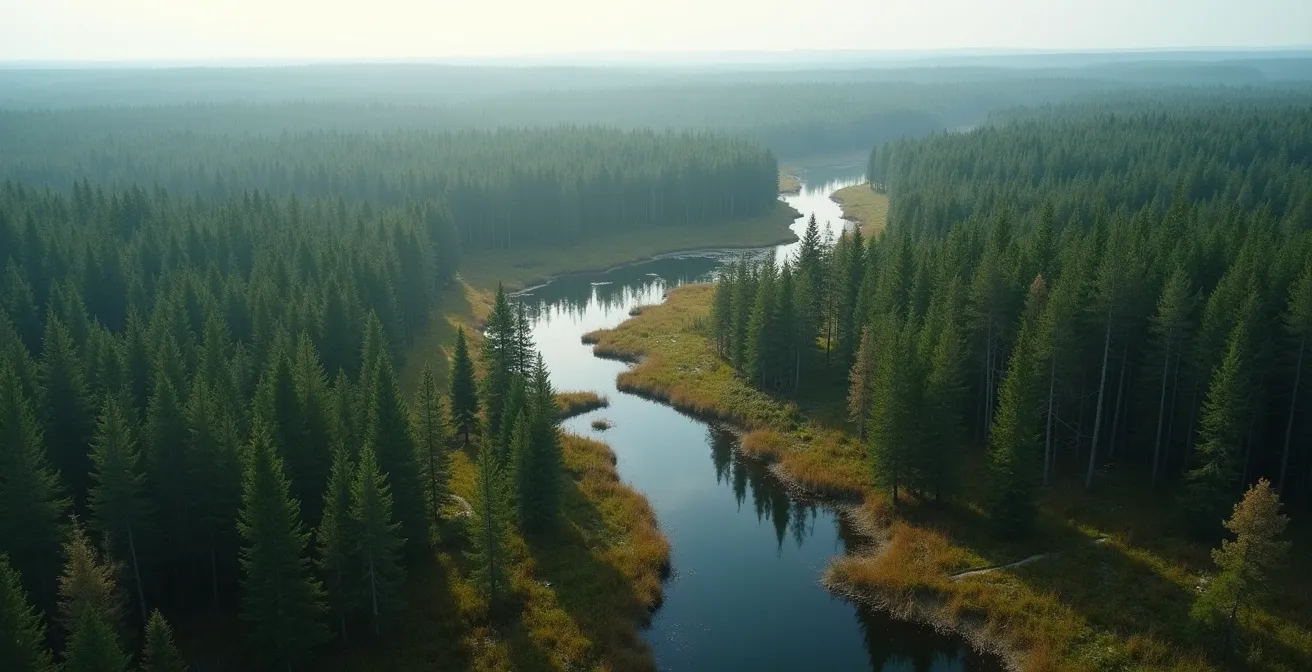
The principle is simple: by regulating populations of large herbivores like moose and white-tailed deer, the wolf modifies their behavior. Herbivores, under predation pressure, avoid browsing for too long in open and exposed areas. They move more often, which limits the intensive and selective browsing of certain plant species, particularly young tree shoots like balsam fir or birch. This “ecology of fear” allows vegetation to regenerate, promoting greater plant species diversity and a more complex forest structure.
Case Study: The Ecological Role of the Wolf as a Keystone Species in Quebec
The Association québécoise des piégeurs et opérateurs de fourrure (AQPOF) highlights the essential role of the wolf as a keystone species. According to the association, the disappearance of the wolf compromises the very structure of natural systems. Its presence is a barometer of biological richness. In Quebec, its predation on moose and deer populations is crucial for limiting overbrowsing. The latter seriously affects the regeneration of the boreal forest, particularly the growth of young balsam firs, which are essential to ecosystem health, as highlighted in an analysis by AQPOF on the role of wolves.
However, this ecological role can conflict with other conservation imperatives. This is notably the case for the woodland caribou, a species in a precarious situation in Quebec. Predation by wolves is one of the threats facing the last herds. This has led to predator control operations, as evidenced by the fact that 85 wolves have been killed in Charlevoix since 2020 in an attempt to protect a caribou population reduced to a handful of individuals. This complex situation shows that wildlife management is a delicate balance, where the beneficial role of a predator for the forest must sometimes be weighed against the survival of another threatened species.
The mistake of confusing wolf and coyote tracks that 90% of beginners make
Knowing how to recognize a track in the snow or mud is a fundamental skill for the amateur naturalist. It is like reading a page from the forest’s recent history. However, distinguishing between a wolf track and that of a large dog or coyote is a challenge that traps many beginners. Several subtle clues, beyond simple size, allow for more reliable identification.
The first criterion is, of course, the dimension of the footprint. A wolf track is notably larger, measuring between 10 and 13 cm in width. In comparison, a coyote’s rarely exceeds 7 cm. A large dog can leave a track similar in size to a wolf’s, but the shape differs. The wolf’s print is more oval and elongated, with the two central toes very forward, while a dog’s is rounder and more compact. Additionally, wolf claws are often more pronounced and thick.
The most discriminating criterion, however, is not the single footprint but the track pattern. The wolf is an animal that optimizes every calorie. Its gait is economical and determined. It moves in a nearly straight line, placing its hind paws exactly into the prints of its front paws (direct registering), resulting in a clean and rectilinear track. The coyote has a more sinuous, exploratory path. The dog, meanwhile, has an erratic gait: it runs, stops, sniffs, and changes direction, creating a messy track that reflects its lack of specific purpose.
This comparative table will help you see more clearly during your next outing.
| Characteristic | Wolf Track | Coyote Track | Large Dog |
|---|---|---|---|
| Print Width | 10-13 cm | 6-7 cm | Variable 7-11 cm |
| Print Length | 11-13 cm | 7-8 cm | 8-12 cm |
| Pad Shape | Elongated oval | Rounder | Round |
| Track Pattern | Straight line, economical | Sinuous, exploratory | Erratic |
| Step Spacing | 60-90 cm | 30-45 cm | Variable |
Action Plan: What to do if you find a suspicious track in Quebec?
- Photograph: Take a clear photo of the print, placing a reference object (coin, key) next to it for scale.
- Geolocate: Note the precise GPS location of the observation along with the date and time.
- Analyze the track: Follow the track for a distance of at least 10 meters to observe the general movement pattern (straight line, sinuous, erratic).
- Report: Use the Government of Quebec’s “Ma Faune” application to transmit your geolocated photos and observations to biologists.
- Contact in case of doubt: If the animal’s presence is associated with abnormal behavior or potential danger, contact SOS Braconnage – Urgence faune sauvage at 1-800-463-2191.
Increased predation: how forest roads favor wolves and bears?
The image of a wild and impenetrable forest is often idealized. In reality, the Quebec forest territory is crisscrossed by a vast network of multi-use roads, snowmobile trails, and logging roads. While these infrastructures facilitate human access to nature, they have an often-overlooked side effect: they transform predation dynamics by creating veritable “highways” for predators like wolves and bears.
In winter, these packed or less snowy paths allow wolves to move much faster and with less effort than in the deep forest. They can thus cover greater distances to hunt and access areas that would otherwise be difficult to reach. For prey like caribou or moose, which are less agile on these compacted surfaces, these roads become potential traps. They lose the advantage provided by deep snow, which normally slows down their pursuers.
This habitat fragmentation has a double negative effect. On one hand, it facilitates predator movement and increases their hunting efficiency. On the other hand, it disrupts prey movement and exposes them further. As Nature Québec points out, forest management and the development of the road network directly increase wolf predation pressure on woodland caribou. This is an ecological imbalance created by the human footprint, where the advantage is given to the hunter at the expense of the prey. Furthermore, according to the Government of Quebec on threats to woodland caribou, these roads are a major cause of fragmentation of their vital habitat.
For the hiker, this reality has a practical consequence: areas near forest roads and wide trails in winter can be preferred travel zones for wolves. While this does not increase the direct risk to humans, it means that signs of presence (tracks, scat) may be more concentrated there. It is another layer of information to integrate into our landscape reading, reminding us that our own infrastructures deeply influence wildlife behavior.
Key Takeaways
- Fear of the wolf often comes from a lack of knowledge; understanding its social and territorial behavior is the best way to soothe it.
- The wolf is a communicator: its howls, tracks, and markings are a language that informs on its presence and intentions, which are rarely threatening to humans.
- Its presence is a sign of vitality: as a regulatory predator, it plays an essential role in the health and diversity of the boreal forest.
How to identify animals that have passed through your land using their tracks?
Identifying tracks left by wildlife is a skill that directly connects one to the local ecosystem. For a landowner or a rural resident, recognizing footprints is not just a curiosity; it is also a diagnostic tool to understand which animals frequent the surroundings and to implement a proactive coexistence strategy. As we have seen, distinguishing a wolf track from that of a coyote or a stray dog is the first crucial step. Once identification is made, it is possible to act preventively to avoid conflicts.
The regular presence of wild canids near a home is almost always linked to the availability of easy-to-access food sources. An improperly closed compost bin, accessible trash cans, or pet food left outside are all unintended invitations. These animals are opportunistic and possess an exceptional sense of smell. Eliminating these attractants is the most effective measure to encourage them to keep their distance.
It is not about turning your property into a fortress, but about making it “boring” and uninteresting for a predator. Maintaining a clear zone around buildings, using motion-sensor lighting, and avoiding creating attraction points for their natural prey (such as feeding deer) are simple but very effective actions. These preventive measures discourage visits without harming the animals, promoting a natural separation between human space and wildlife habitat.
Checklist to make a property uninteresting for wild canids
- Secure waste: Check that all waste containers, recycling, and compost are in hermetically sealed bins.
- Manage outdoor food: Never leave pet food outside, especially at night, and clean up barbecue residues.
- Install deterrent lighting: Place motion-sensor lights at strategic points around the house and outbuildings.
- Maintain a buffer zone: Clear vegetation and tall grass in a strip of at least 10 meters around dwellings to eliminate hiding spots.
- Do not attract prey: Avoid feeding deer, raccoons, or other animals that constitute potential prey for wolves or coyotes.
Ultimately, the question is not so much whether the wolf is a threat, but how we humans can adapt our behavior to coexist intelligently with it. By moving from fear to understanding, the hiker and resident become positive actors in conservation, capable of appreciating the presence of this magnificent predator not as a danger, but as a symbol of a wild and healthy nature.
Frequently Asked Questions about Wolves in Quebec
Should I howl back if I hear wolves?
No, it is strongly discouraged to howl in response. This can create stress for the pack and potentially attract unwanted curiosity from them.
What does a solo howl mean versus a pack chorus?
A solo howl generally indicates an isolated wolf trying to locate its pack. A chorus of several wolves serves to reinforce social bonds and mark territory. In 99% of cases, these vocalizations represent no threat.
From what distance can a wolf howl be heard?
Wolf howls can carry up to 10 kilometers under ideal conditions, allowing for long-distance communication between members of the same pack.