
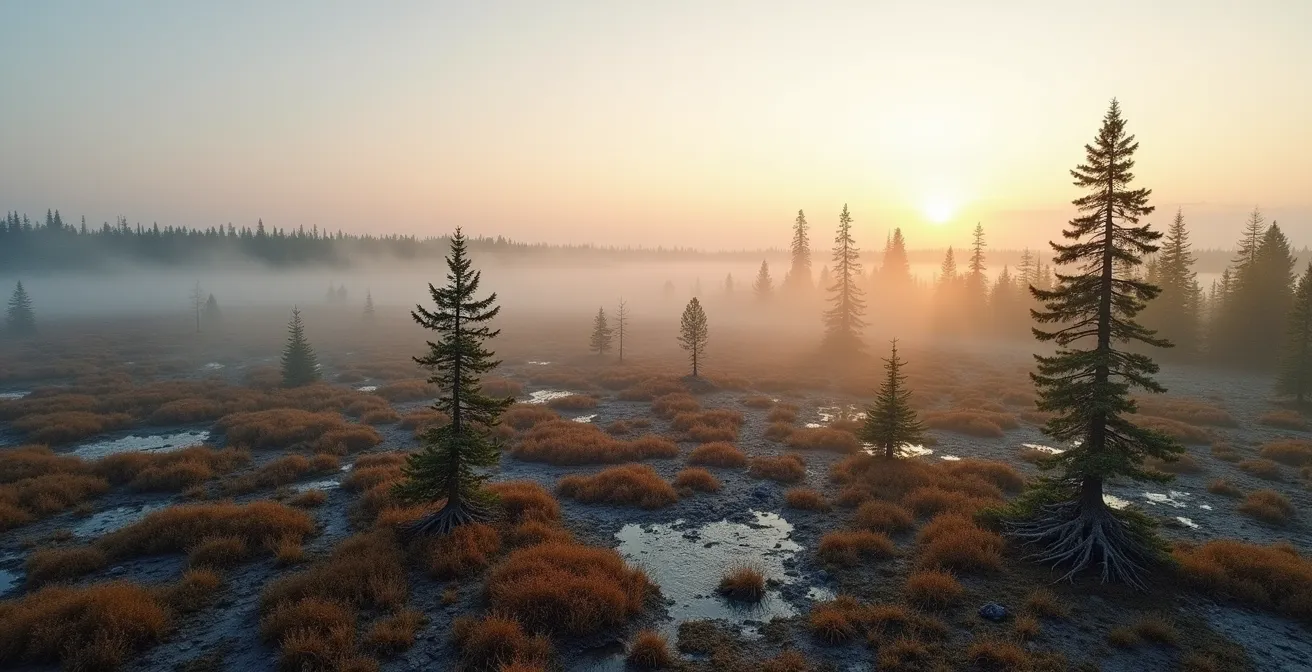
The taiga is not simply a sparse version of the boreal forest, but a “combat ecosystem” dictated by climate thresholds that entirely rewrite the rules of life.
- Tree growth is limited not by choice, but by frozen ground (permafrost) and an extremely short growing season.
- The lichen carpet, far from being a simple moss, acts as an ecosystem engineer that insulates the soil and feeds iconic wildlife like the caribou.
Recommendation: To understand the Canadian Far North, one must stop seeing the taiga as a degraded forest and instead analyze it as a unique tension zone—an ecotone where the forest fights to avoid becoming tundra.
Traveling toward Northern Canada, the landscape transforms. The dense boreal forest—an ocean of spruce and pine—gradually thins out. Trees become spaced apart, their size diminishes, and the ground is covered in a carpet of lichens. You are entering the taiga. For many, the distinction ends there: the taiga is seen simply as a less dense boreal forest, an impoverished version of its southern neighbor. This vision, while understandable, misses the point. The difference between these two biomes is not a simple matter of density, but a fundamental difference in nature, governed by distinct ecological laws.
The taiga is not a degraded forest; it is a tension ecotone, a battlefield where the forest wages a permanent struggle against the extreme conditions that define the edge of the tundra. To understand the taiga is to understand the critical thresholds that govern life in the Far North. It is not just about the cold, but about how permanent ground frost, the nature of fire, and the brevity of sunlight sculpt a world with its own rules, its own survivors, and its own fragilities. This article goes beyond a simple visual comparison to explore the climatic and ecological mechanisms that make the Canadian taiga a world apart, far more complex than a simple “sparse forest.”
To fully grasp the dynamics that oppose these two facets of the Far North, we will analyze the key processes that differentiate them. This article details the limiting factors of growth, the vital influence of frozen ground, the essential role of lichen, specific fire regimes, and finally, the interaction between these ecosystems and the peoples who have lived there for millennia.
Summary: The Deep Mechanisms Distinguishing Taiga from Dense Boreal Forest
- 100 years for 2 meters: Why do taiga spruce trees grow so slowly?
- Frozen ground: How does melting permafrost change the taiga landscape?
- Lichen carpet: Why is this “moss” the key to winter wildlife survival?
- Taiga fires: Why are they larger and more uncontrollable than in the south?
- Ancestral land: How do the Cree and Inuit use the taiga for their livelihood?
- Tundra vs. Forest: What are the differences in behavior and protection?
- Why are natural forest fires necessary for Jack Pine regeneration?
- How not to panic if you get lost in the dense boreal forest?
100 years for 2 meters: Why do taiga spruce trees grow so slowly?
The most visible difference between the dense boreal forest and the taiga is the stature of the trees. In the taiga, black spruce (Picea mariana) appear stunted and twisted, struggling for every centimeter of growth. This is not a sign of disease, but an adaptation to an environment that imposes an extremely low growth threshold. The growing season there is dramatically short, sometimes limited to just a few weeks per year. During this brief window, the tree must complete its entire developmental cycle.
To better grasp this constraint, one must visualize the extreme slowness of this process. In some regions, according to Parks Canada, it is not uncommon to find black spruces in the Cape Breton taiga aged 150 years that do not exceed one meter in height. This near-stagnant growth is the result of several combined factors: thin soil, poor in nutrients, and above all, extreme climatic conditions. Constant icy winds, laden with drifting snow, literally “burn” new shoots on the exposed side, forcing the tree to adopt an asymmetrical and deformed shape known as krummholz.
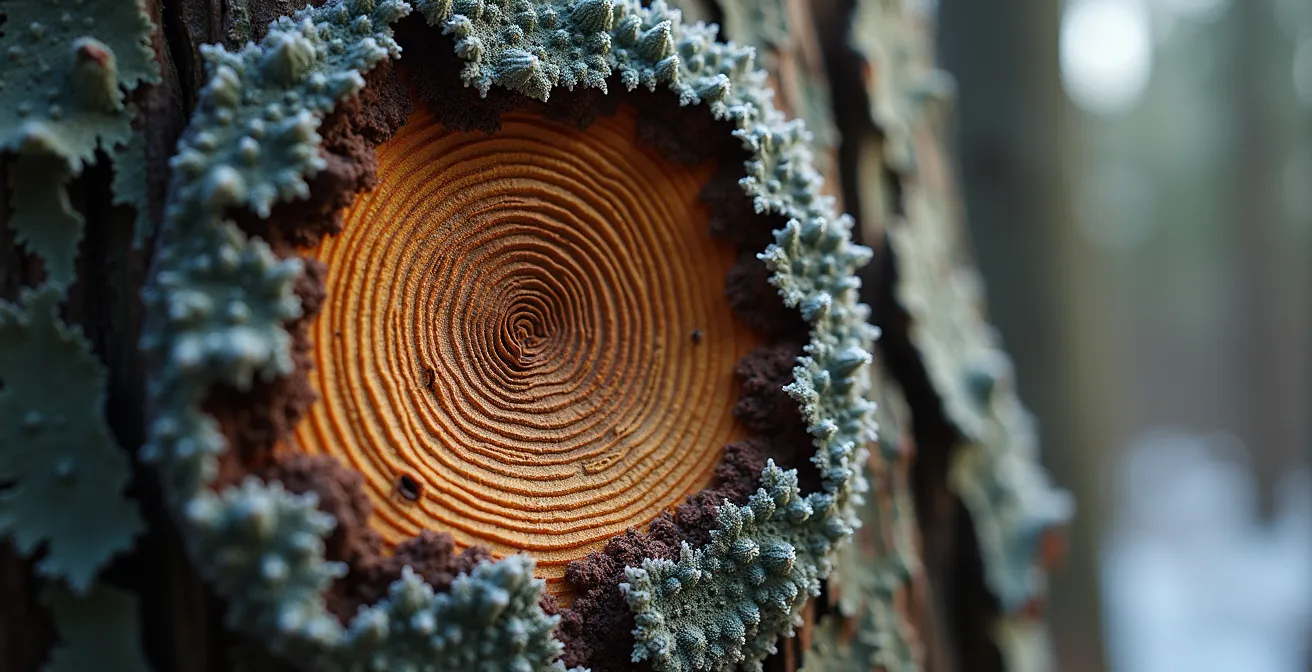
This image perfectly illustrates the density of the growth rings of one of these centenarian trees. Each extremely fine ring bears witness to a year of struggle. Unlike the southern boreal forest where trees can grow rapidly in height to capture light, taiga trees invest their energy in survival, developing structural resilience rather than vertical growth. This is the first fundamental distinction: the dense boreal forest is a race for light; the taiga is a war of attrition against the climate.
Frozen ground: How does melting permafrost change the taiga landscape?
Beneath the carpet of moss and lichen in the taiga lies one of its most decisive and misunderstood players: permafrost. This ground, permanently frozen for thousands of years, is the true foundation of the ecosystem. It dictates hydrology, nutrient availability, and the very stability of the terrain. While the dense boreal forest rests on soil that thaws deeply every summer, the taiga is built on a layer of underground ice that prevents roots from anchoring deeply and blocks water drainage.
This phenomenon creates a landscape dotted with peat bogs, shallow lakes, and waterlogged soils, even in areas with low precipitation. Permafrost acts as an impermeable floor. However, with global warming, this pillar of the taiga is becoming its greatest vulnerability. The melting of permafrost leads to dramatic consequences: ground subsidence (thermokarst), the formation of new lakes, and the destabilization of slopes. Trees, whose shallow roots rest on this once-stable ground, tilt and die, creating “drunken forests” where trunks lean in every direction.
The most worrying aspect is the climatic impact of this melting. As noted by the Centre d’études nordiques, the melting of permafrost releases enormous quantities of carbon and methane, powerful greenhouse gases trapped in organic matter frozen for millennia. This process transforms the taiga from a historical carbon sink into a potential source, creating a feedback loop that accelerates warming. The entire Canadian boreal region, including taiga zones with permafrost, covers 5,421,407 km², which gives an idea of the scale of the carbon stored and at risk.
Lichen carpet: Why is this “moss” the key to winter wildlife survival?
What is most striking about the taiga is the ground. Unlike the dark, needle-covered understory of the dense forest, the taiga floor is often a bright, spongy carpet. This is not ordinary moss, but primarily lichens, specifically caribou lichen (genus Cladonia). This vegetative carpet is not mere decoration; it plays the role of a true ecosystem engineer, with a dual vital function that radically differentiates the taiga from the southern forest.
First, this lichen carpet is an exceptional thermal insulator. In summer, its high albedo (ability to reflect sunlight) and airy structure protect the underlying permafrost from heat, helping to keep the ground frozen. It thus regulates the water and temperature regime of the entire ecosystem. By removing this carpet, the melting of permafrost is accelerated, with all the consequences that entails. Its presence is therefore an essential condition for the stability of the taiga.
Second, and most famously, lichen is the primary food source for many species in winter, particularly the caribou. Rich in carbohydrates, it constitutes a crucial energy resource when all other vegetation is inaccessible. This is where another major difference appears: in the open taiga, the wind sweeps away the snow, leaving the lichen accessible. In contrast, in the dense boreal forest, a thick layer of snow can cover the ground, making this food source inaccessible and forcing wildlife into other strategies. Lichen is therefore the cornerstone of the taiga’s winter food chain, a status it does not hold with the same intensity further south.
Taiga fires: Why are they larger and more uncontrollable than in the south?
Fire is a natural agent of change throughout the boreal forest. However, the fire disturbance regime in the taiga is radically different from that of the dense boreal forest, both in its scale and its consequences. In the dense southern forest, fires are often more contained and play a cyclical role of “rejuvenation,” favoring species like the Jack Pine. In the taiga, fires can reach gigantic proportions and have irreversible transformative effects.
Several factors explain this difference. First, the fuel. The carpet of lichen and dry mosses covering the taiga floor is extremely flammable during dry periods. Once ignited, fire can spread rapidly across immense surfaces, like a grass fire. Next, the open structure of the taiga allows wind to sweep through, fanning the flames and carrying embers over long distances, creating new spots far from the main front. Finally, the isolation and immensity of the territory make fighting these fires almost impossible; they often only go out when they hit a natural obstacle (a large lake, a river) or a change in weather.
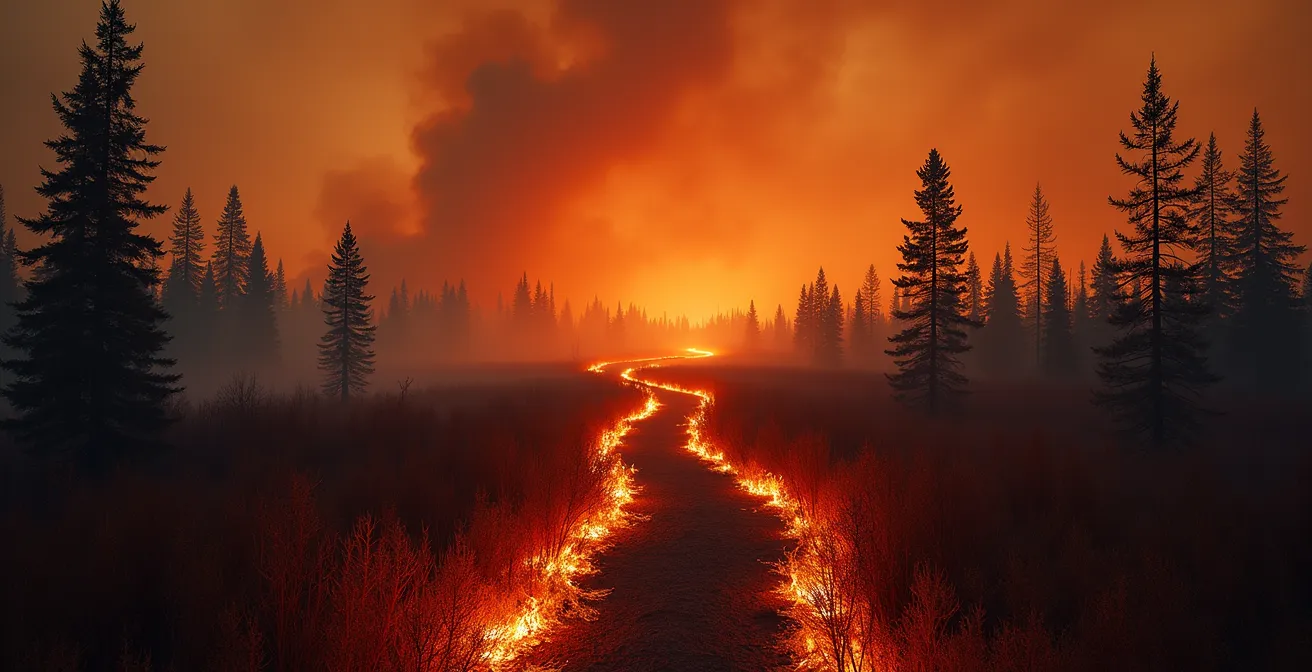
The impact of these mega-fires is profound. A fire of excessive intensity can not only destroy the forest but also consume the thin layer of soil organic matter and melt the upper layer of permafrost. This double destruction can prevent the forest from regenerating. Instead of an ecological succession leading to a new spruce forest, the landscape may shift toward a tundra-like state, dominated by shrubs and grasses. Fire in the taiga is thus not always a simple regenerator; it can be an ecosystem conversion agent.
Ancestral land: How do the Cree and Inuit use the taiga for their livelihood?
The taiga is not a human desert. For many First Nations and Inuit communities in Canada, it is ancestral land, a “pantry,” and a pharmacy. In Canada, more than 600 Indigenous communities depend on the broader boreal forest (including the taiga) for their livelihood, culture, and spirituality. The use of this territory is based on deep Indigenous Traditional Knowledge (ITK), passed down through generations, which allows for living in balance with the cycles of this demanding environment.
Livelihood practices in the taiga are directly adapted to its unique characteristics. Caribou hunting, fishing in its countless lakes, trapping fur-bearing animals, and gathering berries (such as blueberries or cloudberries) are at the heart of the economy and culture. These activities are not random; they follow precise calendars dictated by animal migrations and the seasonal availability of resources. This intimate knowledge of the territory allows for sustainable exploitation, far from the model of intensive extraction.
This ancestral knowledge is increasingly recognized today as an essential component of science and conservation. A striking example is the collaboration between the Huron-Wendat Nation and researchers to document biodiversity north of Quebec City. As reported by Let’s Talk Science, this partnership aims to combine traditional knowledge and scientific methods to prove the necessity of protecting these territories. This integrated approach shows that Indigenous peoples are not just inhabitants of the taiga, but its most expert guardians, whose knowledge is crucial for facing the challenges of climate change.
Tundra vs. Forest: What are the differences in behavior and protection?
Few animals illustrate the dichotomy between the taiga and the dense boreal forest as well as the caribou. Although they belong to the same species (Rangifer tarandus), the “tundra” (or migratory) and “forest” (or sedentary) ecotypes have developed such different survival strategies that they seem to belong to two distinct worlds. These differences are directly shaped by the structure of their respective habitats.
The boreal woodland caribou, which lives in the dense boreal forest, is an animal of camouflage. It lives in small groups and uses the forest cover to hide from predators, primarily wolves. Its strategy is discretion. When calving, the female isolates herself even deeper in the forest to avoid being spotted. This ecotype is relatively sedentary. Conversely, the barren-ground (tundra) caribou, which inhabits the taiga and tundra, adopts the opposite strategy. It lives in immense herds and uses wide-open spaces to see predators from afar and escape by fleeing. Females gather by the thousands on traditional calving grounds, relying on the group effect to dilute risk. The following table summarizes these oppositions.
| Characteristic | Woodland Caribou | Barren-ground Caribou |
|---|---|---|
| Primary Habitat | Dense boreal forest | Tundra and open taiga |
| Anti-predator Strategy | Hides in forest cover | Uses open spaces for long-range visibility |
| Calving | Female isolates in forest | Females gather by the thousands |
| Migration | Relatively sedentary | One of the longest terrestrial migrations |
| Conservation Status in Canada | Threatened species (federal law) | Catastrophic declines in some herds |
These divergent strategies have direct implications for conservation. The woodland caribou is threatened by the fragmentation of its habitat due to forestry and industrial exploitation. The barren-ground caribou faces dramatic declines linked to climate change affecting its food (lichen) and migration routes. Analysis of this iconic animal, detailed in resources like those from the Biogenus Biodiversity Observatory, clearly shows that the taiga and dense forest are not interchangeable: they are two distinct theaters of operation for species survival.
Why are natural forest fires necessary for Jack Pine regeneration?
While fire in the taiga can be a radical agent of transformation, its role in the dense boreal forest is often that of a cyclical regulator, essential for the survival of certain species. The case of the Jack Pine (Pinus banksiana) is the most classic example. This tree, dominant in many areas of the Canadian boreal forest, has co-evolved with fire to the point of depending on it for reproduction.
Jack Pine possesses “serotinous” cones. This means its cones remain hermetically sealed by a solid resin for years, even decades, protecting the seeds inside. These cones only open under intense heat, typically that of a forest fire. When the fire passes, it eliminates competition on the ground, clears the understory, and creates a mineral ash bed rich in nutrients. It is at this precise moment that the Jack Pine cones, heated by the flames, open and release their seeds onto a soil perfectly prepared for germination. Without fire, the Jack Pine would be gradually replaced by other species like spruce or fir, and the forest would age without renewing itself.
This symbiosis with fire is characteristic of the dense boreal forest. However, a quote from a Canadian Forest Service expert warns against overgeneralization: while fire “rejuvenates” the boreal forest by favoring Jack Pine, a fire that is too frequent or intense in the taiga can eliminate black spruce and degrade the soil to the point of preventing the forest from regenerating, leading to a “tundrification” of the landscape. Here we see another fundamental difference: the dense boreal forest is pyrophilic (it “loves” fire), while the taiga is pyrosensitive (it is vulnerable to fire). One uses it to perpetuate itself; the other risks dying from it.
Key Takeaways
- The taiga is not a degraded boreal forest, but a combat ecotone where extreme climatic conditions (cold, wind) and frozen ground (permafrost) dictate unique rules of life.
- The lichen and moss carpet is not passive; it is an ecosystem engineer that insulates the ground to protect permafrost and forms the base of the winter food chain for species like the caribou.
- Disturbance regimes (fire) and wildlife strategies (caribou) are radically different, moving from a model of cyclical resilience in the dense forest to a model of vulnerability and potential tipping points in the taiga.
How not to panic if you get lost in the dense boreal forest?
Getting lost in the Canadian North is a potentially dangerous experience, but the nature of the danger and the survival strategies to adopt differ considerably between the dense boreal forest and the taiga. Understanding these differences is the first step toward not giving in to panic and making the right decisions. Survival instinct must be adjusted to the specific environment you are in.
In the dense boreal forest, the primary danger is disorientation. The thick forest canopy blocks the view, the sun is often hidden, and the landscape can seem uniform, increasing the risk of walking in circles. The priority is to stop (S.T.O.P. method: Stop, Think, Observe, Plan), find shelter, and build a fire. Dry wood is generally abundant, which facilitates the fight against hypothermia and the creation of a smoke signal visible above the canopy.
In the taiga, the paradigm shifts. Visibility is excellent, which can be falsely reassuring. The danger is no longer short-distance disorientation, but the immensity and lack of landmarks—a phenomenon one might call “horizontal vertigo.” The primary risk becomes hypothermia due to constant wind exposure. Wood is a rare and precious resource. The absolute priority is therefore to build a windbreak using peat blocks, snow, or the rare clumps of stunted trees. Fire becomes a secondary goal, conditioned by the ability to find fuel.
Action Plan: Your mental checklist before a northern excursion
- Environment Assessment: Is it a dense forest (low visibility, abundant wood) or a taiga (excellent visibility, constant wind, rare wood)?
- Priority #1: In dense forest, identify a source of dry wood for fire. In taiga, locate a spot for a wind shelter (depression, snowbank).
- Orientation Strategy: In dense forest, use a compass and mark your path to avoid circling. In taiga, use distant landmarks (hills, large lakes) and manage the psychological impact of immensity.
- Resource Management: Conserve energy in dense forest by avoiding unnecessary movement. In taiga, actively manage body heat loss and save fuel.
- Signaling: In dense forest, prioritize a dense, high smoke signal. In taiga, use visual ground signals (colored cloth) visible from afar and from above.
Exploring the taiga and the boreal forest with this deep understanding transforms the experience. Every tree, every patch of lichen, and every track in the snow tells a story of struggle and adaptation. For your next adventure in the Canadian Far North, prepare yourself not only with the right equipment but also with the knowledge of the invisible forces that govern this fascinating world.