
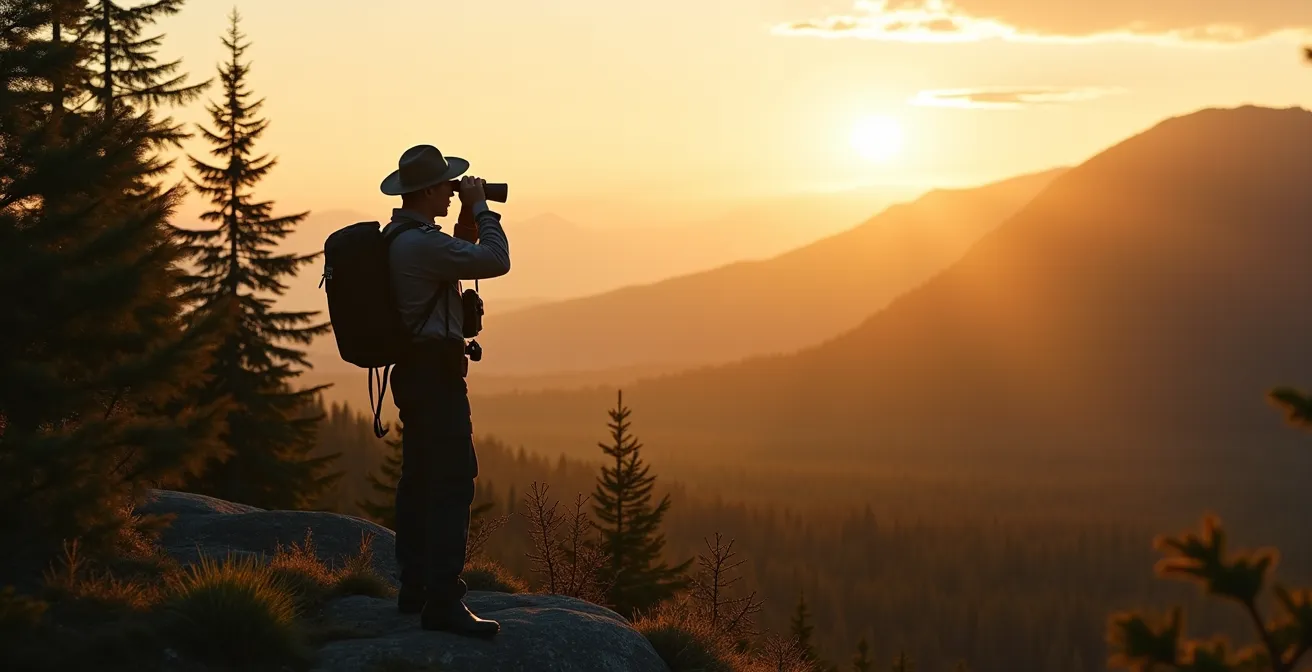
Contrary to the image of a simple ticket issuer, the true power of a wildlife protection officer in Quebec is not found only in their notebook. It lies in a strategic mastery of the terrain, an investigative capacity worthy of a detective, and a keen psychological reading of individuals. It’s not just a question of law; it’s a field war where intelligence and experience prevail over everything else.
We all have this image in mind: the wildlife protection officer approaching your boat, cap set straight, to check your fishing license. For many, their power boils down to that. A ticket book, the right to search a cooler, and lectures on quotas. That’s the visible part, the tip of the iceberg. Let me tell you, after more than thirty years in the field, this vision is terribly reductive. Legal power is one thing; authority is another. And this authority is not earned in school, but in the mud, at night, facing individuals who have nothing to lose.
We often talk about fines and seizures. That is the result. But no one talks about the work upstream, the patience, the observation, the strategic calculation behind every intervention. The true power of an officer is not to blindly apply the law, but to understand the human and animal ecosystem of their territory to know where, when, and how to strike so that it hurts. Not for pleasure, but to protect what cannot defend itself. As a quote from the website of the documentary series dedicated to us reminds us, expertise is nothing new.
Quebec is home to the oldest wildlife protection officer corps in Canada. Over time, their investigative methods have evolved, becoming more efficient and precise.
– Agents de la Faune – Documentary Series, Official Website Agents de la Faune
This article will take you behind the scenes of our profession. Forget the SEPAQ brochures. We’re going to talk about night hunts, managing rowdy campers, searching for a missing hiker, and the physical work that no one sees. You will understand that the power of a park ranger is, above all, a skillful blend of common sense, sweat, and an intimate knowledge of the Quebec wilderness.
To give you a clear vision of the reality on the ground, this article breaks down the various, often misunderstood, facets of a wildlife protection officer’s work. Here are the concrete situations we will address.
Summary: The hidden facets of a wildlife protection officer’s power in Quebec
- Night operation: how do officers track illegal hunters with flashlights?
- Music and parties: how to manage rowdy campers without ruining the family atmosphere?
- Code Red: what is the park ranger’s role when a hiker goes missing?
- Bridges and culverts: what physical work lies behind the maintenance of your favorite trails?
- Aerial inventory: how do rangers count moose from a helicopter?
- Wildlife Reserve or National Park: what difference does it make for your harvesting activities?
- Extreme preservation zone: why are some sectors off-limits to humans?
- How to explore the Quebec wilderness without disturbing the fragile balance of biodiversity?
Night operation: how do officers track illegal hunters with flashlights?
Night hunting, the famous “spotlighting,” is the cancer of our forests. It’s cowardly, it’s destructive, and it’s our number one priority. People think we just patrol at random. Big mistake. It’s a real game of chess. We gather information for weeks, even months. Citizens calling us, suspicious tracks, habits we observe. We build a case, we define surveillance zones. It’s shadow work, meticulous. We use surveillance cameras, night vision binoculars, and above all, our knowledge of the terrain.
Once the trap is set, patience is key. We can spend entire nights, motionless, being eaten by mosquitoes, waiting for that characteristic beam of light. When we take action, it’s never improvised. We know who we are looking for and we are ready. It’s this deep work that leads to major operations like the dismantling of the PIE poaching network in Gaspésie. More than 40 officers mobilized after a long investigation gives you an idea of the coordination required.
The goal isn’t just to catch one guy, but to dismantle the network. These coordinated operations are our most powerful weapon. And when the net closes, the consequences are heavy, as evidenced by the 2024 report of Operation PIE in Gaspésie, which led to convictions totaling more than $316,750 in fines for 81 individuals. That is a message that gets through. Power here is not the ticket; it’s the ability to conduct a complex investigation and conclude it with a judicial blow.
It’s not a simple patrol, but a real field war where technology and human intelligence combine to protect wildlife.
Music and parties: how to manage rowdy campers without ruining the family atmosphere?
Saturday night at a campground is a classic. A group gets carried away, the music goes up, and the families next door start to fume. Our role is not to arrive like a vigilante to put out the campfire and hand out fines. That’s the easy way out that makes things worse. The true power here is the psychological reading of the situation. We don’t intervene with a group of young people the same way we approach a family celebrating a birthday. You have to feel the atmosphere, identify the leader, and adapt your approach.
The first step is always discussion, not confrontation. We arrive calmly, explain the problem—the noise disturbing the neighbors—and ask them to keep it down. Most of the time, that’s enough. People aren’t ill-intentioned; they’re just caught up in the moment. It’s a mediator’s job. You have to show authority, but without being authoritarian. An iron fist in a velvet glove. We remind them of the rules, but we do it with respect, leaving them an honorable way out.
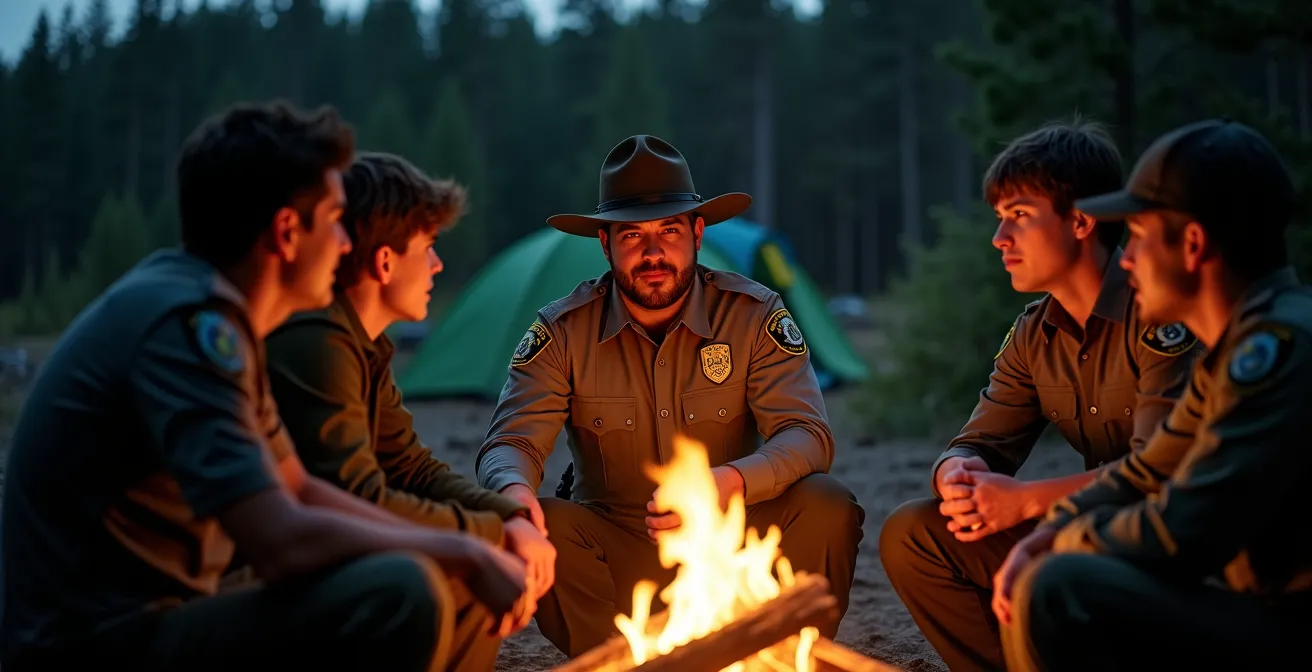
Of course, there are some who refuse to comply. Those who have had too much to drink, who seek confrontation. That’s when the tone changes. We move from a verbal warning to a notice of infraction. The fine is not the goal; it’s the tool of last resort to signal that the discussion is over. It’s a strategic calculation: escalate just enough to regain control without turning the campground into a battlefield. Success is not having distributed the most tickets, but when everyone can sleep in peace, including the rowdy group that understood the message.
This power of persuasion and control is often more effective than an immediate legal sanction, thus preserving the experience for all park users.
Code Red: what is the park ranger’s role when a hiker goes missing?
When a “Code Red” is launched for a lost hiker, our role changes completely. We are no longer nature’s police; we become the coordinators of the critical first hours. The territory is our backyard. We know the trails, the shortcuts, but also the traps: hidden cliffs, swamps, areas where all signal is lost. This intimate knowledge of the terrain is our greatest asset. From the moment the alert is raised, we become the primary source of information for the Sûreté du Québec and search and rescue teams.
Our first action is to gather as much information as possible: what was the planned route? What is the hiker’s experience level? What equipment did they have? We try to reconstruct their path. The last point where they were seen is crucial. Then, we launch the first checks. We check the parking lots to see if their vehicle is still there. We scour the main trails, by car or ATV. It’s a race against time, especially if the weather turns or night falls.
The wildlife protection officer is often the first on the scene and the last to leave. We guide specialized teams, point out the most likely sectors, and actively participate in the searches. We are not trained as mountain rescuers, but our expertise in the sector is irreplaceable. We know where a disoriented person would tend to go, where natural shelters are located. Our power here is not legal; it is operational. It is our ability to transform our knowledge of the territory into an effective search plan that can make the difference between life and death.
Every minute counts, and it is our ability to direct efforts that maximizes the chances of finding the person safe and sound.
Bridges and culverts: what physical work lies behind the maintenance of your favorite trails?
People walking on our trails see sturdy wooden bridges, clear paths, and think they just grow that way. The truth is that behind every kilometer of traversable trail, there are hours of intense physical labor. This is the other facet of our job, the one you never see in the brochures. We are also loggers, carpenters, and machinery operators. A tree fallen across the path? We’re the ones pulling out the chainsaw. A culvert washed away by the spring thaw? We’re the ones rebuilding it, often with materials we have to carry on our backs.
It’s not just labor. It’s work that requires precise technical skills, notably acquired during our additional training at the Centre de formation et de perfectionnement de la protection de la faune in Sainte-Catherine-de-la-Jacques-Cartier. There, we learn construction techniques in natural environments, how to build sustainable infrastructures that respect the environment. A bridge isn’t built just any which way. You have to consider erosion, drainage, and the impact on aquatic wildlife.
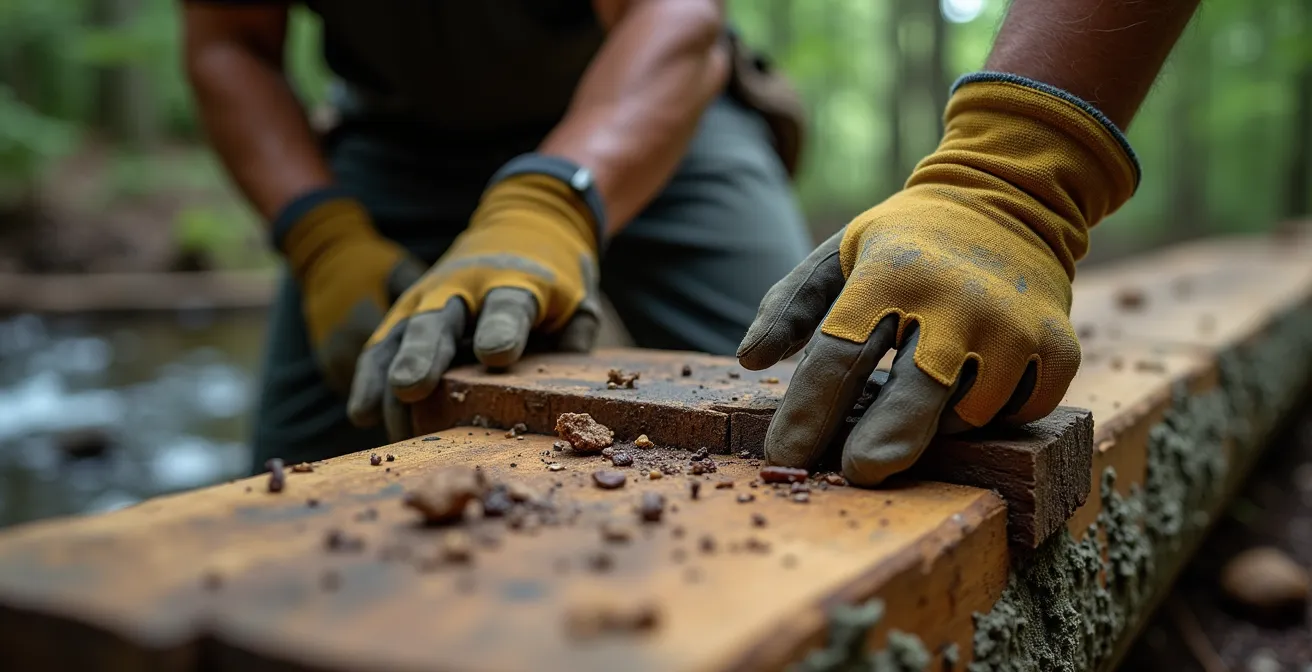
This maintenance work is also a golden opportunity for surveillance. While traveling to remote areas to repair a structure, we are on the lookout. We spot ATV tracks where they shouldn’t be, illegal camps, signs of poaching. This shadow work is doubly useful: it ensures user safety and allows us to maintain a presence and control over our entire territory. Power, here, is leaving a positive mark through our work while erasing those left by offenders.
This little-known aspect of our profession is nonetheless fundamental to ensuring both public safety and territorial surveillance.
Aerial inventory: how do rangers count moose from a helicopter?
Managing wildlife isn’t a matter of opinion; it’s a science. And to make informed decisions on hunting quotas, we need reliable data. That’s where aerial inventories come in. Climbing into a helicopter to count moose might seem exciting, but it is extremely technical and demanding work. We fly at low altitude, following a precise grid, in often difficult conditions. Concentration must be at its peak. We don’t just count; we classify: males, females, calves. We note their apparent state of health. It is field biologist work.
This data is the cornerstone of population management. It allows us to see trends, identify overpopulated zones or, conversely, sectors in trouble. It is thanks to these numbers that we can scientifically justify hunting plans. Without them, we would be flying blind. It’s an enormous responsibility, as a poor assessment can have disastrous consequences on the ecosystem’s balance. It’s an immense power: that of basing harvesting policies on facts, rather than on pressures or perceptions.
According to the ministry, the moose appeared to be infested with a parasite, Parelaphostrongylus tenuis, commonly known as brain worm. The presence of this parasite in moose can be fatal. The first symptoms associated with infestation are disorientation and a decrease, or even loss, of wariness toward humans.
– La Voix du Sud
These inventories also allow us to spot problems, such as visibly sick animals, as mentioned in this testimony. A disoriented moose can be a danger to itself and to humans. This information is vital. It also helps us understand the scale of poaching. When our numbers don’t match what we should be observing, it sets off alarms. And when you know that wildlife offenses can represent colossal sums, as evidenced by a ministry report stating more than $2.6 million in fines over one year, you understand the importance of every data point collected.
This overview is a strategic power that guides our conservation and enforcement actions for years to come.
Wildlife Reserve or National Park: what difference does it make for your harvesting activities?
One of the greatest sources of confusion for users—and of infractions—is the difference between territorial statuses. National park, wildlife reserve, ZEC (Controlled Harvesting Zone)… These aren’t just different names on a map. Each status comes with its own set of rules, and ignoring them can be very costly. Our power here is to apply these regulations to the letter, and the law shows no mercy for those who plead ignorance. In a Quebec National Park, the mission is conservation. Harvesting (hunting, fishing) is generally prohibited there, except for very specific exceptions.
In a wildlife reserve, the mission is twofold: conservation and development of wildlife. Hunting and fishing are central activities there, managed by SEPAQ, with precise terms. In a ZEC, management is delegated to a local association. Rules can vary even further. The citizen has the responsibility to know where they are stepping and which rules apply. “I didn’t know” is never an acceptable defense.
This distinction has a direct impact on our intervention powers. For example, vehicle search powers are often more extensive in a wildlife reserve or a ZEC, where harvesting activities are the norm, than in a national park. Sanctions also vary. An offense committed in a particularly sensitive wildlife habitat can lead to higher fines. Our job is to know these subtleties inside out to apply the right law in the right place.
The table below, based on data compiled by specialized media, illustrates how sanctions can vary. This is not an exhaustive list, but a good overview of the possible consequences, as reported following an analysis of legislative changes regarding poaching.
| Type of Offense | National Park | Wildlife Reserve | ZEC |
|---|---|---|---|
| Fishing without a valid license | $500 to $1,500 (harvesting prohibited) | $500 to $1,500 | $500 to $1,500 |
| Exceeding catch limit | Not applicable | $500 to $1,500 | $500 to $1,500 |
| Certificate suspension | 24 months minimum | 24 months | 24 months |
| Vehicle search powers | Limited | Extended | Extended |
The rigorous application of these distinct regulations constitutes a pillar of our authority and our protection mission.
Extreme preservation zone: why are some sectors off-limits to humans?
There are places on our territories where even we set foot only sparingly. These are extreme preservation zones, or sanctuaries. These are not prohibitions for the sake of it. They are decisions based on science. These zones may house a species in a precarious situation, be an essential breeding ground like a spawning site, or simply an ecosystem too fragile to withstand any human passage. Prohibiting access is the tool for absolute protection. Our power here is to make these invisible boundaries into impassable walls.
Any intrusion into these zones is considered a serious offense. There is zero tolerance. No matter the excuse. This is where the full force of the law comes down. We are no longer talking about a simple ticket, but judicial proceedings that can lead to fines of several thousand dollars, the seizure of all equipment (vehicle, boat, weapons), and the suspension of hunter and angler certificates. For poachers targeting these zones, it’s the jackpot, because the animals there are less wary. For us, it’s a declaration of war.
Case Study: Operation Chameleon
A striking example of our determination to protect these zones is Operation Chameleon, which targeted the commercial poaching of sturgeon in Mauricie. After more than 8,000 hours of surveillance, the operation resulted in exemplary convictions. The most significant point: for the first time in Quebec, commercial fishing licenses were suspended for periods up to 3 years. Touching an offender’s right to work is a show of force that speaks volumes about the seriousness of the issue.
The results of such operations are deterrents. In the case of Operation Chameleon, we are talking about more than $190,000 in fines and 278 kg of sturgeon seized. These figures show that the power of officers goes far beyond a simple reprimand. It is about dismantling criminal operations that threaten the very survival of certain species. Respecting these forbidden zones is not negotiable; it is the foundation of long-term preservation.
Our ability to impose severe sanctions is the guarantor of protecting these critical habitats for future generations.
Key Takeaways
- A wildlife officer’s power goes far beyond fines; it rests on investigation, strategy, and knowledge of the terrain.
- Each type of territory (park, reserve, ZEC) has distinct rules that every user must know to avoid heavy sanctions.
- Wildlife protection is a 360-degree job, including night surveillance, human management, physical trail maintenance, and scientific data collection.
How to explore the Quebec wilderness without disturbing the fragile balance of biodiversity?
After everything I’ve just told you, you understand that our work is a constant battle to maintain a fragile balance. But we cannot be everywhere at all times. The truth is that the greatest power for wildlife protection doesn’t lie in our hands, but in the hands of every citizen who steps into the forest. The vast majority of people are respectful, but it is the actions of a minority that cause the most damage. Respecting the territory is not an option; it is a duty.
Exploring the territory responsibly starts with simple actions: take back all your trash, don’t build fires just anywhere, stay on marked trails, and above all, keep your distance from wildlife. An animal accustomed to humans is an animal in danger. It also means knowing and respecting regulations. Before you leave, get informed. The SEPAQ website, visitor centers, ZEC associations: the information is available. Ignorance, as I said, is not an excuse.
Your most active role is being our eyes and ears. The fight against poaching is everyone’s business. If you witness a suspicious act, your report could be the starting point of a major investigation. The S.O.S. Braconnage program is a powerful tool, but it only works if citizens use it correctly. A good report is factual, precise, and fast. This is your most direct contribution to our “field war.”
Your citizen action plan: reporting an act of poaching
- Don’t touch anything: When discovering acts of poaching, do not contaminate the scene to preserve evidence.
- Note the coordinates: Record the precise GPS coordinates of the location or describe it as accurately as possible.
- Document vehicles: Discreetly photograph the license plates of suspicious vehicles if you can do so safely.
- Stay factual: Describe what you observe (nature of the offense, time, description of individuals) without interpreting.
- Call immediately: Contact S.O.S. Braconnage at 1-800-463-2191. Speed is crucial.
In the end, the protection of our natural heritage is a shared responsibility. Explore, enjoy, but do so with the intelligence and respect that the wilderness commands. It is the only way to ensure that future generations can also marvel at its richness.