
In summary:
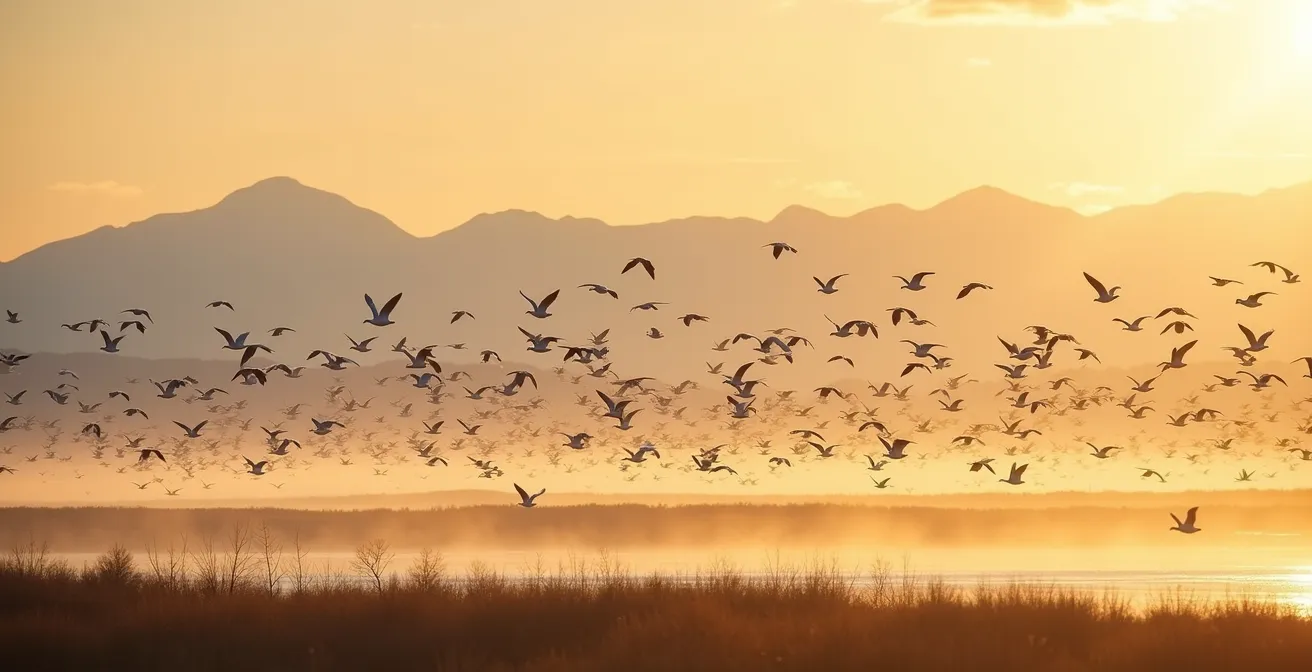
- The best observation periods are spring (April-May) and autumn (October), during the two major migrations.
- To avoid the crowds at Cap-Tourmente, explore the rest areas and fields along the South Shore of the St. Lawrence, particularly around Saint-Vallier and Baie-du-Febvre.
- The secret is to follow the tides: geese feed in the mudflats at low tide and move closer to the banks at high tide.
- For memorable photos, prioritize the soft light of dawn and dusk, which coincide with their major movements.
Every spring and autumn, Quebec’s sky comes alive with a natural spectacle that is both auditory and visual: the great Snow Goose migration. The sound of thousands of birds communicating, the brilliant white of their plumage contrasting with the blue of the sky or the colors of autumn—this is an experience that leaves a lasting impression. For many families and amateur photographers, it is an essential annual event, a true celebration of the wild.
Yet, faced with the scale of the phenomenon, one question keeps coming up: how can you turn this observation into a truly successful moment? You have probably been advised to visit the most famous sites like the Cap-Tourmente National Wildlife Area. While these places are magnificent, they are often synonymous with crowds and represent only one facet of the experience. The real secret lies not just in the choice of location, but in a true science of anticipation: understanding bird behavior, the rhythm of the tides, and the whims of light.
This article is not just a list of places. It is a strategic guide to help you read this natural choreography. We will dive into the reasons for this species’ population explosion, reveal how to find exceptional viewpoints off the beaten path, and give you the technical keys to successful photography. Prepare to never look at white geese the same way again.
To guide you through this fascinating phenomenon, this article is structured to answer all your questions, from the most general to the most technical. You will discover not only the basics but also the tips that will make all the difference in the field.
Summary: The complete guide to the white goose migration in Quebec
- Why has the goose population exploded over the last 30 years?
- How to avoid the crowds at Cap-Tourmente while still enjoying the show?
- Snow Goose or Ross’s Goose: which detail allows you to tell them apart for sure?
- The mistake of getting too close, forcing the flock into an energy-intensive takeoff
- Dawn or dusk: which moment offers the most dramatic light on the flocks?
- Christmas Bird Count: why is counting birds at -20°C a crucial scientific tradition?
- How to spot the ideal mudflats for shorebirds at low tide?
- Shutter speed: which settings to freeze a bird in flight without motion blur?
Why has the goose population exploded over the last 30 years?
The grand spectacle of hundreds of thousands of Snow Geese was not always a given. At the beginning of the 20th century, the species was on the brink of extinction, with an estimated population of only 3,000 individuals. The current situation is the result of a remarkable conservation success, though it is not without consequences. Thanks to strict management measures, including the reopening of controlled hunting in 1975 and special conservation measures since 1999, the population has experienced exponential growth.
Today, the numbers are dizzying. The preliminary report for 2024 estimates the Greater Snow Goose population at over 628,000 individuals, a 7% increase from the previous year. The objective of maintaining the population between 500,000 and 750,000 individuals, set by the Canadian Wildlife Service, has thus been met. However, this abundance has a downside: the impact on agricultural land.
As they feed, geese can cause significant damage to grain corn and forage crops. This impact is so significant that compensation paid to farmers rose from $659,502 in 2014 to $1,623,500 in 2018. This demographic explosion, while spectacular for observers, represents a complex wildlife management challenge, seeking a balance between species conservation and the protection of local economic activities.
How to avoid the crowds at Cap-Tourmente while still enjoying the show?
Cap-Tourmente is the name that immediately comes to mind when talking about Snow Geese. This historic site offers complete infrastructure and magnificent landscapes, but its popularity also means high attendance, especially on October weekends. For a more intimate and equally impressive experience, the key is to explore alternatives, notably along the Navigator’s Route (Route 132) on the South Shore of the St. Lawrence River.
This region, from Lévis to Montmagny, is dotted with rest stops, wharves, and agricultural fields that transform into incredible observation posts. The trick is to stay mobile and let the geese guide you. The villages of Saint-Vallier, Berthier-sur-Mer, or Montmagny offer direct access points to the river where thousands of birds gather, often just a few meters from the shore.
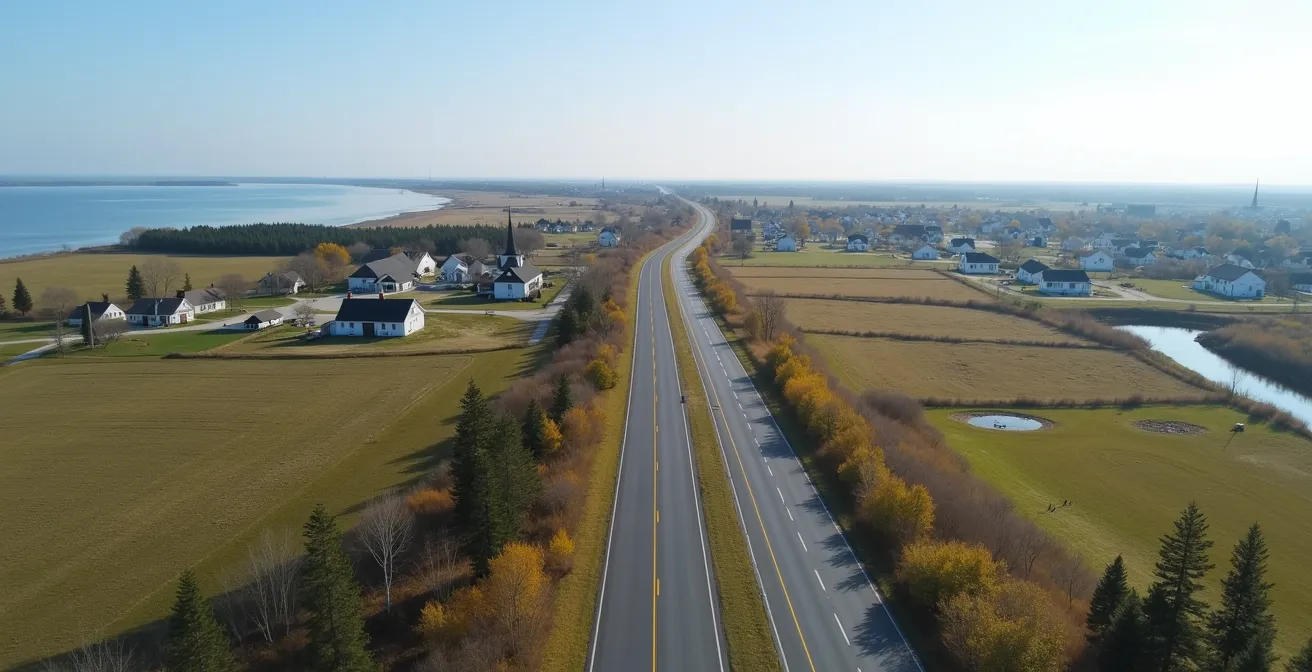
The advantage of these sites is their spontaneous nature and the absence of barriers. You can settle comfortably in your car and enjoy the show in complete peace. To help you plan your next outing, here is a comparison of several sites, including lesser-known but equally spectacular options.
| Site | Best Time | Features | Accessibility |
|---|---|---|---|
| Saint-Vallier | Rising tide | Largest gatherings on the South Shore | Free roadside rest area |
| Baie-du-Febvre | Sunrise (spring) | Up to 500,000 geese in the spring | Route 132, multiple parking lots |
| Beaudet Reservoir (Victoriaville) | October-December | In the heart of the city | Urban, very accessible |
| Cap-Tourmente | Late October | Historic site, developed trails | Paid entry (SÉPAQ rates), full facilities |
Snow Goose or Ross’s Goose: which detail allows you to tell them apart for sure?
In the middle of a field covered with tens of thousands of white dots, a fun challenge for the keen eye is to try to distinguish the Greater Snow Goose from its much rarer cousin, the Ross’s Goose. Although very similar from a distance, one morphological detail allows you to identify them with certainty, even without being an expert. It all comes down to the beak.
The Greater Snow Goose has a robust and relatively long beak. Its most distinctive feature is the presence of black lamellae on the sides of the mandible, forming a dark line that birdwatchers affectionately call the “grin patch” or “smile.” This adaptation allows it to filter mud to extract the roots and rhizomes it feeds on. The Ross’s Goose, on the other hand, is smaller and has a shorter, triangular, and more delicate beak, lacking this marked “grin patch.”
Spotting a Ross’s Goose in the middle of a group of Snow Geese is a true little treasure for an observer, as it is much less common in Quebec. As Birds Canada mentions in its report on the Christmas Bird Count, the sighting of a single Ross’s Goose is a noteworthy event. The next time you observe a group, take the time to scan the beaks with your binoculars; you might make a surprising discovery.
An impressive count of 73,846 Snow Geese was reported in Saint-Jean-sur-le-Richelieu, Quebec, but the sighting of a solitary Ross’s Goose at the St. Clair National Wildlife Area in Ontario is noteworthy.
– Birds Canada, Christmas Bird Count
The mistake of getting too close, forcing the flock into an energy-intensive takeoff
The desire to get closer for a better photo or simply to admire the birds more closely is natural. However, it is the most common and damaging mistake one can make. A panic takeoff, triggered by an overly intrusive observer or photographer, represents a considerable energy cost for the geese. These birds have just traveled thousands of kilometers and need rest and food to accumulate the reserves necessary for the rest of their journey. Every unnecessary takeoff burns precious calories and increases their stress level.
Respecting their vital space is not just a matter of ethics; it is also the best way to ensure quality observation for everyone. A disturbed group of geese will fly far away, ruining the show for everyone present. Patience is the observer’s greatest virtue. By understanding their tide-related behavior, you will realize that the geese will come to you, not the other way around.
To ensure your presence remains a source of admiration and not disturbance, it is essential to follow a simple but strict code of conduct. Here are the fundamental points to respect for responsible observation.
Your action plan for responsible observation
- Respect private property: Never walk into fields, which are private property and essential pantries for the geese.
- Be patient at rising tide: Stay on the shore or in designated areas. The rising tide will naturally push the birds toward you.
- Take advantage of high tide: This is when the geese are most concentrated near the shore, offering the best opportunities for observation and photography without intrusion.
- Keep your distance: Use binoculars or a telephoto lens. If the birds seem nervous or start raising their heads in alert, you are already too close.
- Think of others: One careless move can ruin the experience for dozens of other enthusiasts. Respect is contagious.
Dawn or dusk: which moment offers the most dramatic light on the flocks?
For a photographer, light is everything. For a family, the spectacle is paramount. Fortunately, in the case of Snow Geese, the most spectacular moments coincide with the most beautiful “light windows” of the day: dawn and dusk. The choice between the two depends on the experience you are looking for.
Dawn is a magical and often quieter time. At the first light of day, the geese that spent the night on the water wake up. The show begins with a concert of honking that intensifies until the great departure. In successive waves, groups take off toward the fields to feed. The low, golden light of the rising sun carves out the birds’ silhouettes, and the morning mist rising from the river adds a mystical and dramatic touch to your shots.
Dusk offers a spectacle of a different nature but just as grand. After a day spent inland, the geese return to the safety of the river to spend the night. This massive return, often synchronized with the last rays of the sun, creates unforgettable scenes. The sky turns shades of pink and orange, and the flocks of geese stand out as black silhouettes, creating powerful graphic compositions. As a Radio-Canada analysis confirms, proximity to water at night is a survival strategy against predators like coyotes or foxes, which guarantees this daily movement.
Christmas Bird Count: why is counting birds at -20°C a crucial scientific tradition?
While goose observation is mainly associated with spring and autumn, interest in birds doesn’t stop with the snow. For the most passionate, winter is the stage for a century-old scientific tradition: the Christmas Bird Count (CBC). Organized by Birds Canada, this participatory science event is one of the oldest and most important in the world. For one day, between December 14 and January 5, thousands of volunteers brave the cold to count every bird they see within a 24 km diameter circle.
It may seem crazy, but this data is invaluable. It allows for tracking the evolution of wintering bird populations, understanding the impact of climate change on their distribution, and quickly detecting worrying declines in certain species. In 2024-2025, for the 125th anniversary of the program, there are no fewer than 481 active count circles in Canada.
The information collected by thousands of volunteer participants constitutes one of the world’s most significant sets of wildlife inventory data. Conservation biologists and naturalists use this data daily to assess population trends and bird distribution.
– Birds Canada, Christmas Bird Count Program
Participation is free and open to everyone, even beginners. It is an excellent way to extend your passion for ornithology through the winter, learn to identify local species, and contribute concretely to science. Local birding clubs often organize these events and warmly welcome new participants.
How to spot the ideal mudflats for shorebirds at low tide?
The secret to predicting where Snow Geese will be is not found in an app, but in a tide table. Their lives during the migratory stopover are entirely dictated by the ebb and flow of the St. Lawrence. Understanding this cycle is the key to maximizing your observation chances. The geese’s main pantry is located in the mudflats, also known as tidal flats (battures). This is the area of muddy ground, rich in American bulrush rhizomes, that is exposed at low tide.
So, it is at low tide that the feast begins. The geese leave the safety of the water to move onto these mudflats and feed actively. This is a fascinating moment, but often distant for the observer. The real opportunity arises with the rising tide. As the water covers the flats, the geese are forced to retreat progressively toward the shore. It is a slow procession that brings them, without stress, within a few meters of the bank.
Finally, at high tide, the mudflats are completely submerged. The geese then gather in dense rafts on the water, very close to the banks, or fly off to nearby fields to continue feeding. This is when they are most concentrated and most easily observable from roadside rest areas. Before any outing, consult the tide tables to plan your arrival. Aim for the end of the rising tide and the beginning of high tide for a guaranteed show.
Points to remember
- The goose migration is a conservation success, but poses agricultural management challenges due to their large numbers.
- Observation is not limited to Cap-Tourmente; the South Shore of the St. Lawrence offers more intimate and free sites.
- Respecting distance is crucial: a forced takeoff exhausts the birds and ruins the experience for everyone.
Shutter speed: which settings to freeze a bird in flight without motion blur?
Photographing a takeoff of thousands of geese is an exhilarating technical challenge. The movement is fast, the light is often low (at dawn or dusk), and the action is unpredictable. For the amateur photographer, obtaining a sharp image of a bird in mid-flight is the ultimate goal. It all starts with one crucial setting: shutter speed.
Snow Geese are athletes of the sky. They can fly at an average speed of 55 km/h and reach peaks of over 95 km/h by taking advantage of the winds. To freeze such rapid movement, and especially the beating of their wings, a high shutter speed is non-negotiable. Aim for an absolute minimum of 1/1250s. If the light allows, don’t hesitate to go up to 1/1600s or even 1/2000s to guarantee perfect sharpness.
To reach such speeds in low-light conditions, you will need to make compromises:
- Open your aperture to the maximum (the smallest f/ value, e.g., f/4 or f/5.6) to let in as much light as possible.
- Increase ISO sensitivity. Don’t be afraid to go up to ISO 3200 or 6400. Modern cameras handle digital noise very well, and a sharp photo with a little grain is always better than a blurry photo.
- Use Shutter Priority mode (S or Tv) to control the speed and let the camera handle the aperture, or switch to Manual mode with Auto ISO.
- Activate continuous focus (AF-C or AI Servo) with subject tracking so your camera follows the bird in motion.
- Shoot in high-speed burst mode to increase your chances of capturing the perfect moment of takeoff or the ideal V-formation.
The Snow Goose migration is much more than just a movement of birds; it is an ecosystem in motion, a lesson in survival, and an infinite source of wonder. By applying these tips, you will move from being a simple spectator to an informed and respectful observer. All that’s left is to pack your binoculars, charge your camera, and choose your observation point to experience this magical moment. To start your adventure, the simplest way is to begin by exploring the lesser-known sites that are just as rich in discovery. The road awaits you.
Frequently asked questions about Snow Goose observation in Quebec
What is the difference between the Greater Snow Goose and the White Goose?
There is none. “White Goose” (Oie blanche) is the common name used in Quebec to refer to the Greater Snow Goose (Anser caerulescens atlanticus). Both terms refer to the same spectacular bird observed during migration.
Are the geese present in Quebec all year round?
No, the Snow Geese are only passing through. They nest in the Canadian Arctic during the summer and winter on the American East Coast. Quebec is their main migratory stopover in the spring (April-May) and autumn (October-November), where they stop to rest and feed.
Do you have to pay to observe the geese?
It depends on the site. Places like the Cap-Tourmente National Wildlife Area have entry fees that go toward infrastructure maintenance. However, many sites, particularly along Route 132 on the South Shore (Saint-Vallier, Montmagny) or at Baie-du-Febvre, are entirely free and accessible from roadside rest areas or public parking lots.