
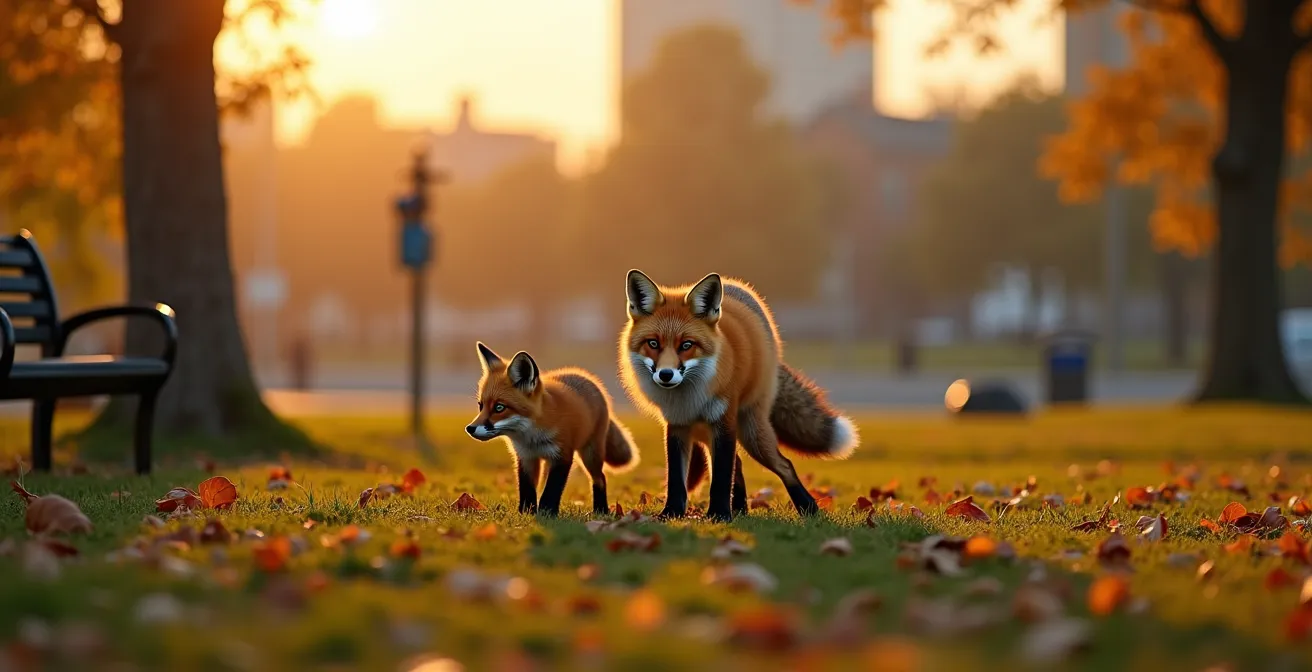
The increased presence of foxes in the city is not an invasion, but a sign of successful cohabitation and adapting wildlife.
- The fox successfully exploits the ecological niche offered by our cities, becoming an effective regulator of rodents.
- Risks, such as rabies, are statistically very low and well-managed, making cohabitation safe if best practices are followed.
Recommendation: Understanding its behavior is the first step in transforming concern into an informed appreciation of this fascinating neighbor.
A flash of red crossing a street at dusk in Rosemont, a slender silhouette slipping between trash cans in Limoilou… If you live in Montreal or Quebec City, this scene is likely becoming increasingly familiar. The presence of the red fox in urban and peri-urban environments is no longer an exceptional event, but a daily reality for many citizens. This appearance naturally raises questions and sometimes concerns: are they dangerous? What are they looking for so far from the forest? Should we be wary of them for our pets or urban chickens?
Faced with this phenomenon, the first reflex is often to think in terms of a problem: an “invasion” due to the destruction of their natural habitat, a potential source of diseases like rabies, or a nuisance for our gardens. These concerns are legitimate, but they only tell part of the story. What if this presence wasn’t a symptom of nature in distress, but rather proof of a fascinating capacity for adaptation? What if the fox, far from being a simple intruder, was becoming a true city dweller, finding its urban ecological niche at the heart of our peri-urban ecosystem?
This article invites you to change your perspective. As urban biologists, our goal is to decode the behavior of this new inhabitant to foster intelligent cohabitation. We will see how its incredible hunting skills are expressed even under the snow of our winters, we will demystify the real health risks, and we will provide practical advice for living in harmony with this neighbor that is as discreet as it is surprising. Because understanding the fox is the first step toward accepting it no longer as a problem, but as an essential link in our cities’ biodiversity.
To better understand this fascinating neighbor, we will explore the different facets of its life in the city, from its biology to our interactions with it. This guide will give you the keys to a serene and informed cohabitation.
Summary: Understanding the Fox, This New Urban Neighbor
- Silver, cross, or red: why do foxes from the same litter have different colors?
- Mousing: how does the fox manage to locate a mouse under 30 cm of snow?
- Fox or raccoon: which animal poses the greatest risk of transmitting rabies in the city?
- The mistake of picking up a lone fox kit thinking it is abandoned
- Buried mesh: how to protect your urban chickens against this expert digger?
- Why do some Canada geese no longer migrate south in winter?
- Why is the leptospirosis vaccine crucial if you live near a wooded area?
- What are the mandatory and recommended vaccines for a dog in Quebec?
Silver, cross, or red: why do foxes from the same litter have different colors?
One of the first things that surprises people when observing foxes is the variety of their coats. While the “red fox” (Vulpes vulpes) is aptly named, it is not uncommon to come across individuals with almost black, silver-gray fur, or a mixture of these shades. This diversity is not a sign of different species, but rather a genetic variation within the same species. In reality, it is all a matter of recessive genes. Red coloration is the most common because it is dominant. Other colorations are the result of the expression of rarer genes.
Three main color morphs are distinguished:
- The red fox: the most frequent coloration, with its orange coat, black legs, and white-tipped tail.
- The silver fox: entirely black or dark gray with silver-tipped hairs, giving it a frosted appearance. This color is due to a recessive gene.
- The cross fox: it presents intermediate pigmentation, often with a dark band along the back and another across the shoulders, forming a cross. This coloration is particularly present in Canada, where it represents between 20% and 44% of the red fox population depending on the region.
The most fascinating part is that this variation can appear within a single family. As confirmed by the Government of Quebec, this genetic diversity is entirely natural.
The fur of the red fox can have three possible colorations: red, cross, and silver foxes are found. All these colorations can be observed within the same litter.
– Government of Quebec, Ministry of the Environment, Climate Change, Wildlife and Parks
Thus, when you see a fox with a dark coat, it is not an exotic visitor, but an expression of the rich genetic diversity of our local red fox populations. This variety testifies to the good health and genetic mixing of the species in our territory.
Mousing: how does the fox manage to locate a mouse under 30 cm of snow?
The Quebec winter, with its thick blanket of snow, may seem like an insurmountable challenge for a predator that feeds mainly on small rodents. Yet, this is where the fox deploys one of its most spectacular and effective hunting techniques: mousing (or *mulotage*). This method is a ballet of precision that relies on exceptionally fine hearing and perfect synchronization with the Earth’s magnetic field.
The fox’s secret lies in its ability to create an auditory map of its environment. Its large ears can rotate independently, allowing it to triangulate with redoubtable precision the position of a vole or mouse moving through tunnels under the snow. Studies have shown that foxes can hear small prey moving under more than 3 feet of snow, a remarkable auditory feat. It doesn’t just hear the movement; it perceives the slightest scratches and shifts.
Once the prey is located, the fox performs a characteristic jump, leaping into the air to dive headfirst into the snow. This technique allows it to pierce the layer of compacted snow and surprise its prey. The image is striking and testifies to a perfect adaptation to winter conditions. This is one of the behaviors that allows the fox to thrive in the city, where snow-covered parks and vacant lots become vast pantries.
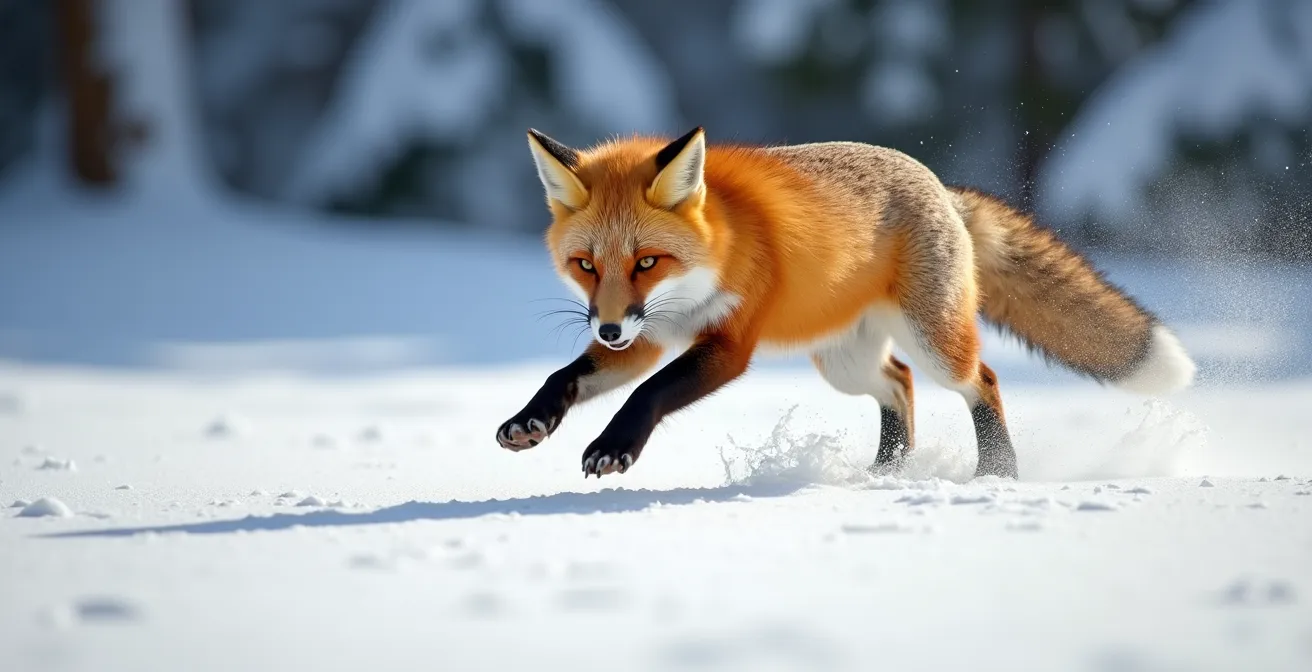
Even more surprisingly, research suggests that the fox may use the Earth’s magnetic field to calibrate its jump. By aligning itself on the north-south axis, it significantly increases its success rate. This sophisticated hunting technique is a perfect example of the fox’s behavioral plasticity, allowing it to exploit food resources year-round, even in the harshest conditions of our urban winters.
Fox or raccoon: which animal poses the greatest risk of transmitting rabies in the city?
The simple mention of the word “rabies” is enough to spark an ancestral fear, and the sight of a fox in the middle of the city can quickly revive this concern. It is therefore essential to put the facts into perspective. In Quebec, while zero risk does not exist, the threat posed by the fox is extremely low, especially compared to other urban wildlife species. Surveillance and vaccination campaigns have been very effective in controlling fox rabies.
Historically, the fox was a vector for rabies, but the situation has changed radically. According to wildlife experts, cases of rabies are extremely rares, notably thanks to vaccination programs using vaccine baits scattered in nature. Today, the main reservoirs of rabies in Quebec are the striped skunk, the bat, and the raccoon. The latter represents the greatest subject of concern in urban areas due to its dense population and frequent interactions with human environments.
The management of this risk is taken very seriously by the authorities, who carry out targeted preventive actions even in the heart of cities.
Case Study: Preventive Management at the Montreal Botanical Garden
An excellent example of managed cohabitation can be found at the Montreal Botanical Garden. The resident pair of foxes, as well as their kits, benefit every year from rabies vaccination campaigns. This operation, led by the City of Montreal in collaboration with the Ministry of Forests, Wildlife and Parks, shows that it is possible to maintain a healthy fox population in an urban environment while virtually eliminating the risk to the public and domestic animals.
The golden rule remains the same for all wildlife: never approach or feed animals. A healthy fox is naturally shy and will avoid contact. An animal that seems disoriented, abnormally aggressive, or docile should be reported to local authorities (animal control or wildlife officers), as it could be sick. But systematically associating the fox with rabies is an outdated idea that does not reflect current sanitary reality in Quebec.
The mistake of picking up a lone fox kit thinking it is abandoned
In the spring, it is not uncommon to come across a touching but potentially misleading scene: one or more fox kits, alone, appearing lost and vulnerable. The first reflex, dictated by empathy, is often to want to “save” these small creatures by picking them up. However, in the vast majority of cases, this is the worst thing to do. This gesture, though well-intentioned, causes more harm than good and can lead to permanently separating a family.
It is perfectly normal for a mother fox to leave her kits alone for several hours. She goes off to hunt to feed her litter and never stays away for very long. Curious kits may leave the den to explore the surroundings. They are not abandoned; their mother is nearby and watching over them, even if you don’t see her. Intervening risks causing immense stress to the animal and imprinting it with human scent, which could complicate its return to its mother.
The correct behavior to adopt is patience and non-intervention. Observe from a distance and let nature take its course. A fox kit is only in real distress if it is visibly injured, or if it is in a dangerous location (such as the middle of a road) and seems unable to move for many hours. In this situation, do not act alone, but contact professionals. Here is the procedure to follow.
Action Plan: What to do if you find a lone fox kit?
- Do not interfere: Do not attempt to approach, touch, or feed the kit. Observe from a great distance.
- Do not capture or corner: Do not trap it in a corner or in your garden. It must be able to move freely so its mother can find it.
- Let it be: Most often, the mother will come back for her young once you have left. Give her the necessary space and quiet.
- Assess distress (after several hours): If, after a long period of observation (several hours without seeing a parent), the animal seems weak, injured, or is constantly crying, it may be time to act.
- Contact competent authorities: Do not take it home. Call the nearest wildlife shelter or municipal services. In Montreal, contact the SPCA or Sauvetage Animal Rescue; in Quebec City, contact the city’s animal services or the Ministry of Wildlife.
By following this protocol, you give the family every chance to reunite and ensure that only animals truly in distress receive help from qualified professionals. This is the best way to help urban wildlife.
Buried mesh: how to protect your urban chickens against this expert digger?
The rise of urban chicken coops in Montreal and Quebec City is excellent news for food autonomy, but it creates a major point of friction with local wildlife, particularly the fox. For this opportunistic predator, a poorly protected coop is an irresistible self-service restaurant. The fox is not only an agile climber; it is, above all, an expert and persistent digger. A simple fence, even a high one, will never be enough to deter it.
The most common mistake is thinking that the threat only comes from above. In reality, the fox’s main intrusion method is from below. It can dig a tunnel under your fence in minutes. The only truly effective solution is therefore to create an underground barrier. It’s not about building a fortress, but using intelligence against the predator’s instinct. The most proven technique is the L-shaped buried mesh.
The principle is simple: when the fox starts digging at the foot of the fence, it hits a metal barrier. Its instinct pushes it to continue digging downward, but it will be blocked by the horizontal part of the mesh. It will generally give up its effort because it does not have the intelligence to step back and start digging further away. This method is remarkably effective at protecting your poultry.

To set up this protection, follow these steps:
- Choose the right material: Use a robust metal mesh (hardware cloth) with fine mesh, 2.5 cm at most, to also prevent small predators from passing through.
- Dig a trench: Around the entire perimeter of the enclosure, dig a trench about 30 to 40 cm deep.
- Install the mesh: Attach the mesh to the lower part of your fence, run it vertically down into the trench, then bend it 90 degrees outward to form an “L” 30 cm wide at the bottom of the trench.
- Backfill and check: Fill the trench back in. The horizontal return of the mesh is now an underground barrier. Don’t forget to also reinforce the doors and the roof of the coop, as raccoons are excellent climbers and manipulators.
Why do some Canada geese no longer migrate south in winter?
The case of the fox is part of a broader phenomenon of wildlife adapting to our urban environments. Another striking example, observed every winter along the St. Lawrence River, is that of the Canada goose. Once a symbol of the arrival of spring and autumn, many geese have become year-round residents, defying the rigors of the Quebec winter. This wildlife residency is, like for the fox, the result of adaptation to human-created conditions.
Two main factors explain this change in behavior. First, the availability of food. In urban parks and peripheral agricultural fields, geese easily find grass and accessible crop residues, especially during milder winters. Direct feeding by humans, although discouraged, also contributes to keeping them in one territory. Second, and this is the most crucial factor, access to open water. Thanks to the discharge of warmer water from factories and cities, several bodies of water remain ice-free even in the heart of winter. These areas provide them with a safe refuge against land predators like the coyote or the fox.
This sedentarization is not without consequences. It perfectly illustrates the complexity of cohabitation.
Impact of Feeding: When Good Intentions Create Conflict
Citizens feeding geese is a major cause of conflict. The birds associate humans with an easy food source and lose their natural wariness. They become more insistent, even aggressive, and their concentration in large numbers in parks leads to overgrazing of lawns and an accumulation of droppings, creating sanitation issues. This example shows how a human interaction, even a benevolent one, can disrupt the balance of the urban ecosystem.
The story of the resident Canada goose mirrors that of the urban fox. It teaches us that the city is no longer just a habitat for humans, but a complex ecosystem where wildlife develops new strategies to survive and thrive. Our role is to learn to manage these new dynamics to minimize conflict and foster sustainable coexistence.
Why is the leptospirosis vaccine crucial if you live near a wooded area?
The growing presence of foxes, coyotes, or raccoons near our homes should not be seen solely through the lens of risk or nuisance. For a biologist, it is first and foremost a positive indicator. It means that our urban and peri-urban green spaces, such as Montreal’s nature parks or the woods on the outskirts of Quebec City, are healthy and rich enough to support a complex food chain. The presence of a predator like the fox is a sign of ecosystem vitality.
As an urban wildlife expert points out, diversity is key. This dynamic is observed in all major North American metropolises.
The increased presence of foxes is a symptom of a diverse and abundant wildlife population.
– Seth Magle, Urban Wildlife Institute, Chicago
This flourishing biodiversity implies a responsibility for pet owners. Where there is diverse wildlife, there is also the circulation of pathogens. Leptospirosis is a perfect example. It is a bacterial disease transmitted by the urine of infected animals, including rodents, raccoons, and, to a lesser extent, foxes. The bacteria survives in moist soils and stagnant water points (puddles, ponds), places our dogs love to frequent during their walks in the forest or large parks.
If your dog has access to these “natural” areas where wildlife is active, they are directly exposed. The leptospirosis vaccine then becomes not just an option, but an essential precaution. It protects your animal from a potentially serious disease which, moreover, is a zoonosis (transmissible to humans). It is a fundamental act of prevention in the context of informed cohabitation with an increasingly present urban wildlife that paradoxically testifies to the good health of our green cities.
Key Takeaways
- The presence of the fox in the city is primarily a sign of successful adaptation to a new ecosystem, rather than a simple “invasion.”
- Real risks to humans (such as rabies) are statistically very low in Quebec, but caution remains: never feed or approach wild animals.
- Harmonious cohabitation is possible through simple preventive measures, such as protecting chicken coops and appropriate vaccination for our domestic animals.
What are the mandatory and recommended vaccines for a dog in Quebec?
Living near active and diverse urban wildlife, as we see in Montreal and Quebec City, involves assuming our share of responsibility to ensure safe cohabitation. Protecting our own pets is the cornerstone of this. Understanding the vaccination landscape for dogs in Quebec is therefore paramount, as it directly addresses the risks present in our shared environment.
It is important to distinguish between what is “mandatory” and what is “recommended.” In Quebec, no provincial law mandates vaccines. However, almost all municipalities, including Montreal and Quebec City, require rabies vaccination to obtain an annual license for your dog. It is therefore a de facto obligation for every responsible dog owner. This vaccine is the most effective barrier to protect not only your animal but also your family and the community against a fatal disease.
Beyond this municipal obligation, the Order of Quebec Veterinarians (OMVQ) establishes recommendations based on science. “Base” (or *core*) vaccines are those that every dog should receive, regardless of its lifestyle. They protect against serious and widespread diseases:
- Distemper
- Infectious canine Hepatitis
- Parvovirus
- Rabies
Next come “contextual” vaccines, the necessity of which depends on your animal’s lifestyle. This is where the presence of foxes and other wild animals becomes a key factor. For a dog living in an apartment in the city center, the risks are lower. But for a dog that frequents parks, wooded areas, or lives in a suburb with a garden, vaccines against leptospirosis and Lyme disease (transmitted by ticks, which are increasingly present) are strongly recommended by veterinarians. They constitute targeted protection against the real risks of our peri-urban ecosystem.
To ensure harmonious cohabitation and effectively protect your companion, the next logical step is to discuss with your veterinarian. They will be able to assess your animal’s lifestyle and propose a personalized vaccination protocol adapted to the specific risks of your neighborhood.
Frequently Asked Questions about Foxes in Urban Environments
Is the rabies vaccine mandatory in Quebec?
No vaccine is mandatory by provincial law, but the rabies vaccine is almost universally required by municipal bylaws to obtain a dog license.
What are the recommended core vaccines?
The Order of Quebec Veterinarians recommends vaccines against Distemper, Hepatitis, Parvovirus, and Rabies as core vaccines for all dogs.
What additional vaccines are recommended near wooded areas?
Leptospirosis and Lyme disease vaccines are particularly important for dogs living near wooded areas or regularly visiting parks, due to increased exposure to wildlife and ticks.