
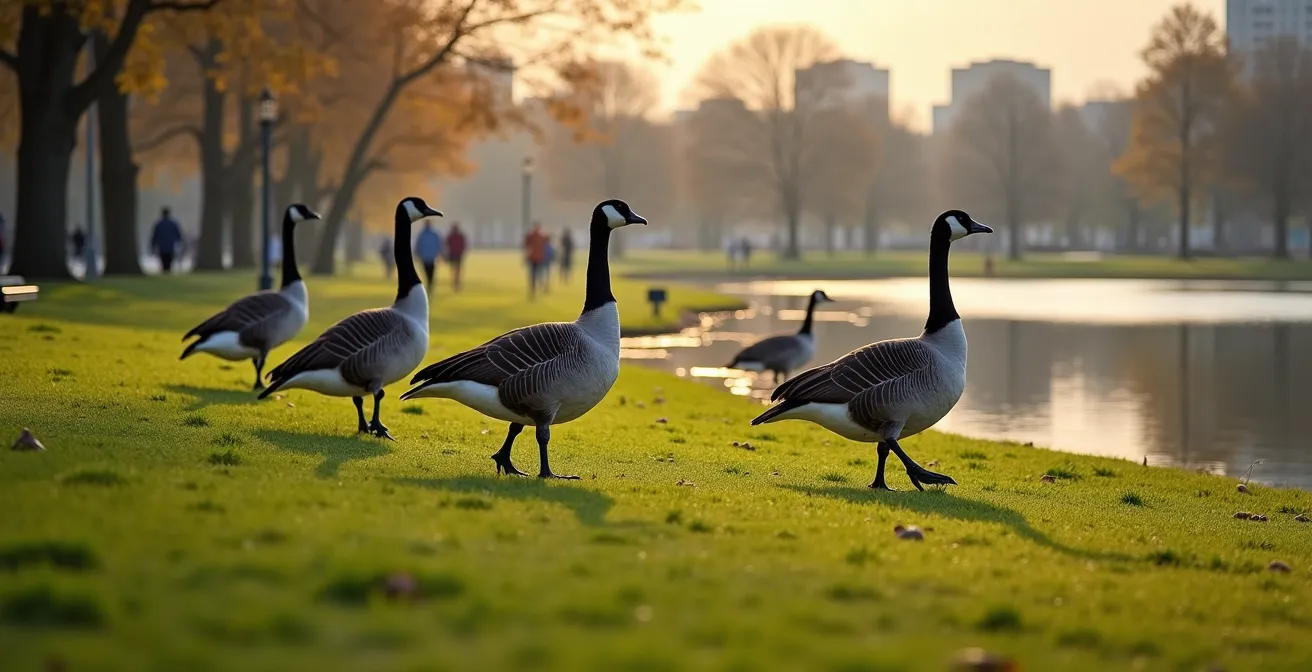
Canada Goose overpopulation in our cities is not an inevitability, but the direct consequence of environments we have made too welcoming for them.
- The heart of the problem lies in the emergence of “resident” goose populations that no longer migrate, following past reintroduction programs.
- The most sustainable solution is not temporary scaring tactics, but habitat modification to make it less attractive (tall vegetation, visual barriers).
Recommendation: Focus your efforts on long-term ecological modifications of your land to reduce its appeal and manage the population in an ethical and sustainable manner.
The image is familiar to any park manager, golf course operator, or citizen in Canada: lush green lawns dotted not only with majestic Canada geese but also with their countless droppings. The harsh sound of their calls has replaced the songs of more discreet birds, and the nesting period transforms a quiet stroll into an obstacle course where one must avoid overprotective parents. Faced with this situation, the first instinct is often to look for ways to “chase” them away, to frighten them to regain some peace. We talk about horns, reflective tape, and various repellents, often with mixed and temporary success.
However, these approaches only address the symptoms of a much deeper phenomenon. What if the problem wasn’t the goose itself, but the way we have unintentionally designed our parks, shorelines, and golf courses to be paradises for them? The true key to managing this forced coexistence lies not in a constant battle against the bird, but in understanding its behavior and strategically modifying this “unintentional hospitality” we offer. Thinking from the goose’s perspective is the first step toward solutions that work in the long term.
This article proposes a pragmatic approach for land managers and anyone facing this overpopulation. We will first break down why so many geese have stopped migrating, then analyze real behaviors and risks, and finally explore proven management strategies, focusing on ecological levers rather than makeshift solutions.
Summary: Managing the Problem of Urban Canada Geese in Canada
- Why do some Canada geese no longer migrate south in winter?
- How to react when a goose hisses and charges to protect its nest?
- Trained dogs or lasers: which ethical method really works to keep them away?
- The mistake of letting children play in grass soiled by goose droppings
- The mown grass problem: how tall vegetation naturally discourages geese from settling?
- The mistake of relying solely on color instead of silhouette and behavior
- Buried fencing: how to protect your urban chickens against this expert digger?
- Music and parties: how to manage rowdy campers without ruining the family atmosphere?
Why do some Canada geese no longer migrate south in winter?
The sight of Canada geese flying in V-formation toward milder skies is a classic image that increasingly fails to match the reality of many regions in Canada. The heart of the current nuisance problem does not come from traditional migratory populations, but from the establishment of so-called “resident” populations. As ornithologist Jacques Sirois summarizes, “The problem now is that the geese have become residents.” They are born, live, and reproduce in our temperate regions without ever undertaking the long journey south.
This situation is not a matter of chance, but of historical human intervention. From the 1930s until the 1980s, several programs were implemented to reintroduce the goose, which was less present at the time, and to boost hunting. Individuals were transplanted from certain American states, notably to southwestern British Columbia. These birds, coming from lineages less inclined to migrate, found an ideal habitat in our agricultural and urban landscapes: abundant food and almost no predators. They flourished and formed sedentary populations.
The consequences are exponential. A striking example is Varennes, Quebec: while there were only two nests counted in 1990, a study revealed that 200 to 300 nests were counted in the same location in 2020. This explosive growth is the driver of most current conflicts, transforming a once-seasonal bird into a permanent and sometimes invasive neighbor.
This distinction between migratory and resident populations is therefore fundamental to any management strategy, as methods and objectives will not be the same.
How to react when a goose hisses and charges to protect its nest?
The scene is a spring classic: a walker gets a little too close to a grassy area and finds themselves face-to-face with a goose that lowers its head, stretches its neck, hisses, and eventually charges. This aggressiveness, while intimidating, is not an act of random malice. It is an extremely powerful territorial defense behavior, triggered by proximity to its nest or goslings. To the goose, you represent a deadly threat to its offspring, and it will use all means to push you away.
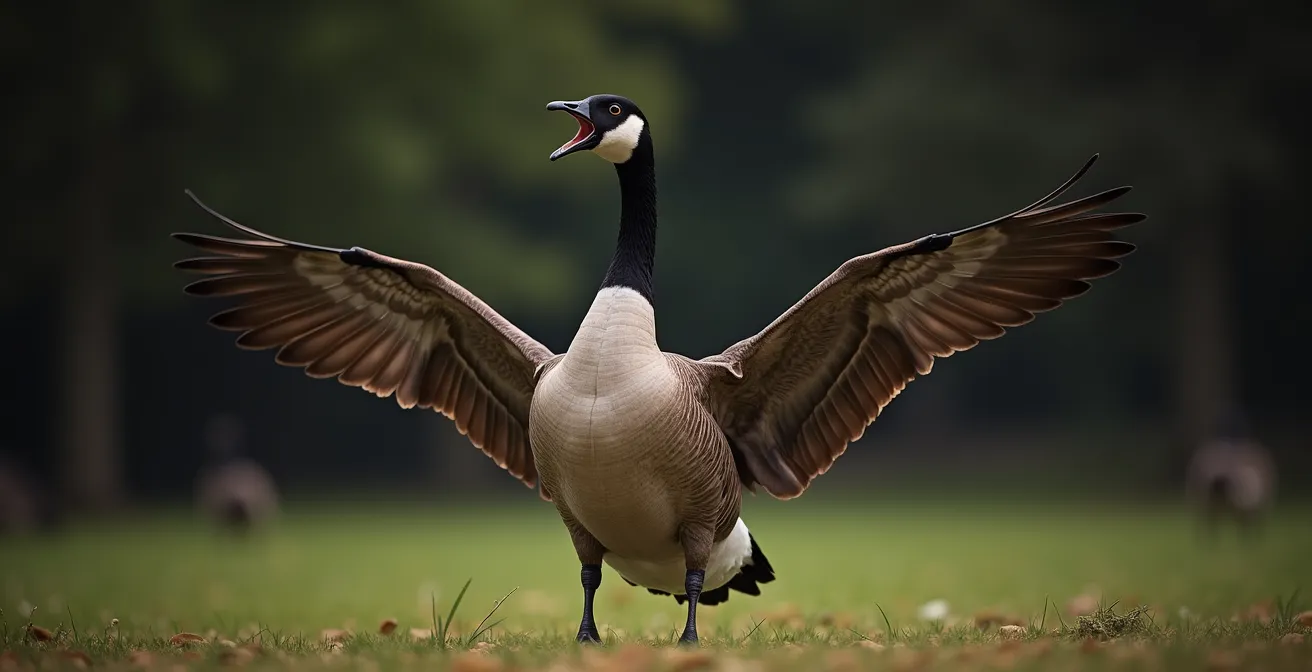
As this typical posture shows, the bird seeks to appear as imposing as possible. Understanding this motivation is the first step in reacting correctly. The goal is not to “win” the confrontation, but to de-escalate the situation by showing that you are not a threat. The Government of Canada recommends several clear actions when facing a defensive goose. The best strategy is always a calm and controlled retreat. Never suddenly turn your back to run, which could encourage a chase. Back away slowly, without direct eye contact, until the bird calms down, indicating you have left its safety zone.
If a charge is inevitable and you are near a building, quickly going up stairs is an effective escape. Generally, prevention is the best approach. Learn to spot nesting areas (often near water with good visibility) and keep your distance, especially in the spring. It is also crucial to never feed Canada geese, as this decreases their fear of humans and can reinforce territorial aggression by encouraging them to settle permanently.
Finally, if a nest is located in an unavoidable passage area and poses a real danger (near a school or hospital entrance), it is advisable to report it to municipal services, such as 311 in many cities, which can evaluate the situation.
Trained dogs or lasers: which ethical method really works to keep them away?
When the mere presence of geese becomes a large-scale management problem, more structured scaring methods are necessary. The goal is not to harm the birds, but to create enough simulated predation pressure to convince them that the site is no longer safe. Two professional approaches stand out for their effectiveness, although their modes of action and constraints differ: the trained herding dog and the green laser.
The trained dog (often a Border Collie) is a very effective method. As the City of Montreal points out in its control program, the idea is that “trained dogs are used to scare geese away, without touching or injuring them.” The dog, under the constant control of its handler, mimics the behavior of a natural predator. It harasses the geese on the ground and in the water, forcing them to take flight and expend energy. Repeated regularly, this action makes the site inhospitable and pushes the geese to seek a quieter location.
The green laser, on the other hand, is a more recent technology. Used at dawn or dusk, the laser’s light point is perceived by the geese as an abnormal and irritating threat. It disrupts their peace and can prompt them to leave. However, its effectiveness may decrease over time as birds can habituate to it. The choice between these methods and other alternatives like remote-controlled vehicles depends on the site, budget, and regulations.
To help managers navigate these options, here is a comparison of the main scaring methods used in Canada, based on information from municipal management programs.
| Method | Effectiveness | Cost | Permit Required |
|---|---|---|---|
| Trained Dog | Very effective in the short term | High (annual contract) | Municipal permit |
| Green Laser | Moderate (rapid habituation) | Medium (equipment + training) | CWS permit possible |
| Remote-Controlled Vehicle | Variable depending on site | Low to Medium | None |
Ultimately, the most effective method is often a combination of approaches, integrated into a global management plan that also includes habitat modifications.
The mistake of letting children play in grass soiled by goose droppings
The most visible and universally criticized nuisance caused by goose overpopulation is the accumulation of their droppings. It is not just an aesthetic problem or a simple mess on shoes. The fundamental error is underestimating the volume produced and the associated health risks, particularly for children. Indeed, a single goose can generate up to one kilogram of excrement per day. Multiply that by a hundred individuals on a park or sports field, and the problem takes on a whole new dimension.
These droppings are vectors for pathogens. They can contain various bacteria, including E. coli and Salmonella, as well as parasites. Children, who play on the ground, put their hands to their mouths, and are more vulnerable, are particularly exposed. A lawn that looks simply “dirty” may actually be a contaminated surface. The risk is even greater near bodies of water, where droppings can be washed away by runoff and contaminate swimming water.
A concrete case illustrates this danger well. In Ottawa, beach water contamination has become a recurring problem. While sewage was once the main source, authorities found that the large goose population had taken over. A study on city beaches showed that droppings accumulate in runoff water, and that areas where water levels are lower are at higher risk of recording high E. coli counts. This has a direct impact on swimming safety and public health.
It is therefore the responsibility of land managers to take this risk seriously, not only through cleaning programs but especially by implementing strategies to reduce the presence of geese on sites most frequented by the public.
The mown grass problem: how tall vegetation naturally discourages geese from settling?
To understand why Canada geese love our parks and golf courses, we have to put ourselves in their place. A vast expanse of freshly mown grass represents the perfect restaurant and security system for them. On one hand, the young shoots of grass are tender and nutritious, an ideal and easily accessible food source. On the other hand, this unobstructed view over hundreds of meters allows them to instantly spot the approach of any potential predator, whether it’s a coyote, an unleashed dog, or a human.
This is where the most powerful and ecological lever for land managers lies: making the habitat inhospitable by breaking this “easy food and maximum security” duo. Letting vegetation grow, particularly along shorelines, is the most effective strategy. A strip of tall vegetation (long grasses, perennials, shrubs) creates a visual barrier. The goose, feeling vulnerable because it is unable to see a predator coming, will hesitate to settle. It will far prefer a site with a clear view that allows it to graze in peace.
Restoring the natural habitat of shorelines, or “shoreline renaturalization,” is the most sustainable solution. This involves replacing the lawn with native plants that not only discourage geese but also improve water quality and promote biodiversity. This approach transforms a management problem into an opportunity for ecological improvement.
Action Plan: Landscaping to Discourage Geese
- Stop frequent mowing: Let the grass grow, especially along bodies of water, to make it less appetizing and create an initial visual barrier.
- Plant strategically: Actively replace lawn with hedges, shrubs, and tall plants to create cover where predators could hide.
- Install physical barriers: A low fence (about 60 cm) or a dense hedge along water access points can be enough to block their path.
- Renaturalize shorelines: Undertake a shoreline restoration project using native plants to recreate a less welcoming natural habitat.
- Use natural “deterrents”: According to biologist Jean-François Gobeil, even the simple act of leaving pine needles on the ground can discourage these birds from landing there.
These modifications, although they require an initial investment, significantly reduce the need for active scaring and offer ecological benefits far beyond goose management alone.
The mistake of relying solely on color instead of silhouette and behavior
In the field of wildlife observation, and particularly birds, a common mistake for the novice is to focus exclusively on plumage color for identification. However, color is often a misleading criterion. It can vary considerably depending on light, shadow, the age of the bird, or even the season. Relying on a “red patch” or a “blue reflection” can lead to many identification errors, especially from a distance.
For large birds like the Canada goose, the most reliable criteria are general silhouette, behavior, and call. The silhouette of the goose, with its characteristic long black neck, black head, and distinctive white “chinstrap,” is recognizable among all others, even in backlight where colors are impossible to distinguish. Its posture, whether grazing grass with its head down or swimming on the water, is also very typical.
Flight behavior is another major clue. The “V” formation is iconic, but even a single individual has a powerful, direct flight with wide, steady wingbeats, very different from the more erratic flight of a Great Blue Heron or the fast, diving flight of a cormorant. Finally, the harsh and loud honking is an infallible auditory marker. Learning to recognize these structural elements is much more effective than looking for shades of brown or gray on the body. It is by combining these clues—silhouette, posture, flight, call—that one achieves certain identification in all circumstances.
This holistic approach not only helps avoid errors but also deepens one’s understanding of the behavior and ecology of each species.
Buried fencing: how to protect your urban chickens against this expert digger?
Raising chickens in urban or peri-urban environments is an increasingly popular activity, but it comes with a crucial responsibility: protection against predators. While aerial threats like hawks are a concern, the most persistent danger often comes from the ground. Predators like foxes, raccoons, or skunks are “expert diggers” capable of bypassing a standard fence by simply going underneath.
The most robust and durable solution against these intruders is the installation of buried wire mesh, often called a “skirt” or “apron.” The principle is simple: it involves preventing the predator from being able to dig at the foot of the fence. To do this, a sturdy fine-mesh metal screen is used (often called “hardware cloth”), ideally 1/2 inch or less to block even the smallest animals.
Installation takes place in two key steps. First, a trench about 20 to 30 centimeters deep is dug all along the outer perimeter of the enclosure or coop. Second, the mesh is attached to the base of the vertical fence, then bent at 90 degrees to form an “L”. This horizontal part of the “L” is laid at the bottom of the trench, extending outward over a width of 30 to 50 centimeters. Once the mesh is in place, the trench is simply refilled with soil. When a predator tries to dig at the base of the fence, it will hit this underground metal barrier and quickly give up.
It is an investment in time and materials that ensures peace of mind and prevents losses that can be as costly as they are discouraging for the amateur breeder.
Key Takeaways
- The Canada goose problem in urban environments stems primarily from “resident” populations that no longer migrate, a legacy of past reintroduction programs.
- The most effective and sustainable solution is not scaring tactics, but habitat modification: reducing mown grass areas and increasing tall vegetation to eliminate their sense of security.
- Health risks associated with the accumulation of droppings are real and documented (bacterial contamination like E. coli), justifying proactive population management in public areas.
Music and parties: how to manage rowdy campers without ruining the family atmosphere?
Managing a campground involves finding a delicate balance between the freedom of some and the peace of others. One of the most common challenges is managing noisy campers, whose loud music or festive gatherings can quickly disrupt the family atmosphere and the rest of other users. Managing this situation requires tact, firmness, and, above all, a clear protocol.
The first line of defense is prevention and communication. Rules regarding noise and curfew hours (usually 11 p.m. to 7 a.m.) must be clearly posted at the entrance, on the website, and given to each camper upon registration. Regular reminders by staff during their rounds can also have a preventive effect. This sets clear expectations and provides a legitimate framework for intervention if necessary.
When a complaint is received or excessive noise is noted, intervention should be gradual. The first approach should be non-confrontational. A staff member approaches the group, greets them cordially, and politely reminds them of the curfew rules. Often, campers don’t realize how far sound carries at night, and this simple intervention is enough. It is crucial to document each intervention: time, location, nature of the noise, and result of the warning. This documentation will be essential if the situation escalates.
If the noise persists after a first warning, a second, firmer intervention is necessary, explaining that the next step will be eviction. If this is still not enough, the protocol must provide for the strict application of the rules, which may include eviction from the campground, potentially with the assistance of security services or local police if campers become hostile. This firmness, applied fairly and consistently, sends a clear message to all campers and protects the peaceful environment that the majority seeks.
To preserve the integrity and reputation of your establishment, the next step consists of formalizing this intervention protocol and training all staff in its calm and professional application.