
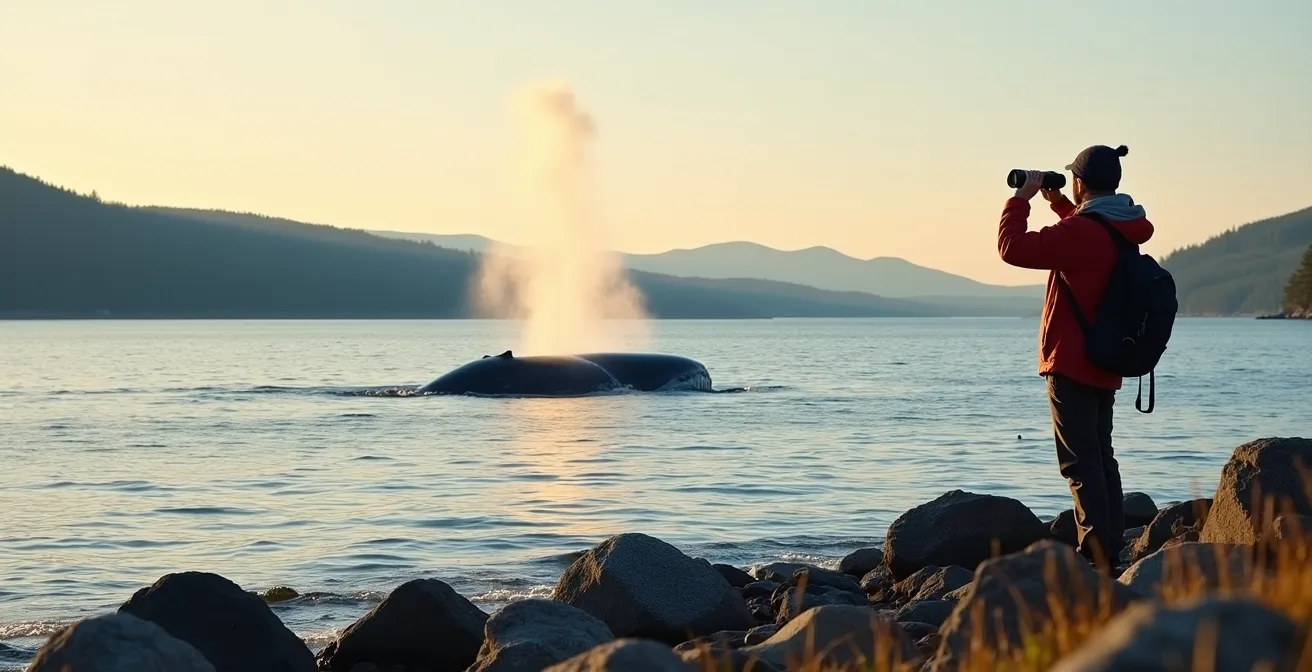
The blue whale paradox is simple: the largest animal in the world is also one of the most elusive, even in the rich St. Lawrence Estuary.
- Its presence is dictated by a single imperative: hunting massive concentrations of krill, making it indifferent to everything else.
- Its diving behaviors and spout, though powerful, are only visible for a few moments, requiring constant attention.
- Its endangered species status and solitary nature drastically limit encounter opportunities.
Recommendation: To hope to spot it, you should not look for the whale, but rather understand and locate its pantry—the upwelling zones where krill abounds.
Aboard a research vessel, you quickly learn humility. Especially when facing a giant that, despite being 30 meters long, chooses to remain invisible most of the time. Every year, enthusiasts from all over the world come to Quebec with a dream: to see a blue whale. Many imagine that simply taking a boat in the right place, in Tadoussac or Gaspésie, is enough for the show to begin. They think its colossal size makes it impossible to miss. It is a mistake that the ocean takes pleasure in correcting.
The truth is more complex and far more fascinating. Observing the blue whale is not a simple matter of luck, but of science and patience. One must learn to read the ocean, to decipher its currents, and to understand that every movement of this animal is dictated by one thing: a ravenous hunger. Its discretion is not a whim, but the direct consequence of its highly specialized feeding ecology. It is not there for tourism; it is there to work, to survive.
But then, if the key is not its size, but its behavior, how can we hope to find it? One must abandon the idea of hunting it and adopt the mindset of a naturalist: understand its environment to anticipate its presence. It is a game of patience where knowledge of the St. Lawrence ecosystem becomes your best asset. This article invites you behind the curtain to understand the mechanisms that make this encounter so rare and precious. We will explore its diet, its visual signatures, the dangers threatening it, and finally, the sanctuaries where your chances are best.
For those who prefer a condensed format, the following video offers a beautiful immersion into the science surrounding these sea giants and the efforts to understand them. It perfectly complements the practical advice in this guide.
To guide you in this fascinating quest, we have structured this article into several key stages. From the St. Lawrence pantry to the subtle clues that betray its presence, each section will give you a piece of the puzzle to understand the discreet giant.
Summary: Understanding and Finding the Blue Whale in the St. Lawrence
- 4 tons of krill: why does the blue whale only come to the St. Lawrence to eat?
- 6-meter column: how to spot the blue whale’s powerful spout on the horizon?
- Maritime traffic: why don’t blue whales avoid merchant ships?
- Blue-grey or black: which color shades prevent confusion with the fin whale?
- North Atlantic: what do we really know about blue whale winter breeding grounds?
- What is the upwelling phenomenon and why does it attract blue whales?
- Why does the depth of the Saguenay Fjord attract large cetaceans?
- Tadoussac or Gaspé: where to go for the best chance of seeing whales?
4 tons of krill: why does the blue whale only come to the St. Lawrence to eat?
The existence of a blue whale is governed by an implacable law: the search for energy. To power its 135 tons, this animal must swallow up to 4 tons of krill per day. This colossal need alone explains its presence in the St. Lawrence Estuary during the summer season. The sea giant does not come for a vacation; it comes to a restaurant. The St. Lawrence is a crucial feeding ground, a true pantry where oceanographic conditions allow for the emergence of massive concentrations of these tiny crustaceans.
Unlike other more opportunistic cetaceans, the blue whale is a hyper-specialist. Its diet consists almost exclusively of krill. It will therefore spend the majority of its time looking for these dense swarms, often at depth, using a spectacular engulfment technique. Once a rich area is located, the whale may stay there for several days, performing repeated dives and only surfacing to breathe. Its behavior is therefore entirely dictated by the krill map, and not by curiosity.
This feeding obsession has a direct consequence for the observer: the whale is unpredictable and often indifferent to its surface environment, including boats. As pointed out by the Mingan Island Cetacean Study (MICS),the St. Lawrence is a region that plays an important role in the feeding of these animals. Understanding this is the first step: you don’t look for a whale, you look for its buffet.
6-meter column: how to spot the blue whale’s powerful spout on the horizon?
On the vastness of the river, the first clue of a whale’s presence is almost always its blow. For the blue whale, this visual signature is particularly spectacular. When it exhales after a dive, it produces a vertical and atomized steam jet that can rise up to 6 meters high, forming a dense, straight column visible for miles on a clear day. This is often the only revealing sign before the animal dives again for long minutes.
The art of observation consists of not confusing it with that of other species. The humpback whale, for example, produces a wider, bushier blow, often heart-shaped, while that of the fin whale is more diffuse and conical. The illustration below highlights these key differences.
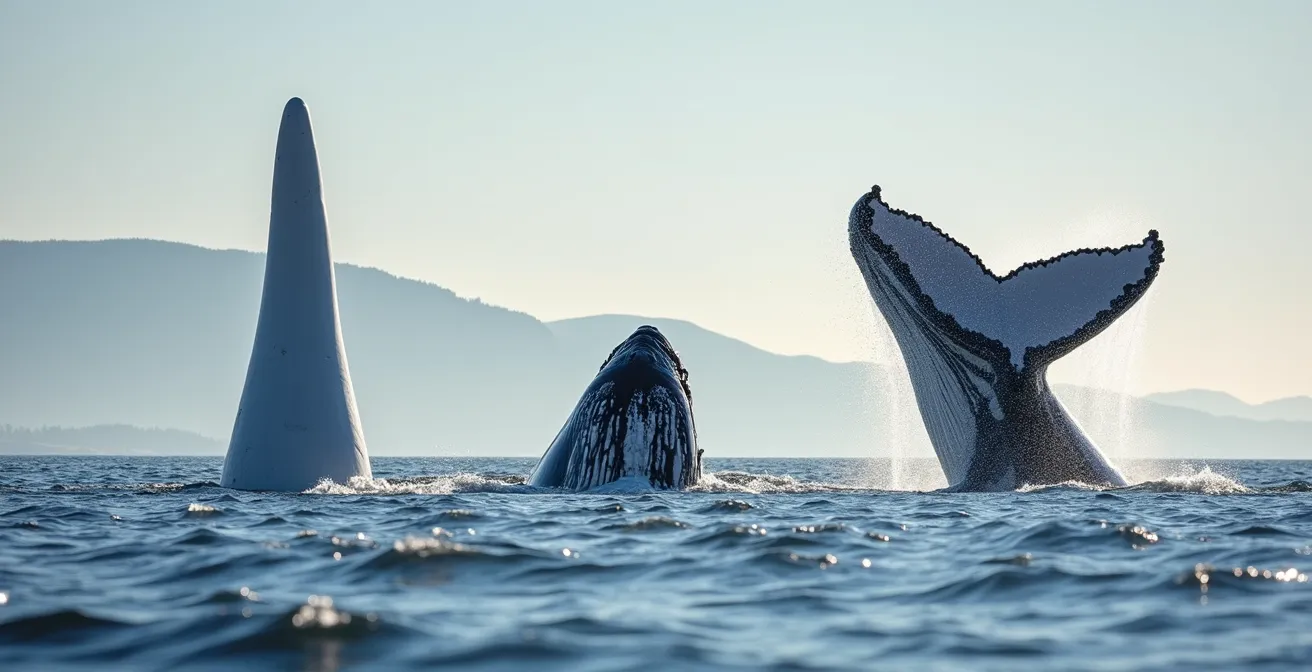
Learning to distinguish these shapes is essential. The window of opportunity is incredibly short. A blue whale can stay underwater for 10 to 20 minutes, or even more, only to surface for a few moments. Spotting this vertical and powerful column requires constant scanning of the horizon, preferably with high-quality binoculars. It is a game of patience where every detail counts.
Your plan for scanning the horizon: spotting the giant’s blow
- Systematically scan the horizon with stabilized binoculars, progressing slowly from left to right so as not to miss any area.
- Identify the distinctive jet of the blue whale: a vertical, powerful, and very thin column, reaching up to 6 meters in height.
- Learn to distinguish it from the wider, heart-shaped “bush” blow characteristic of the humpback whale.
- Do not confuse it with the more diffuse and less impressive jet of the fin whale, its closest cousin.
- Prioritize early morning outings when the sea is calm and the low light makes the water vapor of the spout stand out.
Maritime traffic: why don’t blue whales avoid merchant ships?
It is one of the most tragic paradoxes of the St. Lawrence: how can the largest animal on the planet fall victim to collisions with ships that it should logically detect? The answer lies in its biology and behavior. When a blue whale feeds, it is in a sensory bubble, entirely concentrated on locating and engulfing krill. Its world is dominated by low frequencies and the echoes of its own sonar, not by the noise of surface engines.
Merchant ships, especially the largest ones, produce low-frequency sounds that are not necessarily perceived as a direct threat. The animal may not associate this noise with imminent danger, especially when it is in the middle of a feeding phase. It is not aggressive or reckless; it is simply absorbed by its task of survival. Furthermore, entanglement in ghost fishing gear is another silent threat. The scars on their bodies bear witness: a study conducted by drone revealed that nearly 60% of the blue whales studied showed marks of entanglement.
Faced with this fragile coexistence, measures have been taken to protect these discreet giants.
Case Study: Reducing speed to protect whales
To mitigate the risk of collisions, Transport Canada has implemented crucial measures in the Gulf of St. Lawrence. A mandatory speed limit of 10 knots was established in key areas, particularly during the feeding season. Additionally, the main shipping lane was moved to bypass the most critical feeding areas, demonstrating that maritime spatial planning is possible to promote coexistence between human activities and wildlife.
Blue-grey or black: which color shades prevent confusion with the fin whale?
At a distance, in the changing light of the river, distinguishing a blue whale from a fin whale can be a real challenge, even for a trained eye. Both are immense cetaceans with streamlined bodies. However, several subtle clues allow for differentiation. The most obvious is the color. The blue whale is not actually “blue,” but rather a mottled blue-grey, speckled with lighter spots. This pattern, called “mottling,” is unique to each individual and constitutes its true fingerprint.
The fin whale sports a darker and more uniform grey back, with a striking color asymmetry at the jaw: the right side is white, the left is dark. Other morphological and behavioral clues are crucial, as detailed in the table below, which is based on data provided by local naturalists.
| Characteristic | Blue whale | Fin whale |
|---|---|---|
| Color | Mottled blue-grey with light spots (mottling) | Dark grey, more uniform |
| Dorsal fin position | Very far back, tiny | Larger, more centered |
| Diving behavior | Often shows the tail before diving | Rarely shows the tail in the St. Lawrence |
| Size | 21-30m, up to 135 tons | 18-22m, up to 70 tons |
The mottled pattern of the blue whale is undoubtedly its most distinctive trait once you have the chance to get close. This unique texture is particularly visible when the animal is just below the surface.

North Atlantic: what do we really know about blue whale winter breeding grounds?
While its summer presence in the St. Lawrence is well-documented, a veil of mystery still surrounds the winter life of the North Atlantic blue whale. Where do these giants go to breed and give birth? Unlike humpback whales that gather in the warm waters of the Caribbean, blue whales do not seem to have clearly identified winter “meeting places.” Scientists assume they migrate to more offshore, temperate waters, but the exact locations remain largely unknown. This discretion greatly complicates conservation efforts.
This lack of information is all the more concerning as the population is extremely fragile. Recent estimates suggest that fewer than 200 individuals remain in the Northwest Atlantic population. Every animal counts. The loss of a single individual, whether by collision or entanglement, is a hard blow for the species’ survival. Satellite tracking of a few individuals has provided clues, but the puzzle is far from complete.
The urgency of the situation is reiterated by experts who dedicate their lives to studying these animals. For Richard Sears, biologist and founder of the Mingan Island Cetacean Study (MICS), the attention paid to this species must be an absolute priority:
The blue whale is a species that could be even more threatened than right whales; it deserves as much attention as right whales or belugas.
– Richard Sears, Biologist and founder of MICS
What is the upwelling phenomenon and why does it attract blue whales?
The phenomenon of upwelling is the engine of marine life in the St. Lawrence Estuary and the primary reason blue whales gather there. It is an oceanographic process where winds and currents push surface waters away, allowing deep, cold, and nutrient-rich waters to rise. This mechanism transforms certain areas of the river into an open-air buffet for cetaceans.
The head of the Laurentian Channel, a deep submarine valley extending off Tadoussac, is a particularly powerful upwelling site. Deep waters from the Gulf are forced to rise violently along its steep walls. This injection of nutrients at the surface triggers an explosive chain reaction:
- Cold deep waters rise along the slope of the Laurentian Channel.
- These waters transport essential nutrients (nitrates, phosphates) to the sunlit surface zone.
- These nutrients fertilize phytoplankton (microscopic algae), which proliferate massively (a “bloom”).
- Zooplankton, and especially krill, feed on this phytoplankton, creating gigantic swarms.
- These massive concentrations of krill attract blue whales, which come there to feed.
This is why the Saguenay–St. Lawrence Marine Park is such a hotspot. It contains one of the highest concentrations of krill in the entire Northwest Atlantic, specifically because of this constant upwelling. Searching for the blue whale therefore means searching for these upwelling zones.
Why does the depth of the Saguenay Fjord attract large cetaceans?
The Saguenay Fjord is a geological marvel, an ancient glacial valley invaded by the sea. Its impressive depth, which reaches more than 275 meters in places, creates a unique habitat. However, there is a vital nuance to understand for any whale watcher. While this depth and its cold, salty waters make it a vital habitat for the resident beluga population, it is not where you will find large rorquals like the blue whale.
The main attraction for giants like the blue whale is not the fjord itself, but rather its mouth. This is where the dark, fresh waters of the Saguenay meet the salty, rich waters of the St. Lawrence, creating thermal fronts and currents that concentrate krill. The submarine topography at this precise spot, with the head of the Laurentian Channel nearby, amplifies the upwelling phenomenon and transforms the area into an exceptional pantry.
As Parks Canada experts clarify, a common misconception must be corrected:
While the Fjord is a vital habitat for belugas, large rorquals like the blue whale rarely venture inside. They are instead attracted by the ‘head’ of the Laurentian Channel, just at the mouth.
– Saguenay–St. Lawrence Marine Park, Parks Canada
Key Takeaways
- The quest for the blue whale is primarily a quest for its only food, krill, whose presence is dictated by cold water upwellings.
- Its 6-meter vertical spout is the most reliable visual signature for spotting it, but its fleeting nature requires constant and attentive observation.
- While Tadoussac is a hotspot, the end of summer and the beginning of autumn in Gaspésie or on the North Shore often offer better opportunities for the largest individuals.
Tadoussac or Gaspé: where to go for the best chance of seeing whales?
Choosing the “base camp” to attempt whale watching is a crucial question. The two flagship regions of maritime Quebec, Tadoussac (at the mouth of the Saguenay) and the Gaspé Peninsula (or the North Shore), offer different experiences. Neither guarantees an encounter with a blue whale, but each has its advantages.
Tadoussac is renowned for its high concentration of cetaceans. Thanks to intense upwelling, food is abundant, attracting a great diversity of species, notably belugas (visible year-round), minke whales, and fin whales. It is an excellent choice for a first observation experience because the probability of seeing *whales* is very high in summer. The disadvantage is the higher tourist crowds and a larger number of boats on the water.
The Gaspé Peninsula and the North Shore offer a wilder experience. Whales, including blue whales, are often observed later in the season, from late August to October. The landscapes are grandiose and the boats fewer, which can lead to more intimate observations. However, animals are more dispersed over an immense territory, potentially making the search longer. The following table summarizes key points to help you choose.
Companies that are members of the Eco-Whale Alliance commit to strict rules to minimize disturbance to animals. These rules, in accordance with Canadian regulations, impose an approach distance of 100 meters for most species. For the blue whale, due to its endangered status, this safety distance is increased to 400 meters—a boundary of respect essential for its tranquility.
| Criteria | Tadoussac | Gaspésie/North Shore |
|---|---|---|
| Best period | July-August (families) | Late August-October (blue whales) |
| Advantages | High probability, great diversity, guaranteed belugas | Wild landscapes, fewer boats, larger individuals |
| Disadvantages | More tourists and boats | Whales more dispersed, harder access |
| Approach distance | 100m (400m for blue whale) | 100m (400m for blue whale) |
The quest for the blue whale is above all a lesson in patience and respect. Preparing for your trip by understanding its ecology, choosing the right season and location, and opting for a responsible operator means putting all the chances on your side to experience an encounter that, if it happens, will be etched in your memory forever.