
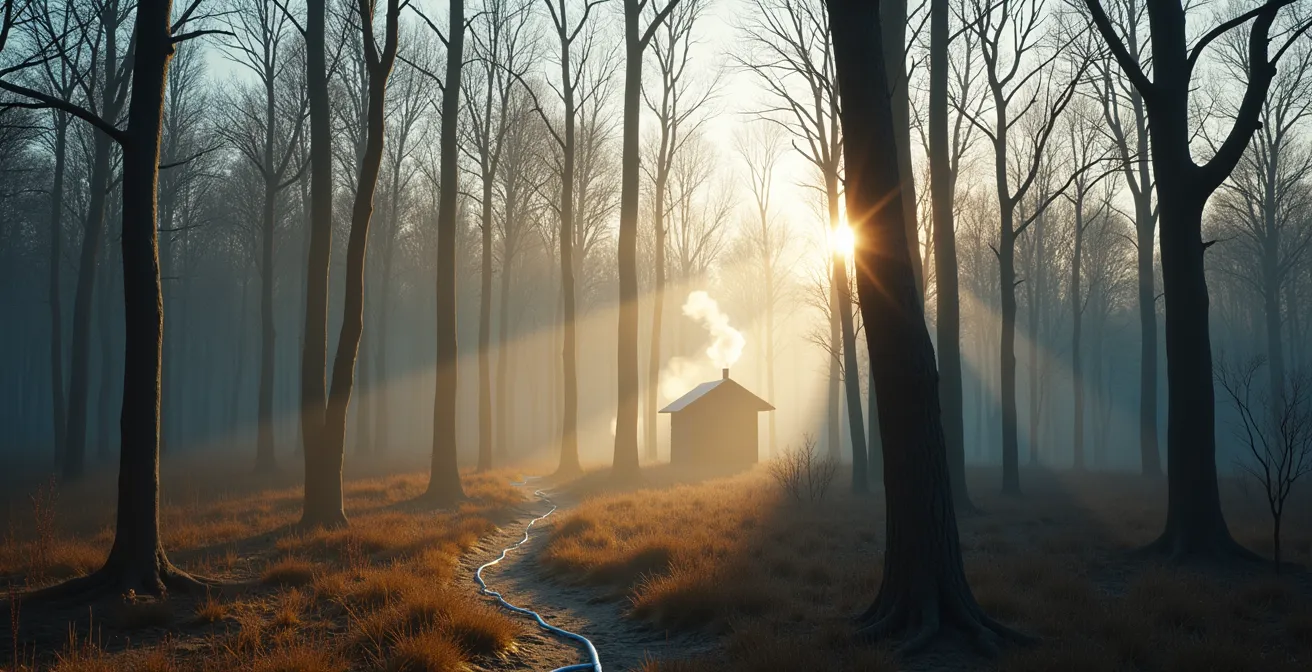
Far from the image of a simple sugar factory, the maple grove is a complex ecosystem where humans are merely partners. This article reveals that maple syrup production is the result of a natural symphony where weather, geology, wildlife, and respectful craftsmanship are intimately linked. Far from being a mere commodity, maple syrup is the expression of a unique forest terroir and a fragile ecological balance that we must understand to better preserve.
The scent of heating maple syrup, the steam escaping from the sugar shack, the sweet taste on the snow… These images are engraved in the collective Quebec imagination. For many, the maple grove is summarized as such: a seasonal factory where maple sap is transformed into liquid gold. We talk about yields, tubing, and evaporators, reducing the forest to a simple production tool. This vision, though pragmatic, misses the essential truth and the best-kept secrets of our woodlands.
But what if the true key was not in mastering the process, but in understanding the silent partnership that links us to the forest? What if the maple grove were not a factory, but an intelligent and vibrant ecosystem, a community of living beings of which we are only guests? From this perspective, maple syrup is no longer a simple manufactured product; it becomes the liquid witness to a much larger story, one of a delicate collaboration between the sky, the earth, the trees, and all their inhabitants.
This article invites you to look beyond the sugar shack. We will explore the maple grove as a living organism, diving into the heart of its biological clock, meeting its other inhabitants, and deciphering how the very ground we walk on shapes the taste of our syrup. It is a journey into the heart of maple ecology to rediscover the true richness of our forests.
To better navigate the secrets of this ecosystem, this article examines the intimate mechanisms that govern life in the maple grove. The summary below will guide you through each facet of this spring symphony.
Summary: Secrets of the Maple Grove Ecosystem
- Freeze and Thaw: Exactly what weather triggers the sap flow in spring?
- Sugar Maple or Red Maple: Which yields the most flavorful syrup?
- Excessive Tapping: How to know if you are exhausting your trees in the long term?
- Yellow-bellied Sapsucker or Squirrel: Who enjoys the sweet sap before humans?
- Climate Change: Why is the sugaring season starting earlier and earlier?
- Yellow Birch or Merisier: How to stop confusing this emblematic Quebec tree?
- Anthocyanins and Carotene: Why does the red maple turn scarlet and not yellow?
- Why is the Laurentian forest considered an open-air geological laboratory?
Freeze and Thaw: Exactly what weather triggers the sap flow in spring?
The sugaring season is not dictated by the calendar, but by a remarkably precise biological clock synchronized with the weather. The flow of maple sap is a purely physical phenomenon that depends on a specific alternation of temperatures. At night, when the thermometer drops below the freezing point, the maple’s branches freeze. This freezing creates suction within the tree’s fibers, which then begins to draw water from the soil through its roots.
Then, during the day, when the sun warms the air and the temperature rises above 0°C, another mechanism kicks in. The wood of the trunk and branches expands, and the gases trapped in the tree’s fibers expand, putting the maple sap under pressure. This sap, loaded with sugars the tree stored during the previous summer, is then pushed down the trunk. It is this perfect cycle of nightly freeze and daily thaw that creates the pressure necessary for the sap to flow from the tap. If it does not freeze enough at night or thaw during the day, the flow stops.
This metabolic window is incredibly short. According to the Maple Syrup Producers of Quebec (PPAQ), annual production in a given maple grove lasts only 20 to 25 days on average. It is a race against time, a fragile ballet between the sun and the frost. As explained in the PPAQ technical guide:
During the day, the temperature warms up and the wood expands. The water trapped in the tree’s rays is subjected to high pressure. This sugary water then descends toward the trunk of the tree and can then flow.
– PPAQ, The stages of maple syrup production – Technical Guide
Understanding this mechanism means realizing that the producer does not “take” the sap from the tree; they only collect the surplus offered by the tree during this unique natural phenomenon.
Sugar Maple or Red Maple: Which yields the most flavorful syrup?
At the heart of our Quebec forests, several maple species coexist, but two primarily capture attention for syrup: the Sugar Maple (Acer saccharum) and its cousin, the Red Maple (Acer rubrum). While both can be tapped, the sugar maple is the undisputed king of the maple grove for one simple reason: the sugar concentration of its sap. Sugar maple sap contains an average of 2 to 3% sucrose, whereas red maple sap usually fluctuates between 1.5 and 2%.
This difference may seem minimal, but it has a huge impact on yield. To obtain maple syrup with a 66% sugar concentration (the legal standard, or 66 degrees Brix), it takes an average of 40 liters of sugar maple sap. With less sugary red maple sap, it would take significantly more, meaning more boiling time and more fuel. This is why the sugar maple is preferred for commercial production.
But the difference doesn’t stop at sugar. The flavor profile also varies. Red maple syrup tends to be more robust, almost caramelized, and its flow season is often shorter. The sugar maple offers a more delicate and complex palette of flavors that evolve throughout the season. Furthermore, its richness is not limited to taste; it contains hidden treasures for science.
Case Study: Quebecol, the miracle molecule of syrup
A team of researchers from Laval University, led by researcher Navindra Seeram, made a fascinating discovery: maple syrup contains a molecule with powerful anti-inflammatory properties, named quebecol in honor of Quebec. This molecule, which does not exist in the raw sap but forms during the heating process, could pave the way for new treatments for diseases like arthritis. This research, which allowed for the synthesis of quebecol in the laboratory, demonstrates that maple syrup is much more than just sugar; it is a complex functional food, a true concentrate of forest chemistry.
This distinction between trees reminds us that syrup is primarily an expression of biology. Each species brings its own signature, and the dominance of the sugar maple in our groves is not a coincidence, but the result of a pragmatic selection that maximizes the efficiency of this gift of nature.
Excessive Tapping: How to know if you are exhausting your trees in the long term?
The partnership between the syrup producer and the forest is based on a fundamental principle: respect for the health and longevity of the tree. Wise tapping is a sustainable tradition, but aggressive harvesting can weaken or even kill the maples that nourish us. The key is never to take more than what the tree can offer without compromising its vigor. Fortunately, clear rules derived from decades of research and practice guide us.
The first rule is patience. A maple should never be tapped before reaching sufficient maturity. The recognized standard is that sap should never be harvested from a maple whose trunk is less than 20 cm in diameter at breast height. Tapping a young tree is to mortgage its growth and its future capacity to produce. The number of taps is also crucial: a single tap for trees 20 to 39 cm, two for those 40 to 59 cm, and a maximum of three for giants 60 cm and larger. Exceeding this quota means creating too many wounds and preventing the tree from properly compartmentalizing its injuries.
Observation is the producer’s best tool. A healthy trunk shows well-closed past tap scars, forming neat vertical lines. If old wounds are wide, swollen, or show signs of rot, it is a signal that the tree is struggling and needs rest. Choosing the location of a new tap is also an art: always at a distance from old scars, in healthy wood, to allow for optimal healing.
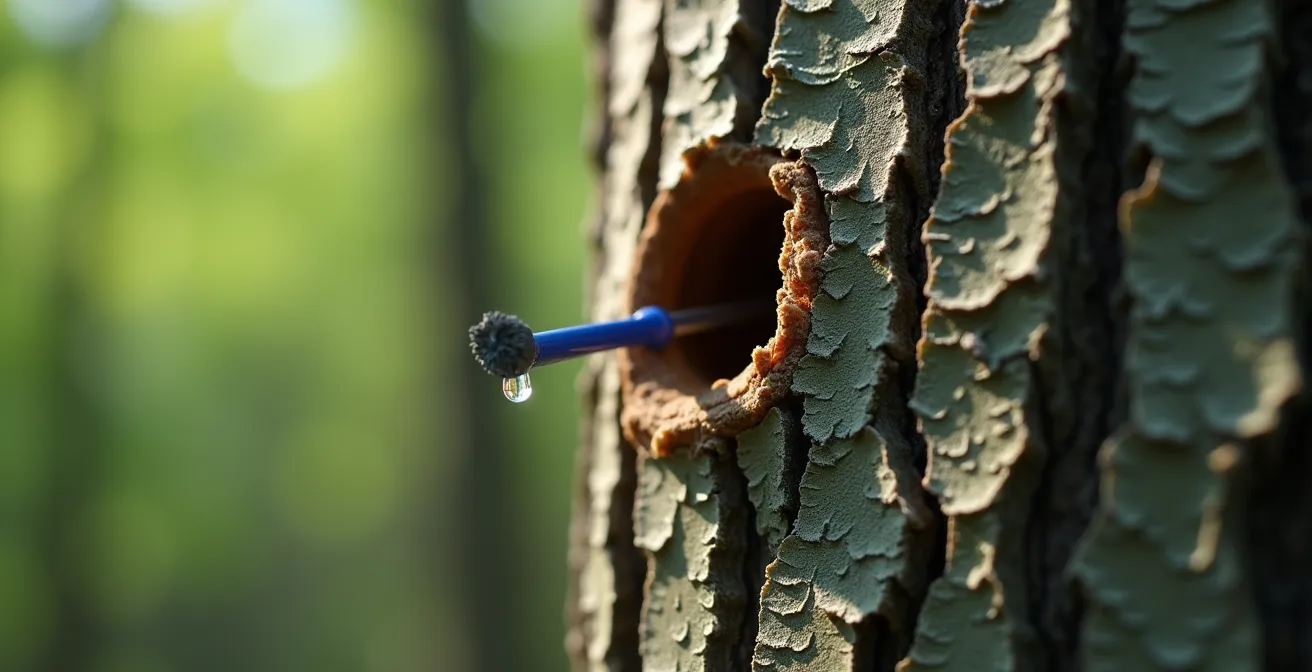
As shown in the image, tap management is a dialogue with the tree, written directly on its bark. Each scar is a memory of a past season, and their condition informs us of our partner’s vitality. Sustainable tapping is proof of a successful silent partnership between humans and the forest.
Action Plan: Respectful Tapping in 5 Points
- Wait for maturity: Do not start harvesting before the tree reaches 45 years and a minimum diameter.
- Respect the diameter: Never tap a trunk less than 20 cm in diameter at breast height.
- Limit taps: Strictly follow the authorized number of taps according to the tree’s diameter (1, 2, or 3 maximum).
- Read the scar history: Observe the healing quality of old taps to judge the tree’s vigor before drilling.
- Choose the optimal location: Place the new tap at least 15 cm horizontally and 50 cm vertically from old ones, in healthy wood.
Yellow-bellied Sapsucker or Squirrel: Who enjoys the sweet sap before humans?
Long before humans discovered how to harvest maple sap, the forest’s inhabitants had already cracked its secret. The maple grove in spring is a true nectar bar, and we are not the only ones to enjoy it. The red squirrel, for example, is a regular. It can often be observed licking the sap that oozes from broken branches or even biting the bark to cause a flow. But the true pioneer, the engineer of the maple ecosystem, is a bird: the Yellow-bellied Sapsucker (Sphyrapicus varius).
This woodpecker has a unique technique. Rather than searching for insects, it drills small rows of horizontal, shallow holes in the bark of trees, particularly maples and birches, to feed on the sap that flows from them. These “sap wells” are an essential food source for the sapsucker, but also for a multitude of other species. It acts as a facilitator, a true ecosystem engineer that makes the resource available to the community.
Its contribution is so significant that it is considered a keystone species in the maple grove. Indeed, dozens of other animals benefit from its work. As noted in a naturalist observation:
The Yellow-bellied Sapsucker (Sphyrapicus varius) acts as a keystone species of the maple grove. The wells it drills feed not only squirrels but also hummingbirds upon their return from migration.
– Naturalist Observation, Ecology of the Canadian Maple Grove
For the Ruby-throated Hummingbird, which returns from its long migration exactly during the sugaring season, these sap wells are a vital energy source while waiting for the first flowers to bloom. Butterflies, such as the Mourning Cloak, and other insects also come to drink there. This interaction shows that the maple grove is not a monoculture, but an interconnected community where every actor, even the smallest, plays an essential role in the global balance. The sugary sap is the fuel that restarts forest life at the end of winter.
Climate Change: Why is the sugaring season starting earlier and earlier?
The biological clock of the maple grove, so finely tuned to the alternation of freeze and thaw, is now facing a major disruption: climate change. Milder winters and earlier springs are upending the traditional sugaring calendar. Historically, the season began around mid-March in Quebec. Today, it is no longer rare to see producers start tapping in mid-February, or even earlier in some regions.
This shift is not just an anecdote. It is a symptom of a warming trend that threatens the very balance of the ecosystem. Research is clear: the window of optimal temperatures for sap flow is moving. According to researchers at UQAC, in a moderate warming scenario, the sugaring season could be advanced by 20 days within a few decades. This means more unpredictable seasons, with winter thaws capable of triggering short flows in the middle of January, followed by intense freezes that damage the trees.
This increased volatility has direct consequences on production and forest management, as illustrated by the 2024 season.
Case Study: The record and early season of 2024
The 2024 sugaring season in Quebec was a striking example of new climatic realities. It began exceptionally early, in mid-February in most regions, instead of the usual mid-March. This precocity, combined with ideal and prolonged freeze-thaw conditions, led to a record production of 239 million pounds of syrup. This abundant season, which extended until late April, helped replenish the global strategic maple syrup reserve, which was at its lowest level since 2008. While the result was positive that year, it highlights the new unpredictability and intensity of the seasons.
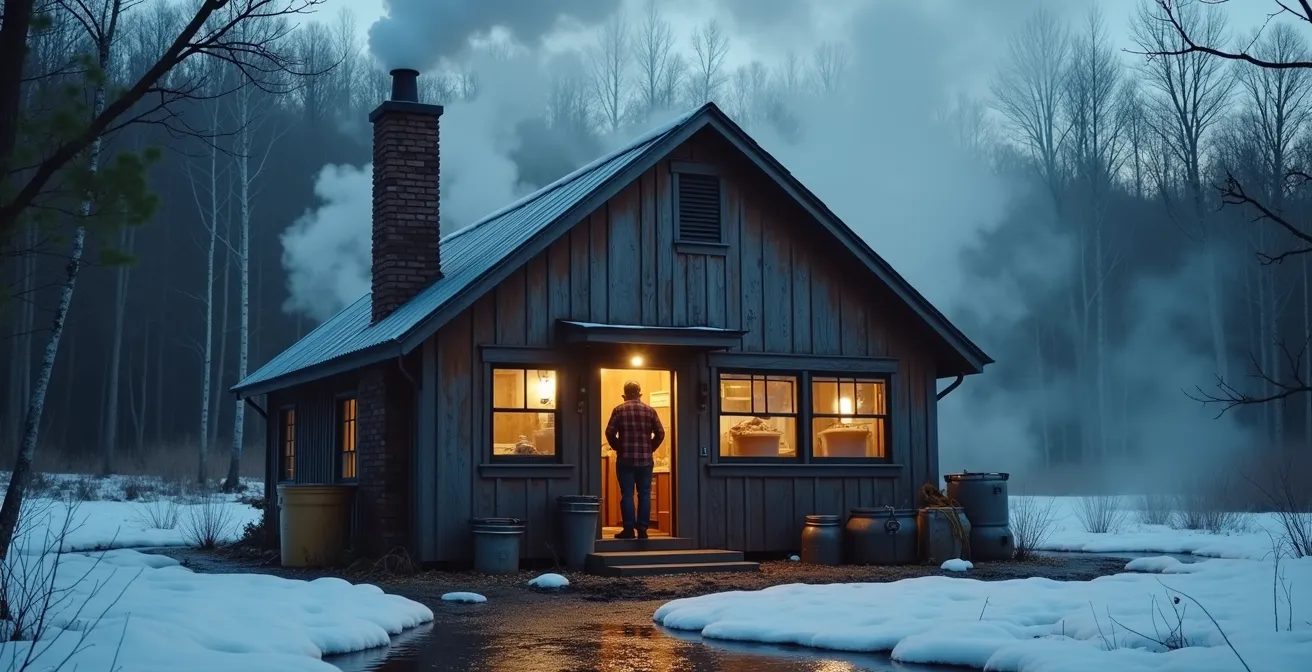
The image of a sugar shack steaming in a landscape where the snow has already almost vanished is no longer an anomaly, but a new norm. For the producer, this requires constant adaptation, increased monitoring, and a questioning of established calendars. It is a reminder that our partnership with the forest is more fragile than ever.
Yellow Birch or Merisier: How to stop confusing this emblematic Quebec tree?
A maple grove is not a plantation of maples; it is a mixed forest, a diversified ecosystem where many species coexist. Among the most important companions of the sugar maple is the Yellow Birch (Betula alleghaniensis), often incorrectly called “merisier” in Quebec because its wood resembles that of the true European cherry. This tree is more than just a neighbor: it is the co-pilot of one of the richest forest types in the province.
To stop confusing them, the bark is the best clue. A young yellow birch has distinctive bark, bronze or golden in color, which peels in thin, curly horizontal strips, giving it a “hairy” appearance. As it ages, the bark becomes grayish and cracks into large irregular plates. The true “merisier” or Pin Cherry (Prunus pensylvanica), on the other hand, has smooth, reddish, and shiny bark marked with horizontal lenticels, much like a cherry tree.
The presence of yellow birch in a maple grove is a sign of high quality. As mentioned in the Quebec Forest Guide:
The yellow birch is the codominant species of the sugar maple-yellow birch forest, one of the richest forest ecosystems in Quebec, a sign of fertile and well-drained soil.
– Quebec Forest Guide, Quebec Forest Ecosystems
This association is not a coincidence. Yellow birch and sugar maple share similar soil requirements: they thrive in deep, moist but well-drained soils rich in minerals. The diversity created by the presence of yellow birch enriches the ecosystem, providing varied habitats for wildlife and improving forest resilience against disease and climate change. It is proof that the strength of the maple grove lies not in a single species, but in the richness of its composition.
Anthocyanins and Carotene: Why does the red maple turn scarlet and not yellow?
If the sugar maple is the king of syrup, the red maple is the prince of autumn colors. While the sugar maple often dresses in spectacular yellow and orange hues, the red maple can turn a scarlet color of breathtaking intensity. This chromatic spectacle is the result of a fascinating chemical battle within the leaf.
During summer, leaves are green thanks to chlorophyll, the pigment that captures sunlight for photosynthesis. However, other pigments are already present, masked by the chlorophyll: carotenoids, which are yellow and orange. When days shorten and temperatures drop, the tree stops producing chlorophyll. As it degrades, the carotenoids are revealed, giving the sugar maple its typical golden colors.
But the red maple has a different strategy. In addition to revealing its carotenoids, it actively begins producing a new type of pigment: anthocyanins. These molecules are responsible for red, purple, and blue colors. Anthocyanin production is triggered by the combination of cold nights and sunny days. Sugar trapped in the leaves, which can no longer be transported to the rest of the tree, reacts with other molecules under the effect of light to form these flaming pigments. The scarlet color of the red maple is therefore an active phenomenon, a final explosion of chemistry before winter rest.
Interestingly, these same families of chemical compounds are found in the syrup. Canadian maple syrup contains more than 20 antioxidant compounds, including polyphenols like those that make up anthocyanins. The color of the syrup, which darkens as the season progresses, is also a story of chemistry, linked to the transformation of sugars and the concentration of these compounds. The color of the forest in autumn and the flavor of the syrup in spring are two facets of the same biochemical richness of the maple.
Takeaways
- The maple grove is an intelligent ecosystem, not a factory; syrup production depends on a fragile biological clock.
- Syrup quality is the expression of a forest terroir, influenced by the geology and biodiversity of the forest.
- Humans are partners of the forest, and sustainable practices like respectful tapping are essential for the survival of this heritage.
Why is the Laurentian forest considered an open-air geological laboratory?
To understand the unique flavor of Quebec maple syrup, one must dig deeper than the tree’s roots. One must descend to the bedrock. The vast majority of Quebec’s maple groves sit on the Canadian Shield, one of the oldest and largest rock foundations in the world. This geological foundation is not an inert backdrop; it is the starting point of what could be called “forest terroir.”
It is upon this socle that Quebec provides an average of 73% of global maple syrup production. This predominance is not only due to the climate but also to this very particular geology. As a geological analysis points out:
The thin and acidic soils of the Canadian Shield, derived from Precambrian rocks, influence the mineral composition of maple sap and thus its terroir.
– Geological Analysis, Geology and Maple Terroir of Quebec
The glaciers that scraped the Canadian Shield deposited a layer of soil (till) that is often thin, acidic, and rich in certain minerals like calcium, potassium, and magnesium, while being poor in others. The sugar maple, by drawing water through this geological filter, absorbs a unique mineral signature. This composition influences not only the health of the tree but also the flavor profile and chemical composition of the maple syrup. A syrup produced in the Appalachians, on deeper and more calcareous soils, will not have exactly the same taste as a syrup from the Laurentians.
The maple grove thus becomes a true open-air laboratory, where one can taste the influence of a geological history spanning billions of years. Every drop of syrup is a translation, in flavors and aromas, of the encounter between a tree, a climate, and the ancient rock in which it has taken root. It is the ultimate expression of the hidden richness of our territory.
The next time you enjoy maple syrup, remember this story. Take a moment to appreciate the silent partnership between nature and the syrup producer, and in turn, become a guardian of this Quebec treasure.