
Summary:
- The main challenge for an indoor cat in winter isn’t the cold, but deep boredom stemming from an unfulfilled hunting instinct.
- Transforming your apartment into a vertical space (3D) is more important than accumulating toys on the floor.
- Short but structured play sessions that mimic the predation cycle are key to regulating energy and preventing nighttime wake-ups.
- Preventive care (parasites, blood work) is crucial, as a sedentary lifestyle can mask health risks.
The Canadian winter is settling in, the days are getting shorter, and your apartment becomes a cozy cocoon. But for your cat, this refuge can quickly turn into a gilded cage. You see them lying there, staring into space, perhaps with a bit more weight than they had in the fall. It’s tempting to think they’re just lazy. We often wonder how long a cat can stay alone without sinking into boredom, especially when our own routines change with the season. So, we buy new toys and try treats, but nothing seems to really work in the long term.
These classic solutions treat the symptoms, not the cause. Apathy, incessant meowing, or even weight gain are not winter fatalities. They are signals of a deeper malaise: a disconnection from their fundamental needs. The real question isn’t “how do I keep my cat busy?” but “how do I give meaning back to their days as a confined feline?”. This is a particularly relevant challenge in Canada, where long and harsh winters drastically limit outdoor stimulation.
What if the key wasn’t to exhaust them with gadgets, but to reactivate their predatory “software”? This article proposes a different approach. Let’s forget simple distraction and focus on recreating the behavioral sequences that structure a cat’s life: hunting, exploring, and managing territory. By feeding their hunter’s spirit—even with a single piece of kibble—we can effectively combat confinement anxiety, the source of boredom and obesity.
Together, we will explore how to transform every corner of your apartment, from floor to ceiling, into a source of stimulation. From the food bowl to the litter box, including targeted play rituals, this guide will provide concrete and caring strategies to ensure your companion’s physical and mental well-being during the long cold season.
To help you navigate these tips, here is an overview of the strategies we will cover. Each section will bring you practical solutions adapted to apartment living, for a fulfilled cat even in the heart of winter.
Summary: Overcoming Boredom and Obesity in Your Apartment Cat
- Why does your cat need to “hunt” for kibble for their mental health?
- How to transform a small apartment into a 3D playground for your cat?
- Clumping or plant-based: which litter to choose for a small, poorly ventilated space?
- The mistake of punishing an “unclean” cat that worsens their anxiety
- Play sessions: when and for how long to play to tire out a nocturnal cat?
- Toys and accessories: how to equip your pet without breaking the bank on useless gadgets?
- How to protect your pet from ticks and heartworm from May to November?
- Annual blood work: why do it starting at age 7 to detect silent diseases?
Why does your cat need to “hunt” for kibble for their mental health?
Watching your cat greedily eat their portion in thirty seconds and then doze for the rest of the day is a common sight. We often wonder if they are bored. In reality, this behavior is often a sign of an unfulfilled fundamental need. In nature, a cat spends much of its time searching for food. It’s not a chore; it’s the engine of their physical and mental activity. Serving their kibble in a bowl is like giving the solution to a puzzle without letting them solve it: practical, but deeply frustrating for their hunter’s brain.
“Food hunting” consists of recreating this challenge. It’s not about making them fast, but about forcing them to think, explore, and manipulate their environment to get their reward. It is an incredibly effective way to fight boredom and stress. As experts point out, making your cat hunt for their food is an excellent way to appeal to their desire for physical and mental stimulation while they eat. This activity channels their energy, prevents weight gain by slowing down ingestion, and reduces anxiety-related behaviors.
There’s no need to invest in expensive gadgets. You can start with everyday objects. A simple case study involves making homemade toys: a food maze can be created with an empty egg carton or a sour cream or cream cheese container with a few holes punched in it. These materials, easily found at Dollarama or Canadian Tire, become powerful tools to awaken your companion’s instincts. The simple act of having to push an object to release a piece of kibble transforms a passive meal into an enriching victory.
To vary the fun, you can:
- Use maze balls and dispenser circuits that force them to interact.
- Hide a few pieces of kibble in crumpled paper or a cloth placed in a box.
- Distribute their daily ration into several small “caches” throughout the apartment to encourage exploration.
- Adapt the difficulty of the puzzles to their progress to maintain their interest.
By transforming mealtime into a session of play and reflection, you offer your cat much more than food: you give them a mission, a purpose that structures their day and nourishes their mind.
How to transform a small apartment into a 3D playground for your cat?
When living in an apartment, we often think in terms of floor space. For a cat, this two-dimensional view is limiting. Their world is vertical. Climbing, observing from a high vantage point, hiding, and controlling their territory from above are behaviors hardwired into their DNA. Thinking an apartment is “too small” for a cat is a common mistake. In reality, a small space well-designed in three dimensions can be a true feline paradise, much more stimulating than a large empty house.
The goal is to create “vertical architecture,” feline highways that allow them to move around without touching the floor. The University of Montreal Veterinary Teaching Hospital confirms: cats love to move at heights and be able to see without being seen. A cat tree is a good start, but it’s only one point on the map. The ideal is to connect several high points to create a real course.
This vertical layout has a double advantage: it multiplies the living space perceived by your cat and offers them safety zones where they can rest away from the household’s hustle and bustle. It’s a powerful remedy for confinement anxiety.
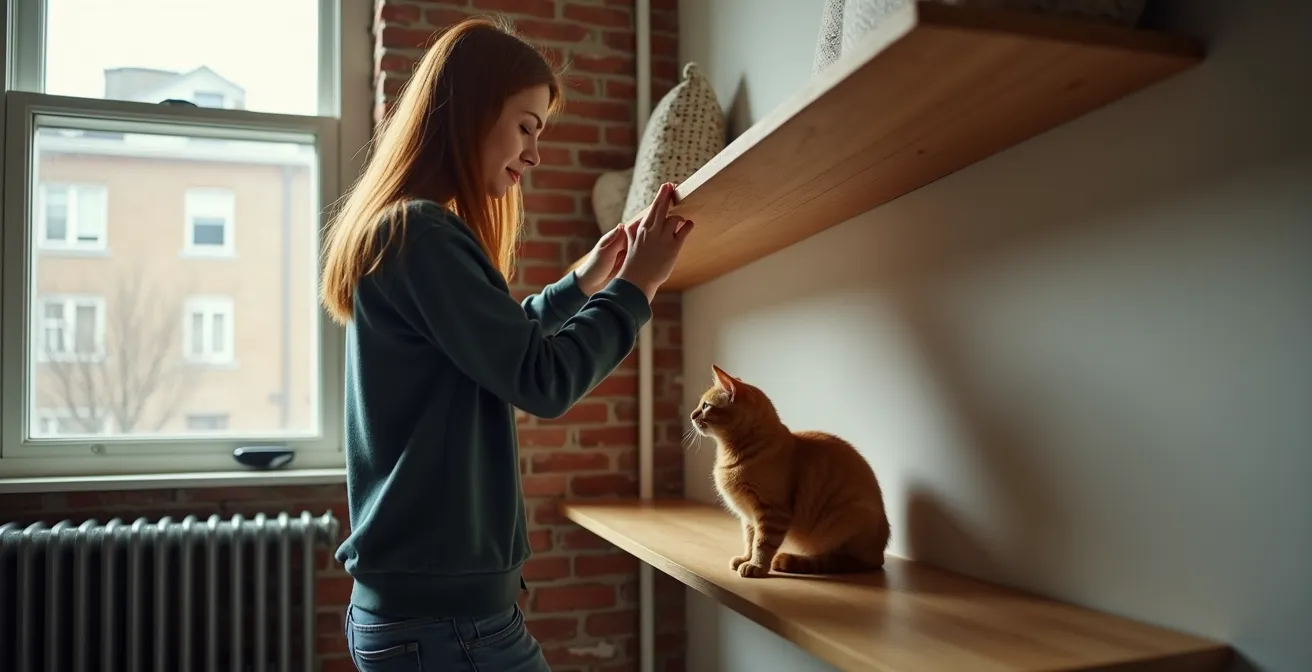
As shown in this installation, a few solid wall shelves can transform a bare wall into an adventure playground. For renters who cannot drill into walls, solutions exist. You can provide access to certain cupboards, the tops of bookshelves, or simply arrange sturdy cardboard boxes and cat tents to create observation posts and hiding spots. The important thing is to offer them paths so they can exploit the entire volume of the room.
Clumping or plant-based: which litter to choose for a small, poorly ventilated space?
The choice of litter in an apartment, especially in winter when windows remain closed, is far from a detail. It is a decision that directly impacts your cat’s comfort and your home’s air quality. A litter box poorly accepted by the cat is one of the primary causes of inappropriate elimination. It’s not a whim: for an animal with such a developed sense of smell, an unpleasant substrate or a smelly box is a source of intense stress. The two main families of litter, clay-based clumping and plant-based (wood, corn, paper), offer distinct advantages and disadvantages for a confined and poorly ventilated space.
Modern clumping litters, often clay-based, are renowned for their excellent odor control and ease of cleaning. They form solid clumps upon contact with urine, allowing you to remove only the soiled parts. However, they can generate dust—a problem in the dry air of heated apartments in winter—and are generally not compostable. Plant-based litters, on the other hand, are often less dusty, biodegradable, and sometimes compostable (check with your Canadian municipality). Their odor absorption capacity can be more variable.
To make an informed choice, it is helpful to compare some popular options on the Canadian market.
| Litter Type | Dust Control | Odor Absorption | Price (14kg) | Municipal Composting |
|---|---|---|---|---|
| Classic Clumping (Quebec) | 99.9% dust-free | Triple action | Average price | No |
| Magic Natural (Canada) | 100% dust-free | 3-week guarantee | High price | Yes (city-dependent) |
| Odourlock (Quebec) | Smart Odour Shield technology | 40 days | Premium price | No |
| Wood Pellets | Naturally low | Natural absorption | Budget price | Yes (biodegradable) |
Beyond the type of litter, winter box management requires some adjustments. It is crucial to increase the frequency of cleaning, as odors concentrate more quickly in an enclosed space. Place the box away from noisy radiators and cold drafts. Finally, using heavy-duty litter bags will make it much easier to transport waste to outdoor bins in freezing weather. Your cat’s sensory well-being depends on a clean, stress-free environment, and the litter is its cornerstone.
The mistake of punishing an “unclean” cat that worsens their anxiety
Finding a puddle of urine on the rug or a mess behind the couch is a frustrating experience for any owner. The first human reaction is often anger. One might be tempted to scold the cat, “rub their nose in it,” or punish them. This is not only ineffective but is the worst mistake you can make. A cat never does their business outside the litter box out of “vengeance” or “spite.” Inappropriate elimination is almost always a symptom of an underlying problem: either a medical issue or, most often, a state of intense stress or anxiety.
Punishing the cat only associates your presence with fear and distress. They won’t understand the reason for your anger, but they will understand that the act of eliminating has become dangerous in your presence. This worsens their anxiety, which can reinforce the inappropriate behavior and break the bond of trust between you. Instead of seeing you as a source of safety, they will perceive you as an unpredictable threat. The key is to change your perspective: don’t see a “bad cat,” but a cat in distress trying to communicate discomfort.
Your role then becomes that of a benevolent detective. The first step is always to rule out a medical cause (urinary tract infection, stones, etc.) with your veterinarian. Once that path is cleared, you must analyze the environment and routine to identify the source of stress. The Canadian winter, with its specificities, brings its share of potential stressors for a sensitive feline. It is crucial to conduct a methodical investigation to understand what might have disrupted their balance.
Action Plan: Identify your cat’s winter stress sources
- Box Location: Check if the litter box has been moved or if it is now near a radiator that has turned on and is noisy, or in a cold draft near a patio door.
- Outdoor Noises: Evaluate the impact of unusual and sudden noises, like snow blowers or snow removal trucks, which can be terrifying.
- Floor Irritants: Observe if road salt or calcium brought in on boots and left in the entryway might irritate their paw pads and create a negative association with the floor.
- Routine Changes: Note if your own schedule changes related to weather (more frequent telecommuting, shorter outings) have modified the play or attention routine you give them.
- Social Life: Identify if the increased presence of visitors during the holidays or long winter evenings might have disrupted their territory and sense of security.
By adopting this investigative approach, you stop fighting your cat and start working with them. You treat the cause of their anxiety, not the symptom, thereby restoring harmony in your home.
Play sessions: when and for how long to play to tire out a nocturnal cat?
The 3:00 AM “zoomies,” the foot attacks under the covers… A cat whose energy isn’t spent during the day tends to express it at night. This is especially true in winter, where the lack of light and stimulation disrupts their biological clock. The solution isn’t to play with them for hours, but to play strategically. According to feline behavior experts, it has been shown that sessions of 5 to 10 minutes of intense play are enough to stimulate a cat, provided they are regular and, above all, respect their instinct.
The secret is to reproduce the complete “predation cycle”: stalking, chasing, capturing, and the “kill” (chewing), followed by a food reward. It is this sequence that brings deep satisfaction and signals to their brain that the “hunt” is finished and successful. A play session that does not end with a definitive “capture” leaves the cat frustrated and even more excited. The best time for this ritual is at the end of the day, at dusk, which corresponds to the natural peak activity of felines. In winter in Canada, this early dusk is a golden opportunity to recalibrate their rhythm.
Here is an effective play protocol recommended by behaviorists. It involves simulating the behavior of prey:
Strategy for Recalibrating the Winter Biological Clock
According to behavior experts, the most effective method is to follow specific steps to simulate a realistic hunt. It is recommended to create anticipation by waving the toy (feather wand, fishing pole) away from the cat, with random movements and pauses, as an insect or mouse would. Once their attention is caught and they are excited, move the toy near them to trigger the chase. Let them catch the “prey” about one out of every three times so they don’t get discouraged, but remain unpredictable. When they catch it, stop moving the toy to simulate the inertia of captured prey. Repeat this cycle several times, then end the session by letting them keep the toy and immediately giving them a small treat or part of their meal. This conclusion is crucial to closing the predation cycle.

By practicing this ritual every evening, you channel their evening energy peak constructively. They will spend their energy, eat, groom themselves, and then be much more inclined to sleep through a good part of the night along with you. You aren’t just “tiring them out”; you are fulfilling a fundamental psychological need.
Toys and accessories: how to equip your pet without breaking the bank on useless gadgets?
The cat accessory aisle is a maze of colorful and often expensive gadgets. It’s easy to spend a fortune hoping to find THE miracle toy that will occupy our companion. The reality is often disappointing: the cat plays for five minutes with the sophisticated new toy before becoming obsessed with… the cardboard box. The key isn’t quantity or price, but variety and rotation of toys, as well as their ability to stimulate different aspects of their instinct.
A good basic kit doesn’t need to be expensive. It must cover several needs: hunting (fishing wands, feather toys), intellectual stimulation (dispenser toys), “self-play” (light balls, fur mice), and comfort (scratching posts, hiding spots). A “Winter Boredom-Buster Kit” can be assembled for about twenty dollars by choosing items wisely at stores like Mondou or even Dollarama. Consider:
- A fishing wand with different attachments (feathers, ribbons).
- A pack of light balls and cloth mice.
- A fabric tunnel that serves as both a hiding spot and a playground.
- One or two kibble dispenser toys like a maze ball.
- A simple laser pointer (to be used with caution, always ending the session on a physical toy they can “catch”).
The cat tree remains a central investment for verticality and scratching. Again, the options are vast, from basic models to luxury structures. It’s useful to compare options based on your budget and available space.
| Option | Approximate Budget ($CAD) | Durability | Pros | Cons |
|---|---|---|---|---|
| Basic Model (Amazon/Walmart) | $60-$120 | 1-3 years | Affordable, fast delivery | Less stable, simple materials |
| DIY with RONA materials | $50-$80 | 1-2 years | Customizable, economical | Construction time, less stable |
| Etsy Canada Artisan | $100-$200 | 2-4 years | Local, unique, quality | Delivery delay, variable price |
The most important secret is rotation. Don’t leave all the toys out all the time. Put half of them away and swap them every week. An old toy that reappears after an absence instantly becomes new and interesting again. It is novelty, not price, that captivates a cat’s attention.
How to protect your pet from ticks and heartworm from May to November?
We often tend to think that an indoor cat, especially in winter, is safe from external parasites like fleas and ticks. This is a false sense of security. With Canadian winters becoming increasingly mild, the parasite season is getting longer. Furthermore, we ourselves can become unwitting vectors. A tick can latch onto our pants during a simple walk in a park and end its journey on the living room rug, within our cat’s reach. Similarly, fleas can be brought in by visitors or other animals.
According to recent veterinary observations, although cats can handle low temperatures, milder winters prolong the flea and tick season, making vigilance necessary almost year-round. Heartworm prevention, transmitted by mosquitoes, generally remains concentrated from May to November, but a dialogue with your veterinarian is essential to establish the most suitable schedule for your specific region of Canada.
For an indoor cat, targeted protection is therefore recommended. It may not be necessary to apply the heaviest treatments, but ignoring the risk completely is unwise. Prevention is much simpler and less costly than treating a flea infestation in an apartment or managing a disease transmitted by ticks. Preventive planning during the calmer winter months is a winning strategy.
Here is a simple action plan for winter:
- Discuss with your vet: Take advantage of less busy clinic times in winter to establish a parasite protection protocol adapted to your cat’s lifestyle and your region’s risks.
- Maintain basic protection: Even for an indoor cat, a preventive flea treatment can be wise, especially if you have other pets or frequently receive visitors with animals.
- Inspect regularly: Get into the habit of checking your cat’s coat, especially after having visitors or returning from outdoor activities.
- Treat the environment: Regularly wash their blankets and cushions at high temperatures. Vacuum frequently, insisting on their cat tree and resting areas.
By integrating these gestures into your routine, you create a discreet but effective protective shield, ensuring peace of mind for you and health for your companion throughout the year.
Key Takeaways
- Your cat’s well-being doesn’t depend on the size of your apartment, but on your ability to satisfy their hunting instinct through stimulating mental activities.
- Designing vertical space (shelves, cat trees) is more crucial than accumulating toys on the floor to combat confinement anxiety.
- A structured 10-minute play ritual every evening, mimicking the predation cycle, is the most effective strategy to regulate your cat’s energy and ensure peaceful nights.
Annual blood work: why do it starting at age 7 to detect silent diseases?
One of the greatest challenges with cats is their incredible ability to mask pain and illness. It’s a survival instinct inherited from their ancestors, for whom showing weakness meant becoming prey. Unfortunately, this also means that by the time a symptom becomes obvious, the disease is often already at an advanced stage. This is particularly true for chronic diseases related to aging and lifestyle, such as kidney failure, hyperthyroidism, or diabetes.
Obesity, which is a major problem for sedentary indoor cats, is an aggravating risk factor for many of these pathologies. According to data from a Canadian veterinary clinic, nearly 58% of cats suffer from obesity. This alarming figure highlights the importance of a preventive approach. Annual blood work, recommended starting at age 7 (considered the beginning of the “senior” age), is the most powerful tool in this preventive medicine. It allows for the detection of subtle changes in organ function long before clinical signs appear.
Performing this screening allows you to establish a “baseline value” specific to your animal. From year to year, your veterinarian can then spot trends and act very early, often with simple dietary adjustments or less heavy treatments, considerably improving your cat’s prognosis and quality of life. It’s an investment in their future, a way to offer them a longer and more comfortable old age. Winter, a calmer season in clinics, is the ideal time to plan this stress-free visit.
The winter veterinary visit itself requires a little preparation to minimize your companion’s anxiety. It is advisable to get the cat used to their carrier by leaving it open in the living room with a cozy blanket. For the trip, preheating the car is essential to avoid thermal shock. After an outing in the cold, even a short one, it’s important to dry your pet well, especially if they are older, and set up a warm space near a radiator to help them warm up. These small, caring gestures make all the difference in the medical visit experience.
By applying these strategies, you are not just “managing” the winter; you are transforming this period of confinement into an opportunity to strengthen your bond and lastingly improve your cat’s physical and mental health. To put these tips into practice, the next step is to evaluate your own environment and choose one or two new habits to integrate starting today.